It is not an overstatement to say that evangelicals are experiencing a "sea change"—a paradigm shift—in their understanding of conversion and redemption, a shift that includes the way in which they think about the salvation of God, the nature and mission of the church, and the character of religious experience. Although there is no one word to capture where evangelicals are going in this regard, there is a word that captures what they are leaving behind: revivalism.
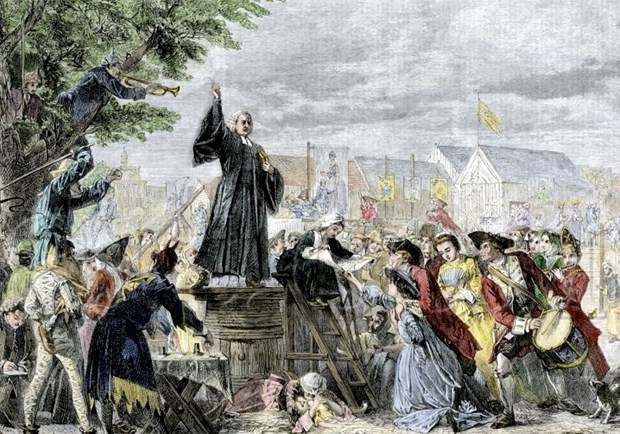
Revivalism is a religious movement heir to both the 17th-century Puritans and the renewal movements of the 18th century, but one that largely emerged in the 19th century. It was broadly institutionalized in the 20th century in the conservative denominations in North America as well as in parachurch and mission agencies that then in turn spread the movement within North America and globally. For evangelicals up until at least a generation ago, the language of conversion was the language of revivalism; it shaped and in many ways determined their approach to worship, evangelism, and spiritual formation.
Evangelicalism is certainly not monolithic; the points at which evangelicals differ among themselves is significant—both Baptists and Pentecostals see themselves as coming under this umbrella, along with Mennonites, and then also Calvinists and Wesleyans. But for all their diversity, the way in which they spoke of conversion and redemption was remarkably similar. Evangelicals took for granted that the language and categories of revivalism were the language and categories of the New Testament. Conversion was viewed to be a punctiliar experience: persons could specify with confidence and assurance the time and place of their conversion, by reference, as often as not, to the moment when they prayed what was typically called "the sinner's prayer."
The focus of conversion was the afterlife: one sought salvation so that one could "go to heaven" after death, and the assumption was that "salvation" would lead to disengagement from the world. Once converted, the central focus of one's life would be church or religious activities, particularly those that helped others come to this understanding of salvation that assured them of "eternal life" after death. Life in the world was thought to hold minimal significance. What counted was the afterlife. And if one had "received Christ," one could be confident of one's eternity with God. Conversion was isolated from the experience of the church. Indeed, it was generally assumed that a person would come to faith outside of the church and then be encouraged, after conversion, to join a church community.
Typically evangelicals approached evangelism through the use of techniques or formulas by which a person would be introduced to spiritual principles or "laws" on the assumption that if these principles were accepted as "true," a person would offer an appropriate prayer and thus "become" a Christian.
Baptism, it was insisted, was subsequent to conversion and essentially optional. For although baptism was thought to be perhaps important, true spiritual experience was considered a personal, interior, subjective experience and thus not sacramental. Evangelicals have typically had a deep distrust in sacramental actions, insisting that they do not have redemptive significance.
Further, the church was often defined as in the business of making conversions happen; its life and mission were oriented toward getting more people converted through whatever means possible. Successful congregations were characterized by numerical "conversion growth."
Significantly, conversion was viewed as something distinct from "disciple-making." The making of disciples was thought to be subsequent to conversions. Thus evangelicals would speak of "making converts into disciples"; evangelism and disciple-making were distinguished, and typically the approach to evangelism was distinct from the approach to spiritual formation.
On each of these points, evangelicals are moving toward a thorough reenvisioning of the nature of conversion and redemption. Increasingly, there is appreciation that conversion is a complex experience by which a person is initiated into a common life with the people of God who together seek the in-breaking of the kingdom, both in this life and in the world to come. This experience is mediated by the church and thus necessarily includes baptism as a rite of initiation. The power or energy of this experience is one of immediate encounter with the risen Christ—rather than principles or laws—and this experience is choreographed by the Spirit rather than evangelistic techniques. Evangelicals are reappropriating the heritage of the Reformation with its emphasis on the means of grace, and thereby affirming the priority of the Spirit's work in religious experience.
The fundamental categories and assumptions of revivalism are thus being questioned as never before. There were voices in the past that questioned revivalism: C S. Lewis, always adored by evangelicals, was seemingly oblivious to the language and categories of revivalism. A. W. Tozer, J. I. Packer, and John R. W. Stott, while obviously evangelicals, nevertheless seemed to be able to articulate the Christian faith in other than the language and categories of revivalism, as did many others. But the difference of the past generation of theological reflection is that we can genuinely speak of a sea change, so much so that the language and categories of revivalism are simply no longer viable. However much this vision powerfully shaped the life of the church and its mission and, indeed, influenced more than a generation of evangelical missionaries to spread around the globe, the church has over the past generation sought new linguistic wineskins and new theological categories by which to understand conversion and redemption.
Article continues below
A number of factors have brought about this thorough rethinking and thus the challenge to revivalism.
Biblical studies. Evangelicals are indebted to both Old and New Testament scholars, including James Dunn, Gordon Fee, N. T Wright, Christopher Wright, and others, who have called for a biblical theology of conversion and redemption that is more deeply rooted in the Scriptures and that takes account of the full scope of God's purposes in Christ. These scholars are drawing more fully on the vision of God's righteousness that emerges in the Old Testament and finds expression in the Gospels, as well as the letters of Paul—and not just a verse here or there, but rather the grand sweep of Pauline theology. As this vision of God's salvation permeates the language and thought of evangelicals, they are being weaned from their propensity to make a one-to-one correlation between conversion and "getting saved." More and more evangelicals appreciate that God's salvation has both a past and future dimension, is about not merely conversion but lifelong transformation, and has both a corporate and cosmic dimension.
The nature of religious experience. Theologians within the evangelical tradition are learning from interdisciplinary contributions to the study of the nature of religious experience, and thus by implication the experience of conversion. Philosophers (such as Charles Taylor and Louis Dupre), behavioral scientists (notably Lewis Rambo, but also developmental theorists such as James Fowler and Erik Erickson, as well as anthropologists such as Paul Hiebert) have broadened the evangelical appreciation of the phenomenon of religious experience. This consideration of the nature of religious experience has also been informed by critical reflection on a postmodern awareness of the spiritual dimension of life, and of the nature of Christian religious experience in a post-Christian social environment (see especially Brad Kallenberg and Robert Webber on this). Further, as evangelical witness has led to the conversion of Hindus and Muslims, there has been an increasing willingness to ask, for example, not "how should a Muslim become a Christian" but how does it actually happen: What is the character of their experience and how can we appreciate this without having to superimpose the categories of revivalism on their faith journey?
Article continues below
Cross-pollination from other Christian traditions. For more than a generation, evangelical theologians have become increasingly open to critical theological engagement with Christians of other theological traditions. The evangelical understanding of conversion and redemption is now informed by Orthodox voices (including Alexander Schmemmann and John Zizioulas), Roman Catholics (such as Yves Conger, Karl Rahner, Hans Urs Balthasar, Bernard Lonergan, Bernard Haring, and Rosemary Haughton), and mainline Protestant theologians (including Karl Barth, Dietrich Bonhoeffer, George Lindbeck, and many others). This exchange and learning across theological traditions has deeply enriched the evangelical understanding of conversion and redemption.
The global character of evangelicalism and the impact of Pentecostalism. The majority of evangelical Christians now live outside of the West and to a great extent are either self-identified Pentecostals or significantly influenced by the Pentecostal and charismatic movement of the past century. Theologians sympathetic to this development, such as Clark Pinnock, insist that emphasis on the ministry of the Spirit is not incidental but central to the life and witness of the church—and therefore to the church's understanding of conversion. This global experience has also forced evangelicals into a deeper appreciation of the social, economic, and ecological implications of conversion, as the voices of the emerging churches of the global church insist that these factors much be taken into account in seeking a biblical theology of genuine religious experience. The global church has reinforced the growing recognition that authentic religious experience is not merely personal and subjective; it also does and must find expression in the tangible including the pursuit of peace and justice, and an identification with the poor.
Article continues below
A recovery of both the evangelical and the ancient Christian heritage. The challenge to revivalism has come, as much as anything, from historians. While evangelicals have actively sought to recover their full Christian heritage—including the breadth of medieval and 16th-century Spanish mysticism—the most notable rethinking of revivalism has come from two sources. Some historians (notably Richard Lovelace, Mark Noll, and Bruce Hindmarsh) have called for a deeper appreciation of the evangelical heritage itself, especially its prerevivalism roots in the great renewal movements of the 18th century. Others have profiled the "ancient" Christian heritage, urging evangelicals to draw on the wisdom of the church fathers and the liturgical and catechetical practices of the early church (Thomas Oden and Robert Webber).
Taken together, these five factors have profoundly affected the way that evangelicals think about conversion and redemption. One voice more than any other is sounded in this conversation—that of Lesslie Newbigin, whose theology was shaped by experience in both West and East, as a missioner and then bishop in India. Newbigin argued that conversion is a matter of understanding, ethics, and community—that there is no conversion without conversion of the mind, identification with the reign of Christ, and incorporation into a faith community that is marked by and sustained by its sacramental actions—baptism and the Lord's Supper. Newbigin's fundamental observation and conviction is that the church is not a provider of religious products and services but rather that the church is a people in mission. The church, collectively, is through an active discipleship a living embodiment of the kingdom to which the church witnesses. Thus the church is not obsessed with its own growth but with the kingdom, as it seeks to live the gospel within particular social and cultural contexts. This perspective is reinforced by Newbigin's recognition and reminder to his readers that all reasoning arises from a particular rational tradition which is embodied within a living community.
Evangelical Christians are deeply concerned for those who do not know God and have yet to experience conversion, through faith and repentance, to Christ Jesus. Nothing I've mentioned here about the "sea change" has altered this vision and commitment. And yet, at their best, evangelicals have always recognized that people are converted not because they have come to terms with "spiritual laws" or questions that might be asked "when they get to heaven," or even "evidence that demands a verdict"—but because they experience the transforming grace of God through an encounter with the risen and ascended Christ.
Article continues below
The only question that remains, then, is whether evangelicals will trust these instincts and devote themselves to Christ-centered worship and kingdom-oriented mission. Will this be evident in deep trust that God will do God's work in God's time? To trust the work of God is to trust the Spirit and this necessarily means that the church trusts the Word—the Scriptures preached—as the essential means of grace and conversion.
This begs the question of what it means to be the church. The evangelical tradition is at a fork in the road and, given this sea change in the understanding of conversion and redemption, the most crucial issue at stake is what it means to be a congregation. Evangelicals will only be able to navigate these waters if they can formulate a dynamic theology of the church that reflects the Triune character of God, the means of grace—Spirit and Word—and a radical orientation in mission toward the kingdom of God.
Editor's note: We've been remiss at bringing The Oxford Handbook of Evangelical Theology, edited by Gerald R. McDermott, to the attention of CT readers. It is book of wide-ranging essays on the current state of evangelical theology, with contributions by a who's who of evangelical theology and practice (from Alistair McGrath and Scot McKnight to Dallas Willard and Howard Snyder). It is the rare reference book that is accessible and relevant. This excerpt comes from Gordon T. Smith's essay on "Conversion and Redemption."—Mark Galli, senior managing editor, Christianity Today.
Gordon T. Smith is the president of reSource Leadership International and adjunct faculty at Regent College, Vancouver, British Columbia. He is the author of many books, most recently, Courage and Calling: Embracing Your God-Given Potential (InterVarsity Press).












 While we pray for peace, we need moral clarity about this war.
 As my doubts about his teachings grew, so did a secret fascination with Jesus.
 Helping marine biodiversity flourish is a means of participating in God’s work, says an Indonesian theologian.





