I recall with some embarrassment a conversation I had when I was a junior in college, as a young man full of anger at the church and brimming with idealism about the future. I was speaking with a friend who happened to think the institutional church was a pretty good idea, and that hymns in particular (the specific topic of conversation that day) were a rich source for theology and worship. I argued that they were too complex for the modern era, a perfect symbol of bygone and boring ways of doing church. Like the new music that broke out of what I thought was a stifling pattern of verses and rhyme, so the church of the future would free itself from the rigidity of bureaucracy and outmoded theology.
We say lots of silly things when we are immature, but the sentiments that drive the passions of youth often hang on stubbornly. Today, I favor hymns over contemporary music precisely because of their complexity and richness. But my favorite hymns still move in the direction of simplicity, like "What Wondrous Love Is," and "They Cast Their Nets in Galilee."
I have also come to appreciate, begrudgingly, the institutional church. But like most people, most weeks, the church remains a source of frustration and confusion for me. I do wish Jesus had thought of a better way to organize his followers.
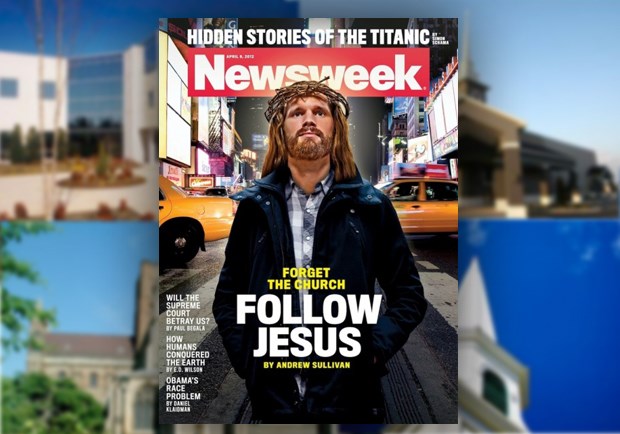
Daily Beast uber-blogger Andrew Sullivan has written a cover story for Newsweek that expresses almost perfectly today's religious zeitgeist. As the title inside puts it, "Christianity in Crisis: Christianity has been destroyed by politics, priests, and get-rich evangelists." Who of us upon reading that would not say, "Exactly!"? And then the subtitle adds this: "Ignore them." To which I want to respond, "I wish!" And the cover copy expresses what many of us want to do: "Forget the church. Follow Jesus."
Sullivan's piece is an angry screed, full of overstatement, misstatement, and just plain misunderstanding. But that's the nature of screeds and what makes them fun to read. Especially when they tap into our own frustrations. In particular, Sullivan pines for a Christianity that would shake off the shackles of partisan politics and abstract theology, and most of all, one that would shed all vestiges of the institutional church and instead give itself to living the "simple ethics of Jesus." In fact, the whole essay is a yearning for simplicity—the word simple or one of its forms appears 21 times in the essay. In this complex and mystifying age, who doesn't yearn for simplicity?
For the sake of space, I'm going to have to skip talking about Sullivan's, and our, frustrations when religion and politics mix. It's an interesting topic that deserves a good hashing out. But let's begin with Sullivan's frustration with theology, or as he put it, "theological doctrines of immense complexity." He's an admirer of Thomas Jefferson, and deeply angry about "doctrines" about Jesus' incarnation or divinity, which he says are "supernatural claims that, fused with politics and power, gave successive generations wars, inquisitions, pogroms, reformations, and counterreformations."
Indeed. As a student of church history myself, my heart has sunk time and again when I've read how Christians have treated one another and those outside the faith in ways violent and cruel, and often in the name of some doctrine or "the truth." One can argue that political history since the Thirty Years War in the 17th century, the so-called "wars of religion," has been nothing but an international attempt to prevent people of faith from killing each other over doctrine.
Today we may not kill each other over doctrine, but pop into a few theologically driven blogs or Facebook conversations, and you'll see that if people had the means, they very well might start a war over their differences. Even in the cause of grace, you find people sparring with one another, ironically, with livid self-righteousness. The neo-Reformed have convinced thousands of young believers to study theology, and as one deeply sympathetic to Reformed theology, I happen to think this is a good thing. But even one of their own has created a parody of their passions. In one clip, a young man, enthusiastic for all things theological, tells his girlfriend that he won't be able to go out tonight because someone said something wrong on Facebook, and of course, he has to correct it!
Sullivan believes, along with Jefferson, that Christians should pay less attention "theological doctrines" and more to "the very words of Jesus." As Sullivan put it, "Jesus' doctrines were the practical commandments, the truly radical ideas that immediately leap out in the simple stories he told and which he exemplified in everything he did."
As a person who has been fascinated with theology, I'll even have to admit that some days the whole business of theology is weariness to the soul. Who really cares about the difference between the imputation or infusion of righteousness? Or infra- and supra-lapsarianism? Or whether faith is a free choice or something that is compelled by a glorious vision of God? Or a hundred and one other theological disputes that, frankly, seem to make little difference in how most people live for God day to day?
Article continues below
But the love of neighbor—that I can get a handle on, especially when you give me a story to picture it, like the Good Samaritan (Luke 10). Couldn't we avoid so much division and wrangling—and get a lot more good done in the world—if we just concentrated on the simple ethics of Jesus?
Ah, but here's the rub: the ethics of Jesus are no less complicated than the theology of Jesus, of which there is plenty as well. Yes, many of Jesus' simple stories and actions are bursting with complicated theology. For example, take his audaciousness in forgiving the sins of the paralytic (Mark 2)—what was he teaching if it wasn't ontology, that is, who he is in his essence? In this case, it's pretty hard to read this without concluding that he is making himself equal to God, the only one with the absolute right to forgive sins. And what else was he teaching when he said, "I and the Father are one" (John 10:30) and "Before Abraham was, I am" (John 8:58)? And once we realize he said those sorts of things time and again, we start getting curious about what he means exactly, and how exactly he can be equal to God, and, yes, what difference that might make in our daily lives.
Or take that complex doctrine we call the atonement. What was Jesus teaching about his death when he said, "the Son of Man came … to give his life as a ransom for many" (Mark 10:45) and "this is my blood of the covenant, which is poured out for many for the forgiveness of sins" (Matt. 26:28)? It sure sounds like some form of substitutionary atonement to me. And that just forces you to start asking questions about sin and forgiveness and what exactly happened on the cross.
This simple Jesus also had a theology of Scripture (not one iota of the law will perish until all is accomplished, Matthew 5), and prayer (Matthew 6–7), the end times (the 100+ passages about the kingdom of God!)—and on it goes. No, Jesus may have been a teacher of simple ethics, but he was also a theologian, and, we might say, a theologian with a lot of insider information!
And when it comes to his so called simple ethics—well, if we dig just beneath the surface, we soon discover they are not so simple. And worse: They also lead to arguments and wars, as much as does theology!
Article continues below
For example, one could argue that nearly every war in the last two centuries has been fought over what it means to love one's neighbor. Many Southern Christians believed that "simple negroes" did not have the capability of taking on the full responsibilities of freedom and citizenship. They believed that love demanded that whites keep these "negroes" in slavery, for their own good. Northern Christians begged to differ, believing that love of neighbor demanded freedom for black Americans.
Or take another example: In the 1930s, many German Christians believed that the welfare of German citizens required absolute allegiance to the Führer, which included loyal support for his various policies toward the Jews and the surrounding nations. Other Christians believed that the love of the Aryan German neighbor did not preclude love for the Jewish German neighbor, and that the welfare of the German people hinged not on Hitler's preeminence but his downfall. Dietrich Bonhoeffer and Karl Barth were the two leading theologians who argued this with their pen and also with their lives, Bonhoeffer losing his in the cause.
Today, Christians debate how or whether to love the unborn child, or whether the life of the unborn child takes precedence over the welfare of the mother. Abortion ethics is all about neighbor love—who exactly constitutes the neighbor, and what it means to love that neighbor.
Or take our debates over sexual ethics. All Christians seem to agree that the biblical picture is clear: when we're talking about sex, we're talking about something core to our being. It's very much wrapped up in this business of being created in the image of God, for it is man and woman together who constitute the image of God according to Genesis 1. Sullivan, who is a devout Catholic and a practicing homosexual, argues, as do many others, that it is none of the church's business what goes on in the bedroom, nor whether what goes on is between people of the same sex or different sexes. Most Christians beg to differ, and argue that precisely because our sexual behavior should reflect the image of God in which we are made, God has a lot of interest in how we express it. Both parties, of course, ground their arguments in love of neighbor, but we disagree about what sexual love should look like, and what expressions really make for a flourishing human being.
I sure wish "the simple ethics of Jesus" were really simple, but they are decidedly not. And we often need a good dose of theology to sort out our competing ethical values.
Article continues below
These things can sometimes become personal and specific. In one church where I served on the board, a delicate situation came to my attention as we were preparing to elect a new slate of church officers. A woman who was living with a man outside of marriage had put her name in the hat as a candidate. I brought this up to the interim pastor, but he didn't have the constitution or theology to deal with an issue like this. He said to me, "If it bothers you, Mark, then you talk to her."
Well, I did talk to her. I suggested that church leadership is a special office, and that while we were not looking for perfection in candidates, it did seem clear in Scripture that church leaders should be avoiding the most flagrant and public sins. To make a long conversation short, she said that she didn't think she was sinning, and that she was not going to withdraw her name.
So she ran for office, and I breathed a sigh of relief when she lost. But it had become clear to me that we in that church had divergent understandings of church leadership and sexual ethics, and that we were in desperate need of deep conversation about systematic and moral theology. Though I happen to think the solution was simple, getting my fellow members to agree was not going to be simple by any stretch of the imagination.
To drive home his point about the need for a simple Jesus ethic, Sullivan points us to Francis of Assisi as a model to emulate. Having written my own biography of Francis, I can certainly concur that Francis should be emulated in many ways.
One of my favorite Francis stories is the one where he meets a nearly naked man on a cold winter day. The man is shivering and looking miserable. Francis proceeds to take off his own cloak, his only cloak, and give it (lend it) to the man. When Francis' companion told Francis that now his master would be chilled to the bone, since he didn't have another cloak, Francis just reminded his friend of the gospel teaching that we are to share our cloak with him who has none. There are many such stories where Francis is shown obeying literally a command of Jesus. It's both deeply attractive and finally mystifying.
But while Francis gained a following in his day, and while there are a few thousand Franciscans worldwide today, the fact of the matter is that Francis' lifestyle—his literal obedience to some of Jesus' commands—has never caught on among Christians. That's partly because we're often just too selfish—there is no doubt about that in my life. But a large part of the reason is that the Franciscan lifestyle is more or less unworkable on this side of the Kingdom of God. Francis may have given up his cloak for that shivering man, but then someone had to go out and make or buy a cloak for Francis lest he freeze to death. The making of that cloak required someone or another to sell and/or buy materials and labor (something Francis forbade) so that a cloak could be made. And if you're going to supply cloaks for a lot of shivering people, like the poor, you have to set up a distribution system, which requires more financial negotiations. And on it goes. The Franciscan ethic only works with small groups of people, and then only if most people in the world are not Franciscans, and by their labors can help the Franciscan work to be sustained.
Article continues below
Francis seems to have understood this—that his lifestyle was not necessarily to be emulated by everyone else. When Francis was on his deathbed, one of his disciples exclaimed in despair about the possibility of living like Francis once his master had died. Francis responded by saying that he had only done what God had asked of him in particular, and that this disciple was only responsible to do the same.
As you study church history and the lives of men and woman that you meet as you go through life, you discover that God has something much more interesting in store for us than a simple and uniform set of ethics to follow. It seems clear that God has called some to be in high society, some in low, some in the university, some in the military, some on Wall Street and some on Pennsylvania Avenue. Disciples of Jesus are found living in families and living alone, living in suburbs and in the city, living in the desert and in the mountains. The world is a big and complex place, and God has put followers of Jesus everywhere, to be salt and light to the whole world. Each and every lifestyle is to be characterized by love, of course. But love, like God, is an infinitely complex thing. The one thing it is not is simple. But I for one find that delightful.
And this delightful and complex expression of love and service to God brings us to the main thing we seem frustrated about today as Christians. Sullivan has expressed it as well as anyone.
A Graced Church
Sullivan has pretty much given up on the institutional church and on the religion called Christianity. He believes in the divinity of Jesus and his resurrection from the dead; he wants to follow the ethics of Jesus and deepen his love for God and neighbor. But he's convinced that "organized religion itself is in trouble" and that "Christianity is in crisis." As the cover copy put it: "Forget the Church. Follow Jesus." This was more or less the theme of the video "Why I Hate Religion but Love Jesus," which went viral a few months ago.
Article continues below
And, really, who can argue with this sentiment? The only difference between Sullivan and most Christians I know is that Sullivan thinks this is "so obvious it is almost a taboo." Maybe he needs to hang around with Protestants more, because it's hardly taboo in our neck of the woods. For years now, it is "common knowledge" that many in the younger generation have given up on the church. This is a bit of an exaggeration, because some of the most dynamic and church-centered movements—like the neo-Reformed movement and the Passion conferences, to name two—are youth movements. But it is clearly true that many 20- and 30-somethings have tried church and found it wanting, and they are just not going to take it anymore. They are either meeting in small groups in homes and apartments for prayer and Bible study, sometimes calling themselves "house churches," or they are going it alone to pursue spirituality and Jesus without religion.
And for good reason. We've noted why so many are frustrated with the church: wars and division and abstruse theological debates, and we have not even mentioned hypocrisy and, well, pettiness. When I was a youth pastor in a well-to-do English speaking church in Mexico City, I was constantly looking for ways for our church to reach out to Mexicans trapped in poverty. In a city of 20 million at the time, you can imagine that this described a large number of people in the city. You can also imagine how appalled I was at one of the first board meetings I attended when, instead of strategizing how we could help the poor, we spent two hours debating whether we should put blow dryers or paper towels in the church bathrooms!
But here's the deal. Whenever you bring people together, religious or not, to get something done together, history demonstrates what you are going to get. First you'll get something done: you'll start a tutoring program or build a community center or form a soccer league or whatever. But this is what you'll also get: politics, bureaucracy, legalism, pettiness, backstabbing, greed, dishonesty, conformism, self-interest—and that's on the good days! Now add religion to the mix, so that the people involved do politics, bureaucracy, legalism, backstabbing, and so forth with a pious smile on their faces. That's the church many days.
Article continues below
Yes, the church is also the institution that created the university, built hospitals, and is a major contributor to the social welfare of the poor and needy. It's also a place where many find healing and love and forgiveness of sin. But take my church, which has a deserved reputation for its effective healing ministry and dynamic spiritual life. It's also a place where I've witnessed leaders become self-righteous, where members hurt one another, where insecurity becomes manifest, where the cause of the poor is sometimes neglected—and I would include myself in all these sins. And this in what is widely considered a very effective and spiritual church!
So the charge stands: the church is in crisis, and organized Christianity is in trouble.
As it has been since day one.
We might recall that in the church in Corinth, factions were so divisive and vicious that Paul had to lecture the church about unity. He had to tell them that they couldn't practice incest as Christians, something that someone forgot to tell them apparently. Or that they couldn't visit prostitutes. And that they had to share their food with one another during church potlucks. Study the New Testament letters to other churches, and you'll find the same sort of thing cropping up: it's called sin.
You see this in the fourth century church—where nominalism first became a problem, because when the emperor became a Christian, anyone who wanted to be on his good side thought it might be a good idea to join the church. You see this in the Middle Ages, when Christians thought killing one another in chivalrous duels over honor was as much fun as we have playing Angry Birds. You see this in the medieval papacy, which couldn't find an immoral practice it didn't like. You see it in 19th century American Protestantism, half of which justified slavery. You see it in the sexual abuse scandals of the Catholic Church and the televangelist scandals of the Pentecostal church. And you see it in the church down the street—like the one Presbyterian church I attended when I was in college, where an elder told me after one Easter service that he just wasn't convinced about this whole Resurrection thing!
All signs of a failing and dying institution, no? But here's the thing. This supposedly failed institution has yet to fail. This organized religion on the verge of collapse still stands. This faith that is in crisis, well, it's still in crisis—and still upheld and loved and used by a gracious God.
Article continues below
At Christianity Today, we've started many magazines and product lines. But we do not put our brand on any new product or service unless it reflects the values and aspiration of Christianity Today. We want people to trust our offerings: if it comes out of Christianity Today, we want them to know that it has a certain character and quality, and that it will more than match their expectations. That's how most people do brand management today.
Then we have Jesus' method of brand management: He creates the church and puts his brand on it, and calls it "the church of Jesus Christ." And yet this institution, time after time, age after age, fails to exhibit his character in any consistent way. It constantly disappoints people's expectations—and I would think Jesus' expectations. If Jesus were like Christianity Today, he would dissolve this product line or sell it to the highest bidder. Anything to get his brand taken off the product called the church.
And yet he leaves it there, for everybody to see: "See these broken, sinful, selfish, corrupt people?" he says. "They're mine, all mine. I can't explain it, but I love them, and I will not let them go."
And then he goes on: "And if you join up with them, you're going to discover something extraordinary. Not unity of theology or ethics, not a like-minded politics or life-style, and certainly not agreement about what songs to sing in worship! But you will find grace and mercy in time of need. Always from me, and more and more from these people. No particular church of mine can last unless my forgiveness permeates it; it is out of business within a generation otherwise; I insist on that. But a lot of my churches are still learning how to forgive, so they don't do it immediately. Not all at once. There are still many of my followers in these churches who are bitter and angry—but I'm working with them. Why don't you work with them as well, and learn something of my grace and mercy?"
When put in this light, it becomes apparent that if we give up on the church, we are giving up on humanity. Because the church is the promise and presence of a redeemed humanity in Christ. If you can't get along with people in the church, I guarantee you will never be able to get along with anyone anywhere. Because what you find in the intense community called the church, you'll find everywhere. And if you want to learn to love other human beings, and to learn mercy and forgiveness, there is no better place than the church. There are many theological reasons Jesus established his church, and one of them is this: It's an incubator of love, a place to learn how to get along with believers from all walks and theologies and ethics.
Article continues below
Recently, I spent a weekend with good Christian friends who have the means to stay in a suite at the Trump Towers in Chicago. Every Thursday I mix it up with refugee children, whose families are barely scraping by but whose devotion to Jesus is rich. One of my best friends is a philosophy professor who constantly reminds me of the superiority of Catholic ethics, and I just returned from a conference where Martin Luther was practically the way, the truth, and the life! Two weeks ago, I had lunch with a homeschool mom who does the most extraordinary outsider art, and is a confirmed libertarian. And then there are all those friends whom I affectionately call DLs (darn liberals), who just can't imagine a government program they wouldn't want to expand! I know pastors work in impoverished inner city parishes and others who head megachurches. I've met Christians who live in community and others who live in gated communities. And on it goes.
This thing called Christianity is a many splendored thing, in theology and in ethics. That means it's irredeemably complex. That means, yes, there are lots of arguments among Christians. That means sometimes there is self-righteousness and mean-spiritedness, by others anyway. But in the end, it is a dappled rainbow of gifts, talents, and passions that in some mysterious way reflect the splendor of God.
And there is no other way to learn love except by plunging in with people like this. No, you don't have to do this in a church. But followers of Jesus are specifically called to learn to live together in love—see John 14 through 17! So the church seems to be an academy of love, and the place where the love of Christ meets us more objectively, especially in word and sacrament.
* * *
Love sometimes expresses itself in anger, even angry screeds. I assume that Andrew Sullivan really does love his Catholic church, and that his frustration is an expression of that. I assume that all of us, Protestants and Catholics, who share his frustration do so because we really do love the church—or really want to love it once again.
Article continues below
Amidst the confusion and complexity of modern faith, it's tempting to long for a simple faith, one with a simple theology and simple ethics. What we are going to discover sooner or later, though, is something better: the faith Jesus offers us, one immensely rich and varied, as complex as a bottle of fine wine, as colorful as an impressionist landscape, as exasperating and wonderful as a family. It's a faith where forgiveness finally wins—Jesus' forgiveness of the church, Jesus' forgiveness of us, and our forgiveness of one another.
Jesus looks at even the likes of us—those who despise that which he lovingly created and holds close to breast, his unholy church—and calls us to join in, that we all might learn to live his merciful life together, as nothing but sinners in the hands of a gracious God.
In "SoulWork," Mark Galli brings news, Christian theology, and spiritual direction together to explore what it means to be formed spiritually in the image of Jesus Christ.
Mark Galli is former editor in chief of Christianity Today and author, most recently, of Karl Barth: An Introductory Biography for Evangelicals.














 While we pray for peace, we need moral clarity about this war.
 A Christian reconciliation group in Israel and Palestine warned that war would come. Now the war threatens their relevance.العربيةFrançais
 When I married into a Jewish family, antisemitism hit home. Now, the holy day reminds me of our future hope.





