Pope Benedict XVI made no secret that the papal office came as a heavy burden to him—as a cross to be carried. Indeed, as Joseph Cardinal Ratzinger, he had repeatedly tried to retire from his previous post as head of the Vatican office for overseeing church doctrine, but Pope John Paul II always refused his resignation. When his predecessor died in 2005, Ratzinger hoped to retire after the papal conclave. During the conclave, when the votes began to go his way, the cardinal—by nature a shy and retiring academic—began to pray, "Please don't do this to me."
That unheeded prayer is echoed by practically the entire college of cardinals in the papal conclave in the opening of Nanni Moretti's We Have a Pope, or Habemus Papam. (The title refers to the traditional Latin phrase with which the new pope's election is proclaimed from the central balcony of St. Peter's Basilica, where the pope makes his first appearance and gives his first Urbi et Orbi blessing to the world.)
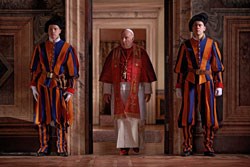
Michel Piccoli as Cardinal Melville
Moretti gives us closeups on one cardinal after another, their inner pleadings in voiceover, until the camera pulls back as a clamor of recusant prayers ascends to heaven: Non io, Signore … Not me, I pray thee … No, Señor. This mildly amusing but ham-fisted sequence is typical of the film's sensibilities, for good and for ill—more the latter than the former, alas.
In a way it's like the antithesis of a Dan Brown novel. Brown's stories peer with feverish, lurid imagination at the inner workings of the Catholic hierarchy, discovering all manner of ridiculous subterfuge, ruthlessness, and skulduggery. Moretti's film hardly peers at all. It's good-natured and inoffensive, regarding the cardinals with gentle amusement. But there's no complexity or ambiguity, no depth or insight.
There are no ambitious cardinals angling for the Petrine office. No charismatic natural leaders (like Karol Wojtyla, who became John Paul II), ready and willing to serve as God wills. No conflicted candidates struggling to resign themselves to whatever cross God might wish them bear, as Cardinal Ratzinger took up his cross. Not even any confirmed non-contenders who aren't worried because they aren't in the running—aren't papabile or pope material. (By the way, if you thought the term was preferiti, you've been reading too much Dan Brown.)
Nothing differentiates any of the cardinals from the others, and when the vote falls to a surprise candidate, one Cardinal Melville (Michel Piccoli), there's no interest in why the votes went his way. Asked if he accepts the election, the stunned cardinal stammers out the expected response. Yet later—just after the Habemus Papam proclamation, but before his name has been announced to the world—Melville suffers a panic attack and flees, leaving the cardinal protodeacon hanging on the balcony before the world. Awkward.
It's impossible not to feel empathy for the plight of the hapless cardinal catapulted into a position of incalculable responsibility for which he feels wholly inadequate. Yet as his initial panic fades and his paralysis stretches to minutes, hours, days and weeks, it becomes equally impossible not to feel increasingly frustrated with the new pope's apparent lack of empathy for the plight into which his mulish immobility has plunged his colleagues, the throngs of pilgrims stranded in St. Peter's Square, and the entire Catholic world.
His name still unknown to the world, Melville (presumably he picked a papal name, since it's the second question after being asked if he accepts his election, but we aren't told what it is) agonizes in the recesses of the Apostolic Palace. He talks to a psychotherapist (played by Moretti himself), an amusingly impractical session in which the therapist is forbidden to ask all the kinds of questions therapists typically ask, while the whole college of cardinals stands by watching. Eventually the pope goes AWOL, wandering the streets of Rome, taking solace in his anonymity.
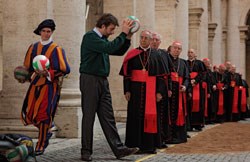
Dr. Brezzi (Nanni Moretti), ready for some volleyball
Meanwhile, the cardinals remain sequestered; the spokesman for the Holy See (Jerzy Stuhr) stalls and makes excuses to the media; the pilgrims in St. Peter's Square continuing praying and singing; heads of state issue statements expressing concern … and the world waits.
Throughout this holding pattern, the pope's thoughts are dominated by a single, intractable idea: I can't do this. To all appeals to act, he pleads for more time. He says he has no problems with his faith, and acknowledges that God has called him. Yet he also says that God sees qualities in him that aren't there (which seems contrary to his claim about his faith).
At no time does anyone follow or even propose any of the obvious courses of action. Obviously, the pope should pray—and his colleagues should pray, and urge him to pray—that God give him grace and guidance to do what he ought. If he believes he is called to the papacy, he should disregard his feelings and, well, pope up. Or, if he's convinced beyond question that he can't do it, he should resign—immediately and quietly—and let the conclave elect a new successor.
Article continues below
None of this is considered. Melville's faith is wholly theoretical, along with every other character (not counting the anonymous throngs in St. Peter's Square). Those "Not me" prayers are the only signs of prayer we see from any of the cardinals: They're never seen saying or attending Mass, or praying their daily office. None of them prays during the conclave for guidance regarding the selection of the successor to Peter, or for God's will to be done. Contemplating their votes, they look more like schoolboys enduring a difficult test than princes of the church fulfilling a sacred trust.
During the subsequent crisis, the cardinals play cards, exercise, and eventually—under the direction of the frustrated therapist—organize a comic volleyball tournament. One of the cardinals airily informs the therapist that the existence of the soul and the subconscious are mutually exclusive. Later a cardinal speaks disparagingly about godless Darwinism (though without denying evolutionary theory per se). Critical thought does not seem to be a virtue of the Catholic hierarchy.
If the pope doesn't question his faith, it's because he doesn't question anything. His whole world seems made up of self-evident, unassailable, brute facts: I'm the pope. God called me. I can't do it. I need more time. I've always loved theater. I'm tired. Piccoli brings as much warmth and sympathy as possible to what eventually becomes, in spite of his efforts, an off-putting character.
Melville's insistence that he needs more time is unconflicted by any sense of urgency for the plight of the world. He does seem troubled by the crowds in St. Peter's Square, but is unmoved to action, or even to awareness that he ought to act. Although he meets with nothing but kindness from strangers on the streets of Rome, he has startling outbursts of anger.
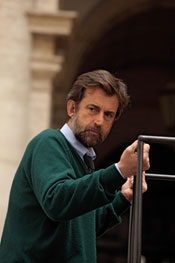
Director Moretti on the set
Melville insists that there are things he'd like to do as pope—there's so much in the church that needs changing. (That's about as close to controversy as the film gets.) Yet after seeing a second psychotherapist (the first therapist's ex-wife, whose fixation on "parental deficit" is one of the movie's few ideas), the pope announces that it make take a couple of years to sort through his problems. If that's the case, immediate resignation is the only remotely non-psychotic decision. But We Have a Pope doesn't seem meant to be a portrait of psychosis.
Article continues below
One can at least appreciate the production values. Moretti seamlessly dovetails footage from Pope John Paul II's funeral and crowds thronging St. Peter's Square with staged footage of his cardinals processing into the conclave. The Sistine Chapel and Sala Regia hall of the Apostolic Palace are impressively recreated in the Cinecittà studios, while the Palazzo Farnese and Villa Medici double for other Vatican locations. A Swiss Guard swearing-in ceremony in the Vatican Gardens is a nice touch.
Yet in the end, when decisive action is finally undertaken, the right thing is done in the worst possible way, causing maximum consternation and confusion for all concerned. What was the point? We Have a Pope is a premise in search of a thesis, a handful of scenes in search of a story. I can't imagine a better summary than this line from my friend Ken Morefield's review: "Dramatically speaking, we never get any white smoke."
(We Have a Pope opens in limited theaters today, and with IFC on Demand on April 11.)
Talk About It
Discussion starters
Have you ever felt that God was calling you to do something you didn't want to do or didn't feel capable of? What was it? What finally happened?
While the pope is AWOL, the Vatican spokesman orchestrates a ruse involving a Swiss Guard impersonating the pope in the papal apartments. Is it ever acceptable to deceive people for the sake of a greater good? Are the moral rules different for governments and states (the Pope being a head of state as well as the head of the Catholic church)?
Do you think the pope's problem is spiritual or psychological? Is it important for a believer with problems affecting their faith life to see a believing counselor? Is the therapist's stated unbelief an issue in his ability to help the pope? Why or why not?
By the same token, director Nanni Moretti—who plays the therapist—is not a believer. Some great films with religious themes have come from unbelieving writers or directors (A Man for All Seasons; Sophie Scholl: The Final Days; The Gospel According to Matthew). Why do you think some unbelieving filmmakers make films about faith more compelling than many Christian films? Do you think Moretti succeeds? Why or why not?
The Family Corner
For parents to consider
We Have a Pope is unrated. The material obviously isn't aimed at kids, but content issues are basically limited to a single F-word and some mixed religious themes. For instance, one cardinal assures the nonbelieving therapist that he won't go to hell because "hell is deserted." The real issues are issues of omission (the absence of practical faith and prayer, etc.).













 While we pray for peace, we need moral clarity about this war.
 We’ve got little information on Jesus’ appearance and personality. But that’s the way God designed it.españolFrançais
 Beyoncé’s right. Whether listening to Cowboy Carter or reading theology, diversity is a good thing.