What Does Catholic Social Teaching Have to Do with the Presidential Race?
While Paul Ryan probably won't impact the outcome of the election, Mitt Romney's vice presidential pick will likely renew debate over the morality of the budget.
Tobin Grant|
Image:
Monkeyz_Uncle / Flickr
What Does Catholic Social Teaching Have to Do with the Presidential Race?
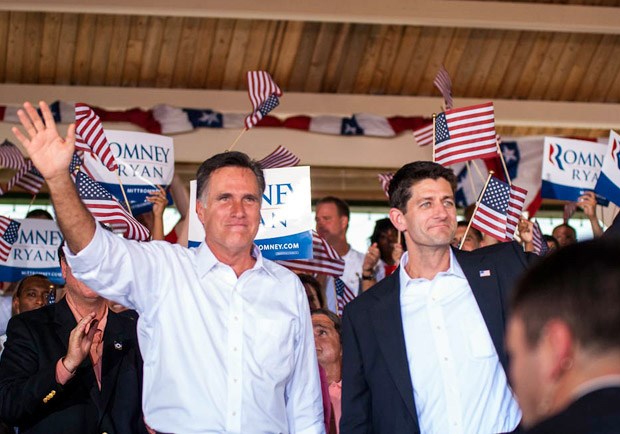
Republican candidate Mitt Romney announced Saturday that his running mate for the White House is congressman Paul Ryan (R-Wisc.). Already, the pundits are asking whether Ryan will put Wisconsin in play or if Ryan will bring in support from Catholics. If past research predicts the future, he will give Romney a short-term bump in the polls and then barely affect the final election results.
Research on the effects of running mates on presidential elections consistently finds marginal effects for vice presidential picks. At best, there is less than 1 percentage point change in the nationwide vote or in the VP candidate's home state, while some studies have found that running mates have no effect on the vote at all.
Even in 2008, when former Alaska governor Sarah Palin rocketed into national politics, Republican candidate John McCain's pick brought in few additional votes. In fact, comedian Tina Fey's impersonation of Palin may have been more effective in changing votes than the real-life candidate.
But running mates can change a campaign even if they do not change the election outcome. Ryan may be most effective not as someone who garners votes but as one who starts debates. As chair of the House Budget Committee, Ryan presented and passed in March the “Ryan Plan,” a bold and controversial budget. It included changes to domestic programs including funding cuts, privatization, and block-grants. The changes were so ambitious that former Speaker of the House Newt Gingrich criticized the Ryan Plan as “right wing social engineering.”
Ryan, a practicing Catholic, took heat from some religious leaders who called his plan immoral. Sojourners and other non-Catholic religious groups criticized the Ryan Plan using Catholic teaching to argue against it.
Ryan, however, disputes allegations that the budget goes against Catholic teaching and argues that his plan lines up with Catholic social thought.
Romney’s vice presidential candidate sees his budget as saving programs for the poor. He suggests that public policy should be judged by its “preferential option for the poor” and be evaluated by its effects on those most vulnerable in society. The preferential option for the poor appeared in a statement by representatives of the U.S. Conference of Catholic Bishops, released at the time the House was considering the Ryan Plan. The bishops did not criticize a specific plan, but they did emphasize the preferential option for the poor as the criteria by which a budget should be judged.
“The moral measure of this budget debate is not which party wins or which powerful interests prevail, but rather how those who are jobless, hungry, homeless or poor are treated. Their voices are too often missing in these debates, but they have the most compelling moral claim on our consciences and our common resources,” the bishops said.
For Ryan, helping the poor is best spurred by encouraging economic growth. “The preferential option for the poor means have an economy that is growing and have an economy that is wired, so that people who are in pockets of poverty that have never seen growth and economic opportunity before get it,” Ryan told the National Catholic Register.
Ryan also disagrees with those who equate solidarity with the poor with government programs.
“Simply put, I do not believe that the preferential option for the poor means a preferential option for big government,” Ryan said.
Ryan's argument focuses on more than pragmatism or a belief in supply-side economics. He also sees a budget that reduces the federal government's power as fulfilling the principle of “subsidiarity,” an idea represented in a lesser-known part of the Catholic catechism. Subsidiarity is the principle that powers of a higher order (e.g., government) should support those of a lower level (e.g., families) but not take them over and assume their responsibilities. Subsidiarity offers a check on efforts to give corporations, governments, or collectives too much power.
In some conservative Catholic circles, federalism, state rights, and local control are seen as subsidiarity in action.
“What American political liberals describe as an assault on Medicare and Medicaid is nothing other than subsidiarity applied to those programs in order to save them,” said Quin Hillyer, a senior editor for The American Spectator. “He would 'block-grant' Medicaid to the states—a 'community of a lower order' than the federal government—and let the states operate the programs with particular attention to local needs.”
In an April interview with CBN, Ryan equated subsidiarity with federalism.
“To me, the principle of subsidiarity, which is really federalism, meaning government closest to the people governs best, having a civil society of the principal of solidarity where we, through our civic organizations, through our churches, through our charities, through all of our different groups where we interact with people as a community, that’s how we advance the common good.” Ryan said. “By not having big government crowd out civic society, but by having enough space in our communities so that we can interact with each other, and take care of people who are down and out in our communities.”
Article continues below
Ryan and other conservatives have been criticized for misunderstanding or oversimplifying subsidiarity. The Vatican, in a conference on subsidiarity, said misunderstandings of subsidiarity are common, calling out interpretations of subsidiarity as meaning privatization or devolution “reductionist and biased.”
CatholicVote.Org's Stephen White said there is a misperception of subsidiarity among some conservatives.
“Federalism is a principle of political decentralization which often parallels the principle of subsidiarity, but is not identical to it,” White wrote. “The goal or end of subsidiarity is the proper ordering of society for the common good. This requires each person and institution of civil society be afforded, as a matter of justice, their proper autonomy.”
While Catholics continue to debate the theology of Ryan's budget, voters will evaluate the Republican Party’s approach to federal spending and taxation. With Ryan joining the ticket, the GOP has a man with a plan—a very detailed and controversial plan—that is argued by both conservative economic theory and conservative interpretation of Catholic social thought.
Ryan is unlikely to change the outcome of the election, but he will very likely impact the debate on the morality of government spending.












 While we pray for peace, we need moral clarity about this war.
 As my doubts about his teachings grew, so did a secret fascination with Jesus.
 Beyoncé’s right. Whether listening to Cowboy Carter or reading theology, diversity is a good thing.





