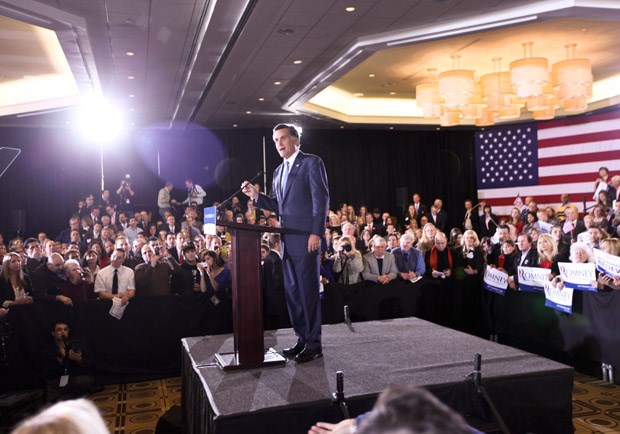
Against the backdrop of "can I vote for a Mormon?" unease among many religious voters, the Romney campaign has downplayed the relevance of religion for the presidency. We're told not to worry about a candidate's faith because the President is not a "pastor in chief." In 2012, that may be a politically savvy truism, but is it really true?
With a Mormon challenging President Obama, a Protestant, several Christian leaders have urged voters to consider credentials instead of creed. Franklin Graham spoke for many when he told ABC News: "Listen, we're not voting for the 'pastor in chief' of the Unites States. We're voting for the President. We're looking for the person that is the most qualified, a person that shares common values, a person that loves the country, a person who can lead this nation out of the economic mess that we've gotten ourselves in, and that's I thinkthe main thing for most people today."
Romney, a former Mormon bishop, has been emphatic in response to questions posed about particulars of his religious beliefs: "I'm not running for pastor in chief. I'm running for commander in chief."
Romney would, of course, not say otherwise. Suggesting that the President does play a significant, albeit informal, religious role would be perceived as committing theocratic heresy that runs afoul of the U.S. Constitution.
Article VI of the Constitution makes it perfectly clear that "no religious test shall ever be required as a qualification to any office." But when the President pledges to preserve, protect, and defend the Constitution in his oath of office, he customarily does so with his hand on the Bible and concludes with the words: "So help me God."
From George Washington's first inaugural address to President Obama's remarks following the recent shooting in Aurora, Colorado, American presidents have routinely invoked God in ways that more or less reflect mainstream religious opinion.
To be sure, that mainstream is ever evolving and expanding. But the mainstreaming of minority groups is often a contentious process, as witnessed by the consternation over Kennedy's Catholicism in 1960, Romney's Mormonism today, and the preposterous yet persistent rumor that Obama is a Muslim. Even though the nation is home to an increasing proportion of nonbelievers, a June 2012 Gallup poll found 43 percent of Americans still say they would not vote for an atheist presidential candidate.
Ironically, the curious American integration of piety and the presidency largely stems from our separation of church and state. Without an established religion led by an archbishop, ecumenical patriarch, or grand mufti, the President acts, for better or worse, as the nation's senior religious figure.
Cambridge University professor Andrew Preston makes this point in his massive, 815-page work Sword of the Spirit, Shield of Faith: Religion in American War and Diplomacy: "There is no official hierarchy in the American civil religion, but as the nation's head of state as well as its chief executive … the president has acted as its de facto pope."
What exactly are the President's papal duties? Preston explains: "Since George Washington, the president has been the interpreter of rites, symbols, and meanings of the civil religion, with some—particularly Abraham Lincoln, Franklin Roosevelt, and Harry Truman—significantly recasting it under the pressure of war."
Obama's and Romney's faith-infused interpretations of the Aurora shooting are case in point, and the most recent chapter in the long history of the presidential pastorate. Both politicians denounced the killing as "evil," and both turned to the Bible for meaning, solace, and hope.
In his public statement after meeting with victims' families in Aurora, Obama quoted the famous eschatological promise found in Revelation 21:4: "He will wipe away every tear from their eyes, and death shall be no more. Neither shall there be mourning, nor crying, nor pain anymore, for the former things have passed away."
Focusing on the here and now, Romney encouraged his audience to "mourn with those who mourn," a reference to Romans 12:15. In poignant remarks packed with Christian language, Romney expressed his prayer that "the grieving will know the nearness of God" and "the comfort of a living God." Citing the apostle Paul by name, Romney quoted from 2 Corinthians 1:3–4, "blessed be God, who comforteth us in all our tribulations, that we may be able to comfort them which are in any trouble."
Many commentators applauded Romney for sounding "presidential." Especially in times of tribulation, Americans expect their President to be their pastor—not in any formal sense as a leader of a church but in the general sense as a provider of spiritual care and theological perspective for the nation.
Article continues below
"Moments like these call for our commander in chief to act as a theologian in chief, and Romney did that today," Boston University religious studies professor Stephen Prothero told CNN. "He offered a theology of comfort, compassionate conservatism if you will, consistent both with the biblical witness and with the needs of the country on tragic days like today."
And it's not just tragedies that oblige the President to don his cassock. The President invariably offers theological and pastoral reflections in his proclamations on Religious Freedom Day, Easter, Thanksgiving, and Christmas, and in his remarks at the National Prayer Breakfast, the White House Iftar and Seder, and many other occasions throughout the year. The State of the Union and other major addresses would feel oddly incomplete without "God bless America," the obligatory presidential sign off since Ronald Reagan. And let's not forget that many presidents appeal to biblical passages and Christian principles as inspiration or justification for their policies—something Obama has done numerous times.
Americans differ widely in their views toward the presidential pastorate. Some want even more religion in the Oval Office. Others adamantly argue for less. For many it probably depends on what religion we're talking about. Whatever our views of what ought to be, let's not kid ourselves about what is—the pastoral dimension of the presidency is an enduring feature of American life.
In the face of feverish speculation about what Romney's Mormonism may mean for America, his supporters should situate his faith in proper context rather than dismiss any notion of its relevance. A candidate's religion is not everything, nor is it nothing. It's something to consider as one important factor among many, because among the President's many roles is that of "pastor in chief."
Judd Birdsall is a former U.S. diplomat and a current Ph.D. candidate at Cambridge University. From 2007 to 2011 he served at the U.S. State Department's Office of International Religious Freedom and was founding chairman of the Forum on Religion & Global Affairs. Previously he wrote on Obama's faith.












 While we pray for peace, we need moral clarity about this war.
 As my doubts about his teachings grew, so did a secret fascination with Jesus.
 Christian artists work at the intersection of music and climate change.





