The angel Gabriel to the Virgin Mary: "The Lord God shall give unto him the throne of his father David. And he shall reign over the house of Jacob for ever; and of his kingdom there shall be no end."
The Magi to Herod: "Where is he that is born king of the Jews?"
Charles Wesley to the church: "Hark! the herald angels sing, 'Glory to the newborn king.'"
The kingship of Israel's Messiah is deeply ingrained in the stories and songs of Christmas. Yet, in our modern and post-modern world, we don't really relate to royalty (other than to gossip about princes cavorting in Las Vegas). Royalty isn't much of a category for us.
In the early 20th century, however, the western world was in turmoil over the best form of governance. In Russia in 1917, political pressures led Tsar Nicholas II to abdicate. The Bolshevik revolution threw the country into anarchy, and the royal family was executed the following year. In Mexico, a 1917 constitution was antagonistic not only to monarchs, but to the Catholic church as well. That Mexican constitution served as a model for the new Russian Constitution of 1918 and the Weimar Republic's German constitution of 1919. In Spain, a 1923 military coup undermined the monarch's power. In Italy, the Kingdom of Italy invaded the Papal States in 1860 and Rome in 1870. The next six decades saw hostile relations between the government and the papacy. Mussolini's fascists imposed martial law in 1922, assassinated opposition politicians in 1924, and by 1925 dropped all pretense of democracy.
Christ the King in 1925
In the middle of this anti-monarchist, anti-Catholic ferment, Pope Pius XI sat down to write an Encyclical Letter (Quas Primas) on the kingship of Christ. The letter was released in December 1925, when the Pope still considered himself a prisoner in the Vatican. It would be over three years before a treaty would grant the Pope and Vatican City a stripped-down but legitimate political status. Pius was fighting for his political life, and he articulated a theology of Christ's kingship as a means to sway opinion in his favor. Beyond theology, Pius gave the faithful a new liturgical feast: The Feast of Christ the King.
This feast has been adopted by a number of Protestant denominations—Lutheran, Anglican, Presbyterian, Methodist—as a result of the liturgical renewal of the 1960s.
Pius noted that it is common to call Christ "king" metaphorically, because he reigns in people's hearts and wills. But Pius's purpose was to outline a kingship that was more than metaphorical and that extended over more than the personal, interior realm of the believer. He believed that Christ's kingship "invests the human authority of princes and rulers with a religious significance; it ennobles the citizen's duty of obedience." Thus, Pius hoped to reconnect the this-worldly offices of king and prince with the divine rulership of Christ himself. This was a throwback to medieval ways of thinking.
In addition, he hoped to assert the freedom of the church from any domination by the state. He wrote that "the Church, founded by Christ as a perfect society, has a natural and inalienable right to perfect freedom and immunity from the power of the state; and that in fulfilling the task committed to her by God of teaching, ruling, and guiding to eternal bliss those who belong to the kingdom of Christ, she cannot be subject to any external power." Most Protestants agree, but for a more individualistic reason. We want freedom to follow our own beliefs, and we are usually willing to grant the same freedom to other religions and denominations as long as they don't interfere with ours.
Third, Pius wished to combat anticlericalism. Because the church had been closely allied with the state ever since the dawn of the Constantinian era, when citizens rebelled against an oppressive state, they often also rebelled against the clergy who had wrapped themselves in the power of the state. France and Mexico were two of the most extreme examples; they actually executed some of the clergy. But anticlerical sentiment ran deep throughout the European continent.
Finally, Pius hoped to reassert the church's right to make laws. He asserted "the right which the Church has from Christ himself, to teach mankind, to make laws, to govern peoples in all that pertains to their eternal salvation." That right, he said, was denied as a result of anti-clerical sentiment, and he complained that the Roman Catholic Church was being treated by modern states as one religion among many false ones.
Christ the King in 2012
Modern political life has come a long way since 1925—and so has the Catholic church. Without denying that Christ is indeed Lord of all, most Christians have come to recognize that democratic pluralism, which is anchored in the dignity of every human being, requires the state to treat all religions equally—to recognize the essential liberties that should be accorded to all faiths. In return, religious organizations should cooperate in the public sphere by calling their adherents to faithfully fulfill their duties to God, family, and society.
Article continues below
The American Jesuit John Courtney Murray, the person who helped the Catholic church to finally accept its role in a modern, pluralistic society, was barely 21 when Pius published Quas Primus. Over the years he argued for a different vision of the church's role in society. At times he was silenced by the Vatican and required to withdraw his writings. Yet, his persistence eventually won the day, and the church began to speak in terms of democratic values. In 1963 Murray was invited to participate in the Second Vatican Council and then to draft Dignitatis Humanae Personae, the Council's endorsement of religion freedom.
Turning back to the theology of Christ's kingship, we agree with Pius that the revolutions of modern history debased the notion of divinely sanctioned authority, replacing it in some instances with sheer power, in other cases with popular sovereignty. In Christian worship, it is important to remember that Christ is our king because he has received royal authority from God the Father, not from popular vote. If Christ were merely our president, we would not worship him.
Second, we agree with Pius that the church should be free to exercise its rights to shape the consciences of believers, engage in social ministry, and evangelize those who do not yet believe. But when Pius waxes nostalgic for the day when the church legislated the morals of society, we must simply disagree. Christian citizens—both as individuals and as voluntary associations of believers—are called not to coerce but to persuade and to work with those of other faiths to improve the morals of society.
Third, we must recognize that God's ruler over human affairs will be fully realized only at the Last Day (see 1 Cor. 15:24–28). Until then, the extent of Christ's rule is defined by the number of those who follow his way. Pius envisioned an ever-increasing spread of cheerful Christians happily obedient to earthly authorities whose role was invested with divine significance. But the Roman Catholic Church came to realize the triumphalistic optimism of that view. In order to point to the fullness of Christ's rule at the Last Day, it shifted the observance of the Feast of Christ the King from the last Sunday before All Saints to the final Sunday of the church year. This subtle shift recognizes the New Testament tension between the already and the not yet.
Article continues below
Finally, Pius was disturbed by nationalism, and so are we whenever nationalist impulses trump the good of all people or loyalty to the international fellowship of Christian believers. In his day Italian, Spanish, and German nationalisms were all asserted at the expense of the church. When love of country is infused with a quasi-religious devotion, it threatens both the freedoms of citizens and the security of neighboring countries. The universal kingship of Christ supersedes our nation's claims on our loyalties.
Christ the King at Christmas
The trouble with thinking about Christ the King today, though, is that, lacking contemporary models of kingship, we may picture him as a super-Henry VIII or Louis XIV. He is of course far more powerful than they ever dreamed of being. But listen to how Scripture describes him:
Jesus to two disciples, quoting Zechariah 9:9: "See, your king comes to you, gentle and riding on a donkey" (Matt. 21:5).
John of Patmos to the church: "The Lamb will triumph over them because he is Lord of lords and King of kings" (Rev. 17:14).
Henry W. Baker, paraphrasing Psalm 23: "The King of love my Shepherd is, / Whose goodness faileth never, / I nothing lack if I am His / And He is mine forever."
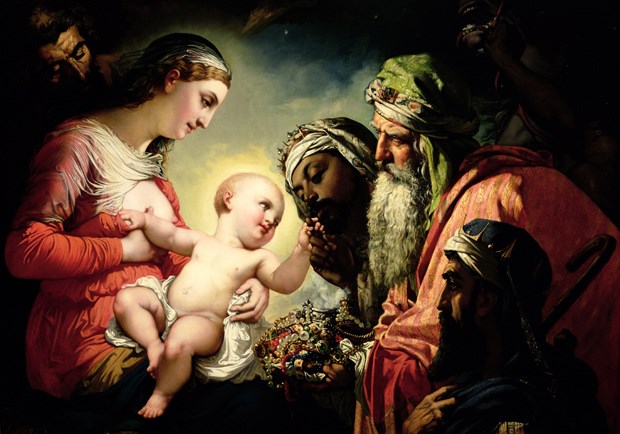
When you worship Christ the King on Christmas day, be amazed at this King of kings who is also gentle, a Lamb, the King of love, and a helpless babe in a barn.
David Neff is editorial vice president of Christianity Today Initiative Development.














 While we pray for peace, we need moral clarity about this war.
 As my doubts about his teachings grew, so did a secret fascination with Jesus.
 The Grammy-winning artist was found dead at her home in Nashville at age 47.





