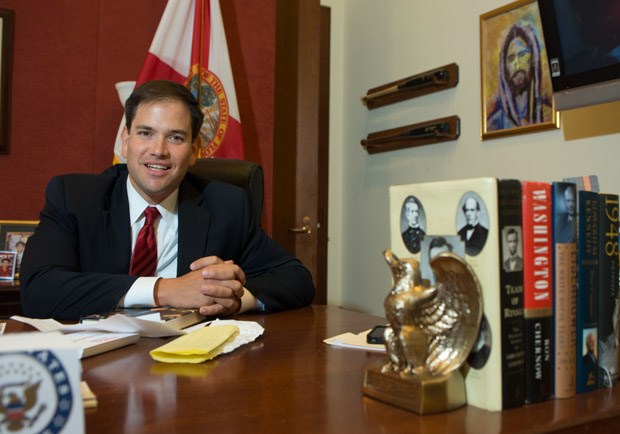
As speculation has grown over who Mitt Romney will pick as his running mate, Florida Senator Marco Rubio has topped nearly every list. Rubio has also drawn attention with the release of his memoir, An American Son, as well as his brief time in the Church of Jesus Christ of Latter-day Saints, his baptism into the Roman Catholic Church, and his ties to an evangelical church. Christianity Today online editor Sarah Pulliam Bailey spoke with Rubio about his diverse faith background, how his faith influences his policy positions, and why Christians should be involved in the public square.
You were baptized as a Mormon and then as a Roman Catholic. Can you describe your faith journey?
My mother desperately wanted to give her kids a wholesome environment, and we were born into a traditional Catholic family. We had extended family members who were and remain active members of the LDS church, which does provide a very wholesome environment. We joined the church for a little less than three years when I was very young, after we moved to Las Vegas in 1979. I'm not sure my mom ever fully understood the church theologically. As a family we were never fully immersed in it because my father didn't buy in, so there are many intricacies to the faith that we never really got involved in. By the time I was in sixth grade, we had left the Mormon Church and gone back to Catholicism, and I did my First Communion on Christmas Day 1984.
And you attended an evangelical church for a period of time?
Sometime in 2000, I unfortunately got really busy with my political stuff. I perhaps didn't do a good job of spiritually leading my family, which is one of the roles I play alongside my wife. In the meantime, my wife and my sister found an excellent local church, Christ Fellowship. It does a phenomenal job on two fronts: bringing people to Jesus, and teaching the written Word through phenomenal preachers. And it has a fantastic children's program. For a period of time, it became our church home almost exclusively. I felt called back to Catholicism around 2004, but have maintained the relationship with Christ Fellowship and attend their services often or listen to the podcasts.
'I really don't endorse criticisms of the President's faith.' -Marco Rubio
Did you have a conversion moment when you acknowledged your sins and Jesus' death on the cross?
There has never been a moment when faith hasn't been an important part of my life. There have been moments when I've been more alive in my faith than others. There have been times when I've been more involved in my faith, dedicating more to it, and giving it more importance. Like everybody else, unfortunately, it's usually in time of need that we tend to turn to our faith.
It would be unfair to say I had a moment of conversion. But one moment when my faith journey took on a different aspect was when my children became a bit older. I recognized that perhaps the most important part of my job in raising them is that I have only a handful of years to influence them and to inspire in them the knowledge of Jesus, Christianity, and what it means for salvation. If I fail in that regard, everything else becomes less meaningful.
Would you describe yourself as an evangelical?
I'm a Roman Catholic. I'm theologically in line with the Roman Catholic Church. I believe in the authority of the church, but I also have tremendous respect for my brothers and sisters in other Christian faiths. I recognize, as the Catholic Church does, that there are excellent teachings of the Word throughout other denominations. The elements of salvation are found in these churches as well. Some unifying principles bind all Christians: that God became a man and died for our sins, and that without that sacrifice, all of us would be doomed.
Since your faith has come up on occasion as a political issue, what would you say to those who suggest President Obama is a Muslim or not a "real Christian"?
I really don't endorse criticisms of the President's faith. I don't think they are fair, to be honest. One key thing about Christianity is that it requires voluntary acceptance of faith. If someone says he is a Christian, it is a sign of Christianity in and of itself. Christianity calls us to our salvation, and it also calls parents to contribute to their children's salvation. It calls us to be a light in the world. It doesn't call us to go around pointing other people out, saying so and so is deficient in their faith. It does call us to hold each other accountable. It's really asking us to look at ourselves, and that's really the only responsibility of Christianity. We're responsible for our own response to God's call in our life, and our own family's response.
When Obama uses his faith to defend same-sex marriage or other policies, do you think he's misinterpreting it?
I certainly don't reach the same conclusions he does. I've never criticized anyone for having their faith influence their public-policy decisions. If your faith is real, burning inside of you, it's going to influence the way you view everything. That belief influences your job and the responsibilities you have.
Article continues below
Are Christians who oppose gay marriage fighting a losing battle?
In terms of the Bible's interpretation of marriage, what our faith teaches is pretty straightforward. There's not much debate about that. The debate is about what society should tolerate, and what society should allow our laws to be. I believe marriage is a unique and specific institution that is the result of thousands of years of wisdom, which concluded that the ideal—not the only way but certainly the ideal—situation to raise children to become productive and healthy humans is in a home with a father and mother married to each other. Does that mean people who are not in that circumstance cannot be successful? Of course not.
It's not a discriminatory thing. I'm not angry at anyone because of it, but I also have to be honest about what I believe marriage should be in our laws.
Republican leaders seem to be shying away from the issue. Is that a strategic move, or should they address gay marriage more directly?
In the short term, the number-one issue threatening our country is the economy. We have to remain focused on the primary issue before us, the fact that millions of Americans have been out of work and that's what they look for their next President to help lead the way out of. That said, culture always matters. You can't have a strong economy or a strong country without strong people. Just like the issue of life, it will always be important, but because the President has presided over such failed economic policies, he is deliberately looking to have a debate about anything other than the economy. From a strategic point of view, we need to be cognizant of that. After all, our faith teaches us to be as gentle as lambs but as wise as serpents.
You proposed legislation on whether employers should have to provide contraception. Do you see the Obama administration as hostile to religious freedom?
In order to make that kind of decision, you have to believe that somehow the wisdom of the government and what you believe government should do is more important than the constitutional protection of religious liberty and religious expression. They're basically saying they believe it's such a good and important idea that they think it is more important than what the Constitution protects. To me, it's not even a religious argument but a constitutional one. If it were any other constitutional principle being violated, I'd be just as adamant about it.
Article continues below
You have also proposed legislation on immigration. From a policy perspective, should Christians emphasize compassion or the rule of law?
I don't think they're mutually exclusive. You can do both. At no time does our faith call us to violate legal principles—on the contrary. We have to recognize that when we're talking about immigration, we're not talking about statistics. We're talking about human beings, the vast majority of whom, the ones who are here legally, are here in search of jobs and a better life. That's where the debate comes in:how do we balance those two things? That's what I hope any future conversation about immigration reform will be balanced by—the balance between our compassion for our fellowman and the need to have rules that are followed.
As we see banks take high risks, how should the government be involved? Is market regulation a moral issue?
It certainly calls into question why the government was involved in bailing out these institutions that a couple years later are making the same risky decisions they were before. On the other hand, it reminds us that while J. P. Morgan lost $2 billion, the federal government this year will spend close to $1.5 trillion more than it takes in.
Given Christians' view of human nature and depravity, is regulation a necessary part of policy? Can corporations be trusted to create optimal outcomes?
We want to make sure people cannot harm others by their irresponsible behavior. We have regulations on everything from how you treat your workers to how people should drive on the streets, regulations that say we can't dump poison into our water system or pollute the air. My individual rights end where other people's rights begin. I can't exercise my rights to hurt other people.
Like everything else, there has to be balance, and that balance is usually in the form of a cost-benefit analysis. What is the benefit of the regulation, and what is the cost of the regulation? Sometimes the costs of the regulation are economic; sometimes there's a cost to our personal freedom. People are willing to sacrifice a certain level of personal freedom in exchange for a public good, but there are limits to that. While government regulations are necessary, they're not always necessary, and they're not always good.
Article continues below
In this cost-benefit balance, how should the United States promote international religious freedom? What happens if it conflicts with our strategic interests?
We need to be clear that we stand for these principles. Any time America looks the other way for short-term economic or political benefit when these principles are being violated somewhere in the world, we lose a little bit of who we are and what makes us special. There's always a temptation to make some pragmatic decision that we should tolerate some decision in some country because they're an ally, or that we should look the other way because they're too big and powerful and we need them for business. From the long-term perspective, we can't afford to do that. We need to be consistent in what we stand for, principles that all men are given by our Creator.
I have to ask about your possible vice presidential nomination.
I'm not going to discuss the vice presidential nomination process. I know Mitt Romney is right now going through a process with the people he's considering, and I am in no way going to comment on that, because it wouldn't be fair to them.
Some have cited irregularities in your record as reasons you might not be asked to be vice president. What would you say to those who claim you have made financial slip-ups?
I'm not above criticism. I'm sure people will find fault with what I've done or failed to do. I would be the first to recognize that I'm not perfect. Sometimes these things are exaggerated. There are things I wish I had done differently because of perceptions. Most of these issues have been talked about extensively during my campaign in Florida. I confronted those issues and answered questions repeatedly, and I'd be more than happy to answer them again if people want to ask them specifically. Ultimately, I've lived a life with real mistakes and real successes. I'm proud of what we've been able to accomplish thanks to the opportunities this country has given me and the sacrifices my parents made.
In preparation for the 2012 election, how should Christians engage in the public sphere?
Well, there's the spiritual activism, which saints are called to and which is separate from the political realm. If you're living out your faith, it influences every aspect of your life. It teaches us to glorify God in everything we do. In everything we do in our lives, we're called to bring glory to God, primarily by the way we live our lives and the things we do so people will look to us and say, "That's what it means to be a Christian; that's what it means to be ambassadors of Christ." If our faith influences every aspect of our lives, then if we decide to become politically active, it should influence that as well.
Article continues below
You distinguished spiritual activism from political activism. Do you see political activism as a ministry?
You can if that's what you're called to, for example, with how we treat the less fortunate. I believe in a safety net, not as a way of life, but as a way to help those who cannot help themselves. But I also believe the number one economic system that's ever been created that allows people to rise above the circumstances of their birth and accomplish things beyond what they were born into is the American free enterprise system. My faith influences me in believing that. I don't think everyone's called to political engagement. No matter what we're called to do, we are called to glorify God in what we do. For those of us who have been called to political action, we're called by our faith to glorify God in the way we carry ourselves in these roles.















 While we pray for peace, we need moral clarity about this war.
 We’ve got little information on Jesus’ appearance and personality. But that’s the way God designed it.españolFrançais
 The Grammy-winning artist was found dead at her home in Nashville at age 47.






