America's Roman Catholic bishops just completed the "Fortnight for Freedom," a two-week period intended to "support a great national campaign of teaching and witness for religious liberty." As evangelical and Catholic leaders have spent the past year opposing the Obama administration's so-called contraceptive mandate, the timing, motives, and agenda driving the "Fortnight for Freedom" have prompted widespread commentary. Rather than scrutinizing the Fortnight's agenda, Protestants could examine deeper questions than what took place on the surface.
It's important to consider the Fortnight's placement on the calendar—the significance of the Fortnight's dates, June 21 to July 4—to understand the nature of religious freedom and the relationship between what to some mixes like oil and water: the Christian tradition and American liberty.
It's worth considering whether the church fathers and the founding fathers enjoy a deeper conceptual affinity—precisely around the meaning and foundations of religious freedom—than many people (including perhaps the bishops) have noticed.
A feast of martyrs vs. the Fourth of July
The Fortnight for Freedom began on June 21, marking the vigil of the feasts of Saint John Fisher and Saint Thomas More. Fisher and More were both executed because they refused to endorse Henry VIII's claimed supremacy over the English church. The vast majority of English nobles and bishops endorsed the supremacy, while Fisher and More stood virtually alone. Though urged to use mental reservation to endorse the succession while denying its legitimacy in their hearts, the men were convinced that they could not do so without violating their consciences and endangering their salvation. As More declared,
I could not meet with the Works of any one Doctor, approved by the Church, that avouch a Layman was, or ever could be the Head of the Church.
Fisher was executed on June 22, 1535, and More was executed on July 6, 1535. In 1970, the Roman Catholic Church declared that they should share the same feast day, so every June 22 More and Fisher are honored as martyrs for the church. They are honored for standing up for a simple idea, though one that has proven consistently controversial and dangerous throughout history: the church cannot be true to itself if it does not enjoy independence from the powers that be.
The other bookend of the Fortnight for Freedom is the Fourth of July, for the obvious reason that this marks Independence Day—the birthday of American liberty. On that date in 1776, of course, the American Continental Congress unanimously adopted the Declaration of Independence drafted by Thomas Jefferson. If June 22 stands for the right of the church to be independent, July 4 stands for the right of every people to be independent. It stands for the right of political self-government, and of course the Declaration of Independence roots the right of political self-government in the permanent and universal rights of all human beings.
We hold these truths to be self-evident, that all men are created equal, that they are endowed by their Creator with certain unalienable rights, that among these are life, liberty and the pursuit of happiness. That to secure these rights, governments are instituted among men, deriving their just powers from the consent of the governed.
June 22 and July 4, then, would seem to have little to do with each other. They represent paradoxes: liturgical vs. the civic, ecclesial independence vs. political self-determination, martyrdom vs. life, liberty, and the pursuit of happiness.
Thomas More vs. Thomas Jefferson
The symbolic gulf between the two dates widens even further when one considers the great men with which they are most closely associated.
June 22 is mostly remembered as the feast day of Thomas More, who stands for a heroic commitment to the independence of the church. But his heroic commitment to the church's independence can't help but look to modern eyes like an unquestioning if not fanatical devotion to the church's authority. While one expression of More's commitment was a willingness to lay down his life as a martyr, another expression of his commitment was a willingness to make martyrs of others. As Lord Chancellor of England under Henry VIII, More presided over the execution of six Protestants for heresy. Unlike his modern admirers, More was proud of this feature of his biography, and he notes in his own epitaph that he was "grievous" to "thieves, murderers, and heretics" alike.
There could hardly be a more perfect contrast with Thomas More than Thomas Jefferson, the secular saint so closely associated with the Fourth of July. After all, the Fourth of July became Jefferson's day not only because he was the author of the Declaration of Independence. It was providentially sealed as Jefferson's civic feast day because of the coincidence of his death (along with John Adams's) on July 4, 1826—50 years to the day after the original signing of the Declaration of Independence in 1776.
Article continues below
Yet Jefferson was a fierce opponent of the Christian traditionalism for which Thomas More lived and died, famously going so far as to produce a kind of "revised rationalist version" of the New Testament, with all the supernatural bits (including Christ's resurrection) cut out. And he was a proud proponent of a degree of religious freedom that More would probably have found inconceivable. In contrast to More's epitaph, Jefferson's authorship of Virginia's Act for Establishing Religious Freedom is one of only three achievements he had inscribed on his gravestone at Monticello.
What did June 22 have to do with the Fourth of July?
So what does Thomas Jefferson have to do with Thomas More? What does the modern American founding have to do with the pre-modern Christian tradition? What do the self-evident truths on which Jefferson staked his life have to do with the Catholic truths for which More gave his life?
If there is a gulf between June 22 and July 4, perhaps it is the consequence of the radical divide described most memorably by Tertullian, a founding father of Western Christianity:
What has Jerusalem to do with Athens, the Church with the Academy, the Christian with the heretic? Our principles come from the Porch of Solomon, who had himself taught that the Lord is to be sought in simplicity of heart. … After Jesus Christ we have no need of speculation, after the Gospel no need of research.
What should we make, then, of a "Fortnight for Freedom" campaign so intent on conjoining Jerusalem and Athens, orthodoxy and liberty, the feast day of the martyr and the Fourth of July?
What hath the heretic to do with the church father?
At least one "heretic" begged to differ with Tertullian's judgment that a heretic and the church have nothing in common. Thomas Jefferson thought he had more in common with Tertullian than Tertullian might have thought conceivable.
In his Notes on the State of Virginia, Jefferson offers a series of claims about religion and religious freedom that at first glance would seem to underscore the gulf between pre-modern Christian orthodoxy and modern liberalism:
[O]ur rulers can have authority over such natural rights only as we have submitted to them. The rights of conscience we never submitted, we could not submit. We are answerable for them to our God. The legitimate powers of government extend to such acts only as are injurious to others. But it does me no injury for my neighbor to say there are twenty gods, or no god. It neither picks my pocket nor breaks my leg.
Article continues below
With this passage, Jefferson not only breaks with the constitutive premises of Christendom. He openly advocates a spirit we associate with secular liberal modernity, in which religious orthodoxy takes a back seat to untrammeled religious liberty. In religious matters, everything is permitted, at least as far as civil authority is concerned. No matter what your heresy may be, whether you believe in "twenty gods, or no god," the "powers of government" must leave you unmolested. So long, of course, as your religion "does me no injury"—with "injury" narrowed to mean only the most tangible harms: "picks my pocket" or "breaks my leg."
It seems clear, in other words, that the heretical spirit of Jefferson could not be more distant from the dogmatic orthodoxy of Tertullian or Thomas More.
Jefferson's debt to Tertullian's pre-modern liberalism
And yet, at the very point where the conceptual worlds of Jefferson and Tertullian might seem a million miles apart and set on opposite trajectories, they suddenly intersect and come into astonishing alignment.
In his copy of his Notes on the State of Virginia, Jefferson placed a single annotation next to the famous passage quoted above, just after the sentence, "The legitimate powers of government extend to such acts only as are injurious to others."
Astoundingly, the annotation is a Latin quotation from Tertullian. In a short letter to the Roman proconsul Scapula, probably written in 212 C.E., the North African church father had written in denunciation of a new wave of Christian persecution.
As one widely used translation of the text quoted by Jefferson puts it:
However, it is a fundamental human right, a privilege of nature, that every man should worship according to his own convictions: one man's religion neither harms nor helps another man. It is assuredly no part of religion to compel religion—to which free-will and not force should lead us—the sacrificial victims even being required of a willing mind.
Here the founding father quotes the church father. And he does so because he recognized that more than 1,500 years earlier, the church father had already articulated a radical case for religious liberty—a case that was hardly less radical, hardly less liberal, and hardly less modern than the case Jefferson articulated.
Is religious freedom a concession or indulgence that governments and peoples grant when they are feeling generous? No, because Tertullian insisted that it is a "fundamental human right."
Article continues below
Is religious freedom a matter of the majority tolerating the minority, or a privilege restricted to Christians and true believers? No, Tertullian argued it is "a privilege of nature" that every human being "should worship according to his own convictions."
Does my neighbor's faith so affect me that I have the right and responsibility to coercively interfere with his religious belief and practice? No, Tertullian anticipated the liberal harm principle of John Locke, Jefferson, and John Stuart Mill in arguing that "one man's religion neither harms nor helps another man" and should be left alone.
But doesn't zeal for orthodoxy and love for lost souls require the church to compel agreement with the true faith? No, as Tertullian understood, "It is assuredly no part of religion to compel religion—to which free-will and not force should lead us."
Freedom is a higher obedience
In the end, a profound underlying kinship binds June 22 with July 4. Of course, between the Christian tradition of Tertullian and More and the Enlightenment rationalism of Jefferson, there will always be a vast gulf concerning the nature, destiny, and highest good of human beings, let alone the nature of God.
Yet they share something profound nonetheless: a higher loyalty sets permanent limits to the powers of government. The truest test of the justice and freedom of any society is how much its government and people respect the fact that all of its members owe their highest obedience to the truth about God as their consciences deliver it, not to the powers that be, whether emperor, king, or democratic majority.
As Tertullian described the defiance of his fellow Christians in the face of Roman persecution:
[W]hen challenged to sacrifice, we stand immovable in loyalty to our conscience. … [S]ome people think it madness, that, though we could for the moment sacrifice and go away unhurt, with a mental reservation, we prefer "obstinacy" to safety.
Our brothers and sisters in the Roman Catholic Church who conceived the "Fortnight for Freedom" were wise to conjoin June 22 and July 4. Those dates, and all the dates in between, are excellent occasions for remembering that our churches and our nation will be truly free only if we "stand immovable in loyalty to our conscience."
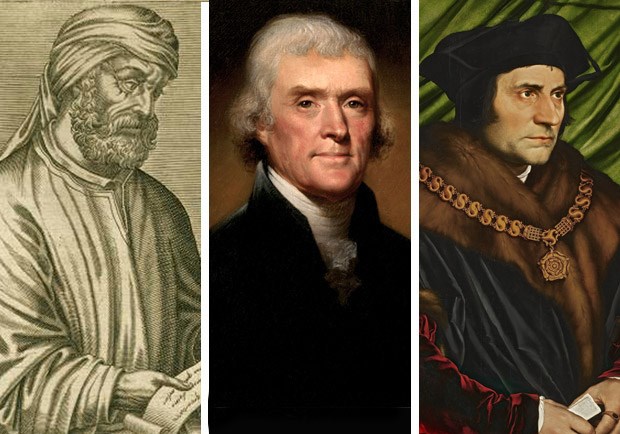
So let us not be afraid to prefer conscientious "obstinacy" to the "safety" of the crowd. The rights and liberties we now defend under the banner of religious freedom are fundamental truths the Christian tradition has cherished from its earliest centuries. And as we persist in defending them against what may well be increasingly unfriendly currents of opinion, let us remember that we follow in the footsteps of the venerable if improbable fraternity of Tertullian, Thomas More, and Thomas Jefferson.
Article continues below
Timothy Samuel Shah is associate director and scholar in residence of the Religious Freedom Project at Georgetown University's Berkley Center for Religion, Peace, and World Affairs.
"Speaking Out" is Christianity Today's guest opinion column and (unlike an editorial) does not necessarily represent the opinion of the magazine.












 While we pray for peace, we need moral clarity about this war.
 We’ve got little information on Jesus’ appearance and personality. But that’s the way God designed it.españolFrançais
 After lobbying from fellow Southern Baptists and Christians affected by the war, the House speaker moves a package forward.





