The Fervent Embrace: Liberal Protestants, Evangelicals, and Israel
Author
Caitlin Carenen
Publisher
NYU Press
Release Date
March 26, 2012
Pages
288
Price
55.0
There is no shortage of books looking at the history, problems, and prospects of the modern state of Israel. I try to keep an eye on developments and, like many, find it simply overwhelming. Narrowing a bibliography simply to religious books on this topic is likewise daunting. Occasionally I delight in meeting someone inside the Christian world who doesn't have an opinion on Israel, the Palestinians, and the Bible. Among conservative evangelicals, someone like this is a rare find.
This means that there is fertile ground here for professional historians to chart the recent history of Judaism in Europe, the development of the modern state of Israel, and how Western Christians have interacted with these developments. One of the best recent attempts has been Tim Weber's intriguing On the Road to Armageddon: How Evangelicals Became Israel's Best Friend (2005). Here Weber focuses on the evangelical camp that he knows well, showing how theology, particularly eschatology, has influenced how evangelicals look at Israel. To trace that theme, one simply has to follow authors such as Don Wagner (Anxious for Armageddon: A Call to Partnership for Middle Eastern and Western Christians, 1995), Victoria Clark (Allies for Armageddon: The Rise of Christian Zionism, 2007), and Stephen Sizer (Zion's Christian Soldiers?: The Bible, Israel and the Church, 2008).
Caitlin Carenen is a professor of history at Eastern Connecticut State University, and her book, The Fervent Embrace: Liberal Protestants, Evangelicals, and Israel (NYU Press), has all the markings of a Ph.D. dissertation completed at Emory University in 2008. However, it has been revised and rewritten to make it both thorough and highly readable.
Carenen's contribution tells the usual political story but draws in the vital role that religion has played in these events, something that politicians and policy-makers often neglect. The Fervent Embrace takes a broad approach that sweeps up not simply evangelicals but also, most intriguingly, the mainline church. She follows a basic historical outline in each successive chapter, moving from early European and American anti-Semitism in the 1930s right through to the formation of the Israeli state and to the evolving attitudes toward Israel in the church.
And it is full of surprises. For example, it is hard to believe that fundamentalists bought into the discredited Protocols of the Elders of Zion in the 1930s and contributed to anti-Jewish sentiments. Or that evangelical writing could view Jewish travails in Europe as opportunities for evangelism—rather than opportunities to call for a stop to what would become a racial genocide. It wasn't until November 1938, after Kristallnacht, that both mainline and evangelical ambivalence toward a Jewish homeland was resolved. But even then, dispensationalists protested anti-Semitism because Jews had to be converted before the second coming of Christ. Jews could become "the world's greatest evangelicals." Once the Holocaust engine began, however, the sheer horror of it brought all voices around: the killing just needed to end.
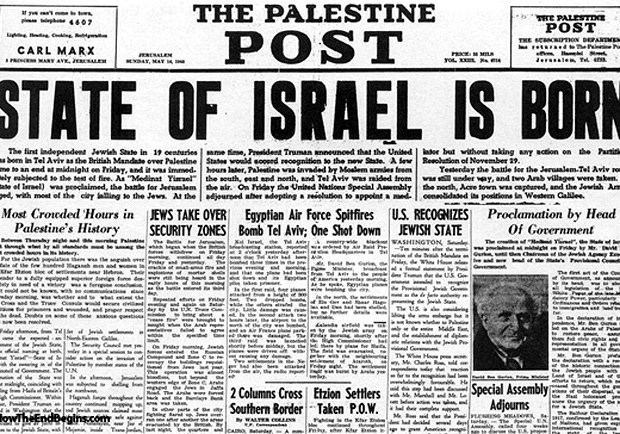
But in addition, a Jewish refuge was needed. And here Christian sympathies were quickly exploited by Jewish Zionist dreams reaching back to the 19th century. Carenen uses commentary in Moody Monthly, Christianity and Crisis, and The Christian Century to help us follow widely held sentiments. Yet there were still disagreements both in the Jewish camp and among Protestants. Conservative Christians insisted that support depended on seeing Israel as a religious state, which was a problem, since Israelis had no such interest. But these objections soon disappeared. Zionist voices were well organized and dominant, networking all members of Congress to petition the President to embrace a new Israeli state. As Israel anticipated declaring statehood in 1948, President Truman had been thoroughly lobbied by Christians and Jews alike. While his State Department and Middle East ambassadors warned about ambiguity and foreign policy imbalance, within an hour of Israel raising its flag, Truman acknowledged the new state and war erupted. Both liberal Protestants and evangelicals saw this as a victory of careful, tactical policy efforts.
But post-Holocaust sympathy for Israel quickly came under strain. "Once American Protestants learned about the displacement of greater than 700,000 Arab Palestinians, many of whom were violently expelled by Israel, their complaints soared."However, evangelicals soon discovered the mystique of preaching about the fulfillment of biblical prophecy, and when Israel conquered the Sinai in 1956, prophecy conferences suddenly found new inspiration. Still, Christian Zionist organizations were well-prepared, organized, and allied with Jewish groups to influence public opinion. According to Carenen, politically these pro-Israel mainline and evangelical lobbyists simply "outmaneuvered the anti-Zionist" Christians at every turn.
It is hard to overestimate the spreading influence of premillennial eschatology from, say, 1950 to 1965. Even for those who didn't understand dispensationalism, premillennial eschatology soon became the default view of conservative Protestants in America. And with it came an overt support for Israel as the harbinger of the culmination of history and the second coming of Christ.
Article continues below
Another strain on Christian sympathies came in 1967. If the expulsions of 1948 had been a problem, Israel's conquest of the entire country, its annexation of Jerusalem, and the further Palestinian expulsions threw mainline Christians into a tailspin. Calls were sounded to aid swelling refugee populations to whom Israel denied reentry. The National Council of Churches and the Lutheran World Federation (just to name two examples) objected strenuously. Evangelicals, on the other hand, celebrated. Tracking the published words of John Walvoord, then president of Dallas Theological Seminary, makes this evangelical zeal clear. Likewise, Eternity Magazine and Christianity Today (begun in 1956) defended Israel's conquests. The map of Israel was beginning to look like maps in their Bibles. In 1970, Hal Lindsey published what would become an evangelical bestseller, The Late Great Planet Earth. This book, shaped by a dispensationalist view of Israel's role in divine history, quickly sold over 10 million copies. By 1990, 28 million were in the hands of American Christians.
Carenen shows how mainline influence waned in the 1980s ("the collapse of the liberal vision") while evangelical influence grew. Jerry Falwell's pronouncement in 1980, "To stand against Israel is to stand against God," is a good index of growing evangelical passion. And from Ronald Reagan to George W. Bush, the influence of evangelical political activists, often working alongside Jewish activists, has been palpable. Today evangelical zeal is less focused on eschatology and centered more on garnering God's blessing for the United States by blessing Israel. The humanitarian Zionism of 1930s liberals has been replaced by an "entitlement Zionism" which supports Israeli statehood for reasons both biblical and pragmatic.
Dissenting Voices
The Fervent Embrace is to be commended as thorough and evenhanded. But for those who live and work in the evangelical world, it is frustrating to see ourselves summarized through the extreme voices of Jerry Falwell or Hal Lindsey—and today, Pat Robertson and John Hagee. Evangelicals are more complex than this.
Another problem is the glaring omission of any account of evangelical dissent to Zionism. Carenen gives brief mention of Sojourners and Jim Wallis's justice-centered theology, but doesn't seem to realize that there are major publications and organizations today that acknowledge modern Israel while denying it has any special status conferred by Bible prophecy—and they lodge strong dissent about Israel's treatment of Palestinians. Moreover, she doesn't realize that there are many evangelicals—700 of them gathered in Bethlehem last March—who feel a strong alliance with the body of Christ in the Palestinian world and will not deny that commitment based on controversial eschatological positions.
Article continues below
For the advanced student of this conflict, Carenen's work is helpful. I benefited enormously from it. But perhaps we need a sure-handed evangelical scholar like Tim Weber to update the discussion on this subject with a more complete evangelical portrait.
Gary M. Burge is professor of New Testament at Wheaton College. In addition to numerous books on biblical studies, he has published two books on Israel and Christian Zionism: Whose Land? Whose Promise? What Christians Are Not Being Told About Israel and Palestine (Pilgrim Press, 2003) and Jesus and the Land: The New Testament Challenge to Holy Land Theology (Baker Academic, 2010).
Our Rating
Book Title
The Fervent Embrace: Liberal Protestants, Evangelicals, and Israel















 While we pray for peace, we need moral clarity about this war.
 We’ve got little information on Jesus’ appearance and personality. But that’s the way God designed it.españolFrançais
 Christian artists work at the intersection of music and climate change.





