Noomi Rapace, Logan Marshall-Green, Michael Fassbender
Theatre Release
June 08, 2012 by Twentieth Century Fox Film Corporation
Heralded as director Ridley Scott's return to science-fiction, Prometheus combines the horrific monster violence of Alien with the pacing and sensibility of James Cameron's sequel, Aliens. Scott has always been quite open about the fact that he considered Alien more of a horror film than a true example of science fiction, calling it (in the film's DVD commentary) "fundamentally a thriller." That the his next film after Alien was Blade Runner, one of the most intelligent and most beloved science-fiction films of all time, both shades some viewers' memories of Alien and helped raise expectations that Prometheus would be a film about big ideas and not just one with big explosions.
For the first twenty minutes or so, Prometheus looks like it might meet those expectations. After archaeologists Elizabeth Shaw and Charlie Holloway discover cave drawings in various pre-historic locations suggesting that humanity's ancestors were aware of (and influenced by) visitors from another planet, dying tycoon Peter Weyland funds an expedition to visit the planet indicated in the drawings. Weyland hopes that its occupants can provide answers to cosmological questions such as how life on earth began and what will happen to him when he dies. Based on the drawings, they expect to find humanoid aliens, which they dub "the engineers" based on their belief that these life forms may have "built" life on earth. As anyone who has seen the first Alien film will suspect, what they find instead is an outpost decimated by some sort of attack. That it never appears to occur to anyone on the Prometheus that there could be a relationship between the deaths of the "engineers" and the mysterious pods oozing black oil they find in a room in the settlement is one of several places where plausibility is exchanged for brevity.
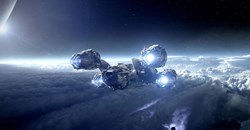
Prometheus hurtles through space
Gestures are made at a faith vs. science conflict—Elizabeth wears, loses, and regains a cross to symbolize her loss and rediscovery of religious faith—but despite some elevated language trying to equate meeting the "engineers" with meeting God and some exchanges about how humans and robots differ in relation to their respective creators, the premise of the film is never really developed beyond the point of providing a rationale for the ship to go to the planet indicated by the cave drawings. Once it arrives there, the film becomes a standard chase and escape thriller for the last hour; what had pretensions of being an origin story is revealed to be simply a prequel, more interested in settling questions from the first film—for example, what is the "Space Jockey" found by the crew of the Nostromo?—than in actually trying to think through or address the deeper spiritual questions the characters say they hope to have answered by making the quest.
Prometheus's biggest problem is not a lack of ambition, but of execution. The film is at no loss for ideas, but it can't really pause to catch its breath long enough to develop any of them. Ultimately, the film's themes fight each other for enough room to breathe, ending up as a pastiche of references to hot button issues rather an attempt to really leverage the alternate setting (as the best science fiction does) to tell us about our own world. There is a mini abortion-denial allegory, some (now standard) soulless-corporation skewering, warnings about the arrogance of science and the technological imperative ("anyone with half a brain and a swath of DNA can create life"), and even some anti-militarism. "Why do they hate us?" one character asks about those trying to kill the crew and, maybe, all of humanity. Whether this is meant to equate terrorists with soulless killing organisms or to suggest that terror wreaked on military-industrial societies is merely the blowback from their own, perverted drive to conquer and oppress others depends largely on whether you choose to believe the screenplay is subtly ironic or simply oblivious to many of its own implications.
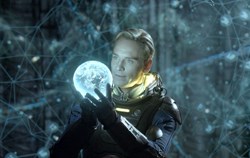
Michael Fassbender as David
Even if one solely judges the film as an entry into the horror genre, the architecture of the narrative—the setting of the action in motion—is rather clumsy. For allegedly brilliant scientists, the crew members of the Prometheus do some shockingly stupid things. Characters waffle from being too scared to investigate movement in one scene to being willing to walk up to an alien life form and trying to pet it like a stray dog in the next. The mark of an intelligent and scary thriller (and this is what makes Cameron's Aliens the best of the franchise in my opinion) is not how gruesome the special effects are but how intelligent the humans are in trying to suppress their fears in order to try to survive a terrifying situation. I would argue, too, that the best horror has a cathartic effect that is largely missing from the horror-action hybrids; the segue from booming score to soothing classical music over the end credits is so jarring that the choice of final music almost comes across as an apology for how dark and brooding the preceding film was.
Article continues below
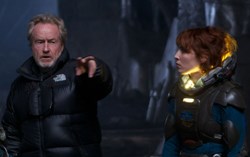
Director Ridley Scott on set with Noomi Rapace
And yet … as clumsy as the transition is from set up to spectacle, my goodness, what a spectacle it is. As an attempt at cerebral science fiction in the style of 2001: A Space Odyssey or Blade Runner the film lacks development, but as a summer thrill ride its velocity and intensity rarely let up once the roller coaster starts moving. A sequence involving a machine programmed to perform surgery is as terrifying and nauseating as anything you've likely seen. The special effects in the climactic attempt to intercept a threat before it can spread to planet earth are sublime. It is hard to imagine anyone at all concerned with narrative using the word "entertaining" in conjunction with Prometheus, but summer audiences wanting action and suspense are going to be well sated by the time they leave the theater.
Talk About It
Discussion starters
When David questions Mary about her religion, she states, "It is what I choose to believe." Is belief [always/merely] a choice? What is the difference between "belief" and "faith"? Are all beliefs equally plausible, and, if not, what is the relationship between belief, skepticism, and faith that the film posits?
When examining the planet's surface for evidence of life, Charlie says "God does not build in straight lines." What does this line mean and how does it relate to the film's portrayal of the contrast between evolution and intelligent design?
The film describes Prometheus as a titan who tried to put humans on "equal footing with the gods." Is that a sufficient or accurate summary of the film's mythological namesake? Is that what the crew of the ship in the film is trying to accomplish or is the symbolism of the title in some way ironic?
Can/should the film be read as an allegory of Gnosticism?
The Family Corner
For parents to consider
Prometheus is rated R for intense and repeated science-fiction violence. The graphic nature of the violence is more akin to what one might expect to find in a horror film than an action film, with close ups of dismemberments and bodies being torn apart being more common than explosions or shoot-and-fall violence. The individual acts of violence are not prolonged (excepting one or two sequences) but they are all graphic and explicit; the camera rarely cuts away. Even viewers desensitized to movie violence may find some scenes difficult to watch. There is no nudity to speak of (a humanoid alien is shown disrobing), though there is some sexual bantering among the crew and one couple is shown having sex. The two female leads are shown in minimal undergarments. Some language is present, but it is easy to miss in the deluge of action. Think of the famously horrific scene from Scott's Alien as a benchmark and increase the intensity by a factor of one or two and the frequency a factor of ten. The film is not for the faint of heart or the idly curious.
Christian artists work at the intersection of music and climate change.
Kelsey Kramer McGinnis
Prometheus
1 of 4
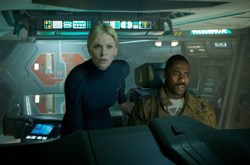
Prometheus hurtles through spaceCharlize Theron as Meredith, Idris Elba as JanekMichael Fassbender as DavidDirector Ridley Scott on set with Noomi Rapace













 While we pray for peace, we need moral clarity about this war.
 As my doubts about his teachings grew, so did a secret fascination with Jesus.
 Christian artists work at the intersection of music and climate change.