The central character of Hans Christian Andersen's fairy tale The Little Mermaid dreams of giving up her life in the sea to find love on dry land. The agony she undergoes exchanging her tail for a fully human form is poignant. It makes one wonder what it would be like to become another sort of thing, something we've desperately wanted to become.
Even before the Fall, human beings longed for dramatic change. In Genesis we see that Eve longed to be like God, to share in his very wisdom and goodness (Gen. 3:5-6). That longing was not the problem, since we see that in Christ, we are destined to "participate in the divine nature" (2 Pet. 1:4). Rather, the problem was that Eve grasped at God's wisdom and goodness instead of waiting and trusting God to fulfill her God-given longing. After the Fall, that longing is now utterly frustrated in human beings. This is one gracious reason God has given us the moral law—to show (a) that it truly is our destiny to live godly lives as outlined in the law, and (b) that it is now impossible to live in accordance with God's law without divine grace.
Thus we find ourselves in a desperate situation. We long to know and experience truth, beauty, and love in perfect fulfillment—the very wisdom and goodness of God. This yearning is what drives human beings relentlessly to create, to write, to ponder, and to love. But history and our everyday experience show we fall so far short of this goal as to lead us to despair; we are, as Paul put it, in a "wretched" situation, destined to live and die in futility (Rom. 7:24).
In the midst of our desperate situation, the gospel announces some startling news: In Christ, God has done that which is necessary for us to be changed, to enjoy the life we were created to enjoy, to participate in his being, to know and experience divine wisdom, beauty, and love—the very things we have longed for all along.
Future articles in this series will examine how one can personally participate in this dramatic transformation. Here I want to examine one crucial event that makes this dramatic transformation possible: the Incarnation.
Many assume that the Crucifixion and Resurrection make our transformation in Christ possible. And of course, there is a great deal of truth in this assumption. But we often think of the Incarnation as the warm-up to the real drama: Jesus needed to become human so he could die for us. What many Christians have forgotten is that our redemption began with the Incarnation.
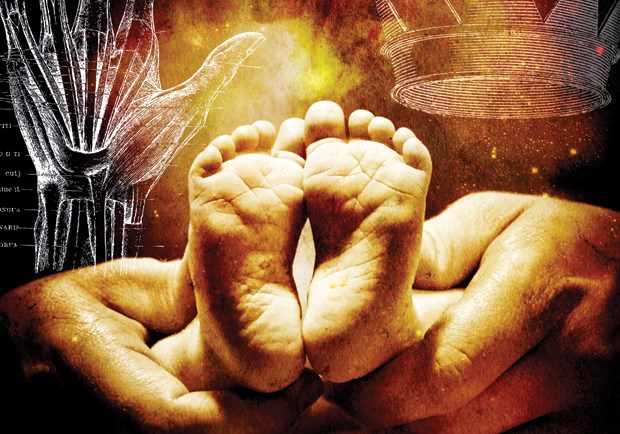
In the Incarnation, God the Son stoops down to gather up our humanity, becoming one of us so that he may reconcile us to God. He takes up our humanity in addition to his divinity—he unites what makes us human to what makes him divine. As the church father Athanasius puts it in the first chapter of The Incarnation of the Word of God, "He has not assumed a body as proper to his own nature, far from it, for as the Word he is without body." Rather, "He has been manifested in a human body for this reason only, out of the love and goodness of his Father, for the salvation of us men." Then he makes the startling claim that God the Son assumed humanity so that we might become divine. Not that we should lose our individual identity in total fusion with the Godhead, but that we can be united with God through Christ.
We often think of the Incarnation as the warm-up to the real drama: Jesus needed to become human so he could die for us. What many Christians have forgotten is that our redemption 'began' with the Incarnation.
Similar thoughts are found in evangelical theology. In his Dissertation Concerning the End for which God Created the World, Jonathan Edwards, the great Puritan pastor-theologian, argues that God's desire in salvation is to bring us into increasingly intimate communion with himself. Our glorified life in the world to come will involve drawing ever closer to God in an infinite embrace, yet without being absorbed into God like a drop of water in the ocean. We are to be united with God without being "godded with God," as Edwards puts it.
So how is it that the Incarnation, and not just the Crucifixion and Resurrection, makes this unity possible?
The Image of God
Today, many are asking what makes human beings different. What sets us apart from other creatures? There are many answers to that question. Theological leaders through the centuries have labored long and hard to comprehend human uniqueness. Many of them have focused upon the biblical idea found in Genesis 1:26-27 that we are made in the image of God. According to Scripture, no other creature possesses this divine image. But interestingly, Paul tells us that Christ is himself the image of the invisible God (2 Cor. 4:4; Col. 1:15), while the author of Hebrews says Jesus is "the radiance of God's glory and the exact representation of his being" (Heb. 1:3). He has been made temporarily "lower than the angels" (Heb. 2:9) in order to be crowned with glory and honor on account of his suffering for our salvation.
Article continues below
Much ink has been spilled in trying to understand what bearing the image of God entails. But rather than attempting to isolate some quality that only humans possess, we should begin, like the New Testament, with Christ. For if Christ is the image of the invisible God, then he sheds light on what it means for humans to carry the divine image. This is hardly a new insight. In Against Heresies, Bishop Irenaeus of Lyons observed that when "the Word of God became flesh … he both showed forth the image [of God] truly, since he became himself what was his image; and he re-established the similitude after a sure manner, by assimilating man to the invisible Father through means of the visible Word."
In other words, in becoming human, God the Son took up our humanity into God. By becoming human, Christ bridged the divide between God and man, doing so from God's side, by God's initiative—the exact opposite of Eve's, and our, natural grasping inclination. Christ's participation in our humanity, then, enables us to participate in his divinity, through being united to God in Christ.
This is what it means, then, to be made in the divine image—to participate in the life of Jesus Christ, who is both fully human and fully divine. In becoming human, God has taken up our humanity into his own divine life. He has endured the hardships and temptations of earthly life not merely to provide us a moral example, but also to begin renewing and sanctifying our humanity. His Incarnation actually repairs the defaced image of God that results from our sin. As Irenaeus suggests, God remakes us in his image.
Christ's Vicarious Humanity
In this way of thinking, the Incarnation itself is also a vicarious work. Evangelical theology already imagines the Crucifixion in this way: As Christ's work on our behalf, performed by a representative standing in our place to take upon himself the penal consequences of our sin. But now we see that God the Son also acts on our behalf in the very act of taking upon himself human flesh. His work does not come in two parts, becoming human and living a perfect life, and then dying on our behalf. No, his work is one whole. He acts on our behalf and in our stead from the Incarnation onwards—in his birth, life, death, and resurrection.
This is sometimes referred to as Christ's "vicarious humanity," and is often associated with Scottish theologians like John McLeod Campbell in the 19th century and Thomas and James Torrance in the 20th. But as has already been indicated, this doctrine can be found much earlier in the life of the church, especially in the writings of the Fathers.
Article continues below
With the concept of Christ's vicarious humanity comes a related notion: The characteristics of human life become the property of God the Son, while the characteristics of his divine life become the property of his human nature. In other words, God the Son acquires the qualities of a human being in addition to his divine qualities. He is no longer just a divine person. Now he is a divine person with a human nature. His divinity and humanity are not fused together in some mixture of divine and human characteristics, like many heroes of myth and legend. Rather, his two natures are held together in this one complex person.
An admittedly crude illustration comes from cooking. When we add yeast to dough, the yeast and the dough interact and enable the dough to rise. In one sense, the yeast has become doughy, and the dough has become yeasty—they have taken on the properties of one another.
Of course, the illustration is limited. One difference is this: the dough and yeast get lost in one another, so that one soon forgets the parts and only thinks of something new called "bread." But Christ's human attributes—born in Bethlehem to Mary, raised in first-century Jewish culture in the Middle East—do not compromise his divine nature. Nor does he become something new or different in taking on human flesh. His divinity and his humanity remain intact, yet united in one person. So when he walks and talks and preaches and heals the sick, he is acting as a divine-human being, the God-man.
Theologians like John Calvin describe a wonderful exchange between the qualities of the two natures of Christ—one that jeopardizes the integrity of neither. In the Institutes of the Christian Religion, Calvin puts it like this:
This is the wonderful exchange which, out of his measureless benevolence, he has made with us; that, becoming Son of Man with us, he has made us sons of God with him; that, by his descent to earth, he has prepared an ascent to heaven for us; that, by taking on our mortality, he has conferred his immortality upon us; that, accepting our weakness, he has strengthened us by his power; that, receiving our poverty upon himself, he has transferred his wealth to us; that, taking the weight of our iniquity upon himself (which oppressed us), he has clothed us with his righteousness. (Institutes, 4.17.2)
Article continues below
Several centuries after Calvin, Edwards termed these apparent paradoxes the "admirable conjunction of diverse excellencies." In a sermon titled "The Excellency of Christ," Edwards argues that there is nothing intellectually untoward about ascribing a multitude of differing attributes to Christ. In reality, says Edwards, any misapprehension we might have comes not from any actual incongruities within Christ's nature, but from the inherent limitations of human understanding.
But if Edwards is correct to see in Christ an "admirable conjunction of diverse excellencies," a difficult question arises: Does this mean that his humanity adds to, or improves upon, this package of divine excellence? Does the Incarnation, beyond bringing about our participation in the life of God, add something to God's life as well? Does this "yeast" finally find fulfilment in the dough of humanity?
In becoming human, God has taken up our humanity into his own divine life. He has endured the hardships and temptations of earthly life not merely to provide us a moral example, but also to begin renewing and sanctifying our humanity.
The answer is that it does not, for the simple reason that God is already perfect. One cannot add to perfection. The "addition" of a human nature to the person of Christ does not mean the Son becomes more perfect still. Rather, it is the means by which God makes himself visible to us and shows forth his divine image. So although the Incarnation does not add to God's perfection, it does give us, his creatures, an additional reason to love and delight in him.
Still, Edwards understood that true knowledge of God must go beyond merely looking at God. It must involve acquaintance with God. It is no good thinking we know God from studying books or thinking about him. We might put it like this: Without encountering the admirable conjunction of diverse excellencies laid bare in Christ, fallen humans cannot know and enjoy communion with God any more than someone can know what honey is like by understanding its chemistry but not tasting it.
A Life-Changing Doctrine
In this light, we see that the Incarnation is not a mere prerequisite to the Crucifixion and Resurrection. It is part and parcel of the way in which God has chosen to redeem his people.
Article continues below
By God participating in our humanity, we are now, by faith, enabled to participate in his divinity. We can, after all, enjoy the wisdom and goodness and love of God. This is not something we can gain by grasping for it, as did Eve, but something God has graciously done for us. At the same time, the Incarnation helps us literally see what God is like, and gives us a model to imitate as we "work out [our] salvation with fear and trembling," for God has taken on human nature truly "to will and to act in order to fulfill his good purpose" (Phil. 2:12-13).
It is difficult, then, to see the doctrine of the Incarnation as anything other than life-affirming and life-changing. To know that God has made us in the image of Christ, and entered into our lives so that we may enter into his, is to know that we are set apart from other creatures to love, enjoy, and serve him forever.
Oliver D. Crisp is professor of systematic theology at Fuller Theological Seminary and the author of several books on the Incarnation.
















 While we pray for peace, we need moral clarity about this war.
 A Christian reconciliation group in Israel and Palestine warned that war would come. Now the war threatens their relevance.العربيةFrançais
 Eastern Orthodox poet Scott Cairns reflects on his new collection, his journey of faith, and poetry’s capacity to apprehend inexhaustible realities.






