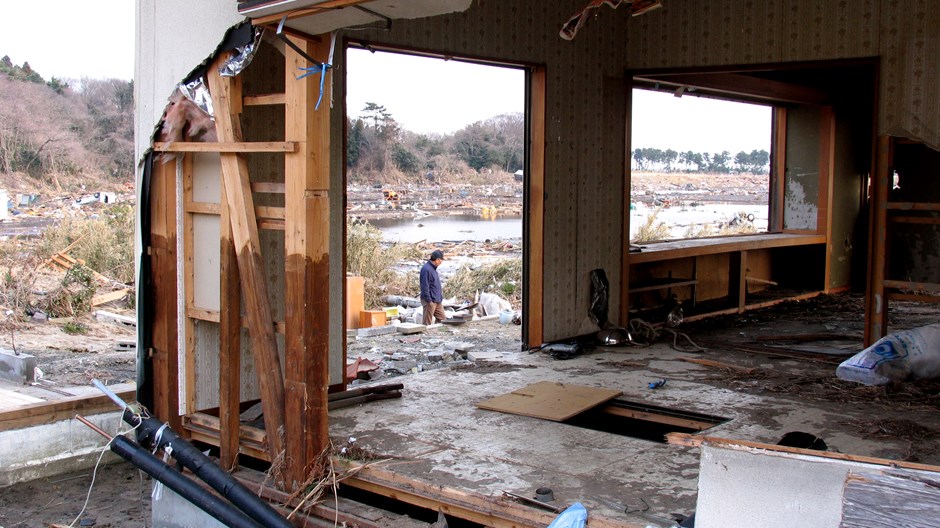
For two days last spring, Hiroshi Minegishi lived inside his car in a parking lot, surrounded by mountains of debris from the historic March 11 earthquake and tsunami.
On the third day, he climbed across rooftops and crushed cars, arriving at the spot where his small church once stood. It took him a long time to find pieces of tile and tin that resembled the place where he ministered as a pastor for so many years. For a moment, Pastor Minegishi stopped his efforts and prayed, "God, somehow be glorified in the midst of this horror."
At the time of the quake, Minegishi was about 200 yards from the coastline in the northeast fishing town of Kesennuma. As he fled to higher ground after hearing tsunami-warning sirens, he received a chilling text message from his daughter miles away in Tokyo: "Escape. Escape. Escape."
"I decided then that all I really have—or ever had—was the love of Christ," Minegishi said, "so I need to let him rule."
In the year since the largest quake in Japan's recorded history, Christians have witnessed more than the walls of buildings come down. During Christianity Today's recent travels through the quake zone, pastors and other Christian leaders said that the cultural and spiritual barriers that have for generations divided Christians from each other and from greater Japanese society have weakened in the aftermath.
"We've been called to remember in these months that the church really is the body of Christ," said Joseph Handley, president of Asian Access, an interdenominational evangelical organization that works throughout Asia to develop Christian leaders.
"It doesn't matter if it is a traditional-looking building, Samaritan's Purse aid workers circling up in their tents, or a businessman rebuilding homes and community centers in a fishing village. All of it is part of the true presence of the invisible church, bringing the kingdom of God to bear for the good of Japan."
Japan has a longstanding reputation as a "missionary's graveyard," Handley told CT. Christian workers from overseas have seen few results, becoming discouraged and returning home. "For the few who stay, ministry is truly a lifetime commitment with slow, small triumphs building on friendships established over generations."
New Moment Arrives
During interviews, Japanese pastors said that the end of World War II was the last time there was such an open window for Christian outreach in a nation largely composed of Shinto and Buddhist believers.
Right after the war, in late 1945, Supreme Commander Douglas MacArthur urged visiting American clergy to send 1,000 missionaries to Japan. He said it was "necessary to replace the old Japanese religion with Christianity." Protestant and Roman Catholic leaders affirmed the call and mobilized hundreds of American missionaries.
But Doug Birdsall, the Lausanne Movement's executive chair who served as a missionary in Japan for 19 years, told CT that the American missions response did not achieve the expected result of seeding Japan with churches that would grow in number and influence. Birdsall said, "A historic opportunity was lost." Christians in Japan have never composed more than 2 percent of the population.
When the earthquake and tsunami hit on March 11, they struck a nation already suffering economically and culturally. "The economy has been struggling for more than a decade, suicide rates have skyrocketed, and there's a disintegration of family structure with growing divorce rates and numbers of latchkey kids," Handley said.
In the aftermath, Japanese church leaders soon realized a second chance had arrived. They now could respond to the physical needs of their neighbors at the grassroots and reintroduce them to Christ. "This time there [is] an outpouring of love, prayer, and support," Birdsall said. "The church has been praying for decades for a time of major breakthrough for the gospel. There is no country in the world where the church has sown the gospel so generously, yet reaped so sparingly."
After the quake and ensuing tsunami and nuclear power plant failure, Japan's government became unusually receptive to overseas aid, including aid from Christian agencies involved in relief work, such as Samaritan's Purse, Food for the Hungry, and national groups such as CRASH Japan.
"We are in a new era now," said Handley. "This is clearly Japan's hour for Christ."
Shortly before the March quake, pastor Shuzou Suzuki returned from Bible school to his neighborhood of Watanoha, Ishinomaki, a major port city of 164,000 where more than 3,000 died. He was unsure of his mission.
Soon after, Suzuki began a partnership with the Housing Reform Project, associated with Samaritan's Purse. He has been mucking out houses and counseling grieving families, and recently planted a church and ministry center in the newly restored neighborhood blocks that the aid workers have rebuilt.
Article continues below
The Watanoha Christ Church and Disaster Relief Center has regular Sunday worship services with people from the community. Local residents are curious to learn more about the volunteers' Christian faith and hopeful attitude. Watanoha Christ Church also hosts women's coffee hours, Bible studies, and youth groups, and stores relief supplies.
"Nothing can compare to the joy that comes from knowing the love of Jesus Christ," Suzuki said enthusiastically. "I've been praying for a place like this—where we can meet to worship, pray, study the Bible. Through the prayers of the church, I hope that people will turn to Jesus in these confusing times."
Caring Reconnection
Prior to the earthquake, there was little connection between the typical Japanese church and the community at large. Pastors were exemplary shepherds of their small congregations, devoting their lives to fellowship and discipleship. But their social engagement was minimal, and the community remained suspicious or largely unaware of the church's purpose or role.
The tsunami changed that. Due to their grassroots networks, churches became some of the first distribution centers. They took in evacuees, stored supplies, served meals. "Churches were the shred of hope that people clung to when they had nothing else," Handley said.
"As these centers became centers for hope, the walls started melting away. People started saying, 'Wow, these people are real. They aren't some strange cult or taken over by some foreign religion. They are really our people and they care about us.'
"There was a sense of camaraderie developing between the church and the community as they started to band together for the good of the whole—augmented, of course, by tons of aid pouring in."
Nobuyoshi Nagai, a northeast pastor, told CT that church leaders in the hard-hit Tohoku region believe they must act quickly and address the urgent needs of their congregations and communities at the same time. He said, "For just a short time, there is some vulnerability. We have a window of about two years. The needs are overwhelming."
In Ohira, Pastor Nagai's church became a nucleus for volunteers and supplies for Ishinomaki and Kesennuma. "We didn't really know if we could handle what seemed to be required of us," he said. "But we also knew we had to do all that we could do."
Article continues below
Over the first few months following the tsunami, more than a thousand people stayed with Nagai while his small congregation, Gospel Town, worked to keep people fed and cared for up and down the coast.
The church became an information clearinghouse for many tiny coastal communities that the government had been unable to reach with aid. Some of these connections led to unprecedented opportunities—beginning a junior-high Bible study and gospel choir, or growing a college sports and worship program in Sendai to mobilize young Christians for service.
"We won't see a drastic change," Nagai added, "but in this slow, gradual change, people know where to come for help."
In a country whose Christian population has plateaued for generations at about 1 percent, the Tohoku region was among the least churched in the country. "We haven't been planting here. We haven't focused here," Nagai said. "There are so many towns without any churches at all."
Now Nagai said there is a plan to plant 100 new churches out of the small existing network over the next five to ten years. "The global church community has never prayed so intently for this area, but there is so much work to be done. I ask them to maximize prayer," Nagai said.
Unexpected Conversations
Improvements in the public's perception of local Japanese churches have motivated more church leaders to work across denominational lines. But the lethal devastation due to the Fukushima nuclear plant failure has forced entire communities, including congregations, to relocate.
Pastor Akira Sato led the members of four churches in Fukushima prefecture—all of them within five miles of the nuclear power plant crippled by the tsunami. While the churches were relatively unaffected by the earthquake and tsunami, they are in untouchable land—a ghost town. It is illegal for Sato, his family, and his congregation to return to their homes, perhaps forever.
"Our church has never stopped worshiping together, though," said Sato. While the town broke apart, scattering to shelters and relatives' homes elsewhere, the members of Fukushima First Bible Baptist Church began their exodus together. Eventually, a Christian camp in the mountains near Tokyo offered to shelter the entire church community as long-term evacuees.
Plans are in place to commemorate the anniversary of the disaster by moving back to Fukushima, just outside the nuclear evacuation zone, to start a new church and apartment complex for the elderly.
Article continues below
'There is no country in the world ?where the church has sown the ?gospel so generously, yet reaped ?so sparingly.'—Doug Birdsall, Lausanne Movement
"We need to return to offer hope and encouragement to the church members who stayed in Fukushima outside the evacuation zone," Sato said. "Being scattered makes all of us feel the isolation even more strongly."
Admitting to discouragement, deep pain, even hopelessness at times, Pastor Sato said, "We will not be beaten by this disaster. We will live to see Fukushima become famous not for this nuclear accident, but as a symbol of hope."
"A building with a cross on top is one way of doing church," Handley said. "But [church] can happen in a community center, a gym floor, or the newly framed structure for a small business being rebuilt.
"Believers working together in any spectrum of church life doesn't require the presence of a building. And for the first time on a large scale in Japan, we're seeing people from different backgrounds and denominations put aside their differences."
Asian Access is trying out new ways of investing in ministry areas that it might never have imagined as the domain of churches. (The ministry also received an offer from a donor to match dollar for dollar up to $1 million, potentially providing $2 million "to bring hope and healing" to Japan through its churches.)
Members are supporting several small business projects, such as a home for the elderly that will be built next door to Pastor Sato's new church in Fukushima. "And yet, these projects are done with the idea that they will become 'invisible churches,'" Handley said.
"We'll place disciples there who will be a part of the process of recreating business enterprises where they were decimated, serving the pressing needs of the community with a discipleship mindset."
"I thought my church died that day, but it did not," Sato told CT. "We lost four chapels and multiple organizations, but the church remains. We don't need to worry because the church is our home. We lost many visible things, but we rediscovered the invisible power of Christ."
Alanna Foxwell-Barajas is a freelance writer in Atlanta. Additional reporting provided by Takeshi Takezowa and Jordan Foxwell.
Previous Christianity Today coverage of Japan and the aftermath of last year's earthquake and tsunami include:
Prayers for Japan's Unborn Children | As the country quells a nuclear crisis, I'm reminded that even the best-intentioned parents can't fully protect their children. (Her.meneutics, March 21, 2011)
Missionaries Grapple with Leaving Japan | After the disaster, the balancing act between living out a missionary calling and keeping safe became particularly difficult. (Liveblog, March 18, 2011)
Japan: World Vision Stays Out of Radiation Zones | Workers in Japan are doing what they can to help out in the wake of the tragedy while staying clear of the radiation zones. (Liveblog, March 17, 2011)















 While we pray for peace, we need moral clarity about this war.
 We’ve got little information on Jesus’ appearance and personality. But that’s the way God designed it.españolFrançais
 The Grammy-winning artist was found dead at her home in Nashville at age 47.






