"Let's have some fun," says one god to another, suggesting that they "put on a show." The moment comes late in Wrath of the Titans. Very, very late. I don't remember the response, if any, but "Why start now?" would have been appropriate.
Writing about the 2010 Clash of the Titans remake, I complained that while the intrigues of the Greek gods ought to play like "Dallas" on Mount Olympus, in that film the gods seemed as grand and passionate as "The Simpsons." In a way it's worse in this sequel: Mount Olympus is never even seen, and the gods, irrelevant and losing their powers now that men have learned not to worship or pray to them, have become earthbound, or even Tartarus-bound.
Betrayed by Hades (Ralph Fiennes) and Ares (Édgar Ramírez), Zeus (Liam Neeson) spends nearly the whole film chained in a stygian pit with his remaining powers being drained away, which seems to amount to his arms very, very slowly turning into lava, or something. Perseus (Sam Worthington), the half-human son of Zeus, still wants nothing to do with his father; we're told Perseus refused to pray to Zeus even when Perseus's wife Io died between films—an odd turn of events, considering she was immortal. Actually, she was killed in the previous film, but Zeus brought her back to life in the end. What's the good of marrying an immortal woman if she keeps dying on you?
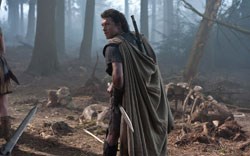
Sam Worthington as Perseus
The good, I guess, is that Perseus still has his ten-year-old son Helius (John Bell), with whom he wants to be left in peace. Unfortunately, with the gods fading, their power is no longer sufficient to keep the demonic hordes of Tartarus imprisoned, imperiling all mankind—which Perseus ordinarily wouldn't care about, except that demon attacks are inconvenient to his plans to raise his son in peace. It seems the demonic has more staying power than the divine, or at least the loss of faith in the divine doesn't make one less vulnerable to the demonic, but more.
There are battles with gods and monsters, a descent into an underworld labyrinth, efforts to collect a triad of primordial weapons, and a big bad villain named Kronos (the first actual Titan to make an appearance in any of these films, including the original) who looks like the Balrog crossed with the giant liquid warrior from Miyazaki's Nausicaä of the Valley of the Wind. A lot of stuff happens, but did the filmmakers at any point ask themselves: Is any of this fun? Are these characters appealing or engaging? Are any of these special effects in the service of memorable, inspired creatures or settings? Have we created anything beautiful, anything that suggests a world worth fighting for?
People complained that John Carter had a boring hero and a drab palette. I was one of them. Next to Perseus and his world, John Carter is as colorful as Tony Stark and Barsoom is as colorful as Pandora. In Avatar it didn't matter that Sam Worthington's character wasn't interesting, because his world was so arresting. (As C. S. Lewis points out in "On Stories," stories about extraordinary worlds ought to have ordinary protagonists.) Here, in a world that's practically all rock and sand, where even the costumes and the monsters are drab and colorless, Worthington is an epicenter of dullness.
Is there any respite? A brief scene in which Perseus introduces his awed son to Pegasus is not only a rare moment of awe and beauty, but a glimpse of father-son bonding that is much needed—but hardly sufficient, given that Perseus's relationship with Helios is his one meaningful connection and motivation. A brief ocean voyage and a visit to a mysterious wooded island is the only oasis in the desert of earthtones. A towering shadow in the mist on the wooded island is fleetingly evocative, but once revealed the actual Cyclops isn't very interesting, as impressively rendered as he is.
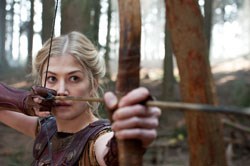
Rosamund Pike as Andromeda
Replacing Alexa Davalos as Queen Andromeda, Rosamund Pike makes an immediate impression as a confident military leader (in drab battle gear, naturally) marshaling her troops to confront the demonic menace. Not until the very, very end, when Perseus abruptly plants a smooch on her lips while she's in the middle of saying something and then walks away, is there the slightest romantic connection.
Toby Kebbell and Bill Nighy camp it up as, respectively, a less illustrious demigod named Agenor and the lame god Hephaestus, smith of the gods and creator of the fabled weapons of Zeus, Hades, and Poseidon. In a less self-serious production their mugging might be funny, but they're so out of step with the ponderous tone of the rest of the film that they fall flat. Would you believe that even though the Kraken is destroyed, they still manage to work in the line "Release the Kraken"? Oh, and Bubo the mechanical owl has another inert cameo.
The plot makes no sense. If the walls of Tartarus are crumbling, threatening to unleash demonic hordes on the earth, why does Kronos, the biggest bad in Tartarus, need to make a deal with two of his hated progeny who banished him to Tartarus in the first place? Why not simply escape and destroy them all? What happens to all the rest of the demons that were threatening to escape? We see a pair of gods destroy a handful of them, but surely that wasn't the whole crew?
Article continues below
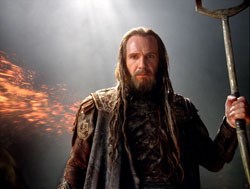
Ralph Fiennes as Hades
The anti-religiosity of the original is accentuated here as the heroes constantly warn one another against the danger of praying to any of the gods—especially, as the soldiers are tempted to do, to Ares, since to do so will only alert Ares to their location and summon him to kill them.
The Greco-Roman gods were always petty, capricious deities unworthy of worship. On the other hand, it's probably better to worship anything than to worship nothing—and the overall thrust of the Wrath/Clash movies is that mankind is outgrowing their dependence on any higher power. "There will be no more gods, no more sacrifice," intones Zeus. Funny, I'm pretty sure the twilight of the gods was followed by a new day of faith in the light of a rising Son.
Talk About It
Discussion starters
Which do you like better, the new Clash/Wrath movies or the original Clash of the Titans? Why?
Is Perseus an admirable hero? Why or why not?
In one scene, Perseus tells a healer, "Just fix my body, and leave my soul to me." Hades bitterly tells Zeus, "When your beloved humans die, at least their souls go to another place. When gods die, it isn't death—it's oblivion." Yet the film also suggests that religion is dying. Is this a contradiction? What sort of worldview does it suggest?
Where do you suppose souls would go in the world of these movies? Do we see any souls in any underworld realm? If Hades exists, one might think souls go to Hades—but if Hades himself goes to oblivion, would there still be a Hades for souls to go to?
One character describes humans this way: "We hope when there is no hope. We believe even when it's idiotic to believe. Yet somehow we prevail." How does this compare or contrast to the Christian ideas of faith and hope?
The Family Corner
For parents to consider
Wrath of the Titans is rated PG-13 for intense sequences of fantasy violence. It's replete with monster menace and video game-style combat scenes pitting men against monsters and demons, as well as god-on-god and god-on-man violence. In one sequence Ares stabs and kills a pleading female soldier who made the mistake of praying to him. A number of gods die and crumble into sand. We see Perseus being stitched up after a battle, and in another scene an amputee with a bandaged leg stump receives medical care. One character mentions having been taught the secret of seducing mermaids.















 While we pray for peace, we need moral clarity about this war.
 A Christian reconciliation group in Israel and Palestine warned that war would come. Now the war threatens their relevance.العربيةFrançais
 The Grammy-winning artist was found dead at her home in Nashville at age 47.