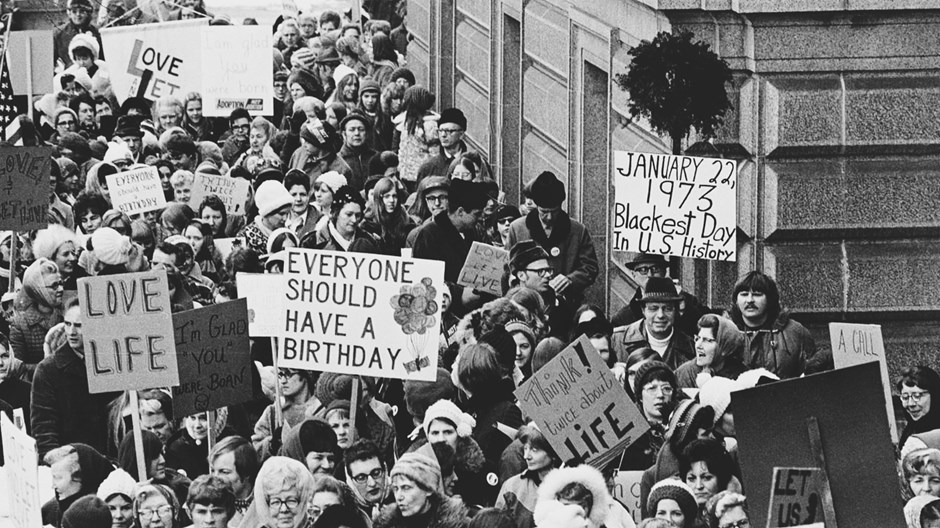
Evangelicals came to their current views on abortion through a combination of ethical reasoning, biblical hermeneutics, historical research, theological reflection, and contemporary American politics. That was my argument in a recent post, which was a response to a post by Jonathan Dudley at CNN. Dudley has just published a well-researched response in The Huffington Post that deserves a response, though I'd like to raise issues that underlie this conversation.
But let me admit that Dudley did catch me committing hyperbole. The title of my response referred to his CNN post as a "fake history." It's certainly not "fake" in this respect: Evangelicals were in fact divided, and many if not most of our leaders were formally "pro-choice" in the 1960s and 1970s. I do not mean to suggest that Dudley's argument in this respect is wrong.
I do think it is misleading in some respects, but that is to be expected when one is trying to do history in a column-length format. To call early evangelicals "pro-choice" in today's context implies that they held pro-choice views in the same spirit as many pro-choice advocates do today. Dudley is correct is suggesting that some pro-choice advocates do indeed believe that the fetus has moral value, and that they don't necessarily think abortion is the principal answer to the control of human reproduction—my apologies if I implied otherwise. The problem is that a large part of the pro-choice community—which includes millions beyond the United States—do indeed fail to see that the fetus has moral value, and do indeed champion abortion as just another method of birth control. This must be the subject of another essay, but the astonishing rate at which girls are aborted merely because of their gender (the United Nations estimates that as many as 200 million girls are missing because of this) suggests that entire nations are turning a blind eye to moral value of these lives. 1960s evangelicals were often pro-choice, yes, but the framework in which they held that position—when abortion was rare and exceptional—no longer pertains. Today pro-choice advocates stubbornly hold on to their views when abortion is no longer rare (over a million children are aborted every year in the United States alone) or exceptional (and practically government policy in some places), and the practice has led to a brutal gendercide.
As I noted in my last essay, only when Northern Christians discovered how absolutely horrific slavery was did they change or harden their views about slavery. Likewise to say evangelicals were pro-choice at a different time and different historical setting, while true, does not convey accurately the context in which those beliefs were held. One reason many evangelicals converted to the pro-life camp is because they finally recognized the terrible and inevitable consequences of pro-choice policy.
That being said, one part of Dudley's argument feels "fake," to me because, as a fully accurate title would have it, "it is incomplete to such a degree as to seriously misunderstand the reality." (But that makes for very bad title copy, no?). Seriously: Dudley's argument is grounded in a worldview that is reductionistic—that is, he argues that it was politics and really nothing else that tipped the scales for evangelical beliefs about abortion, and for their interpretation of Scripture. As I've suggested: Who can quarrel with the simple fact that abortion politics helped shape evangelical opinion and biblical exegesis?
But after noting how hard it was for early evangelical abortion foes to get their fellow evangelicals to take abortion more seriously, Dudley says, "In 1980, Falwell used his unparalleled platform to change all that" [italics added]. He went on:
Declaring that "[t]he Bible clearly teaches that life begins at conception," he allied with like-minded evangelicals to disseminate that interpretation across America. Falwell's assertion that this position was the obvious one in Scripture necessarily implied that the host of intelligent, pious evangelicals who came before him just didn't read their Bibles closely enough. It also made the Bible say the same thing his Catholic political allies believed (though Catholics believed it for other reasons).Although this was politically convenient, Falwell's interpretations were just as much a product of his time as those of his evangelical predecessors.
To begin with, this paragraph imagines that evangelicals are mindless drones who blindly follow the lead of any charismatic figure in our midst: Falwell asserts that the Bible says X about abortion, and every evangelical falls into line. The assumption is laughable. If anything, if a charismatic leader declares the Bible says X, two new evangelical movements and four new denominations will form to refute that interpretation! In other words, to use an old analogy, it's as easy to get evangelicals to rally around a common biblical interpretation as it is to herd cats. When it happens, it's pretty much a miracle.
Article continues below
I can speak with personal knowledge of large swaths of evangelical leaders and groups who had little-to-no sympathy for Jerry Falwell—some of us were deeply hostile to him and his politics and many of his biblical views. Many of us were living in a parallel universe, coming to see the evils of abortion in our way.
Take the previous editor in chief of Christianity Today, David Neff. In an email, he writes,
I know that my own conversion on the abortion issue was not at all influenced by Jerry Falwell or by Franky Schaeffer. It was influenced by C. Everett Koop and by Michael Gorman's InterVarsity Press book, Abortion and the Early Church. Koop provided a cultural argument and Gorman grounded it firmly in the Christian tradition.
Dudley fails to realize how many key evangelical leaders were going through this same process of conversion as was Neff. It was not politics but ethics, history, and a fresh look at Scripture that tipped the scales.
Layers of Biblical Teaching
In saying that evangelical views on abortion are "a product of his time," Dudley implies that the new biblical teaching was and is utterly relative: "It's harder to argue the Bible clearly teaches something when the overwhelming majority of its past interpreters didn't read the Bible that way." Let's think about this assumption for a bit.
First, all interpretations of the Bible are products of their time. All ethical reasoning is a product of its time. This is such a truism as to be hardly worth stating. All ethical standards arise out of a particular time and place, and cannot be fully understood without understanding those circumstances. But the fact that the Bill of Rights, to take one example, is a product of its time does not have much bearing on whether the rights enshrined there have lasting or even eternal value. But it does say that it took a particular constellation of events for the lasting and eternal value of human rights to be recognized.
Christians often have to wait for history to unfold before we recognize important biblical truths. Human rights is an example. The Bible does not use rights language, and so naturally, it would have been hard at first to grasp how the Bible could be a great, if not the greatest human rights document. But a closer look reveals some implicit biblical rights: The commandment to not steal assumes the right to property. The commandment to not kill assumes the right to life. The teaching that we are created in the image of God argues for the intrinsic value of human beings. And so on and so forth. That Christians now champion human rights across the globe and ground their efforts in their reading of Scripture—well, it simply illustrates the many levels of the Bible and its teachings. It's no wonder that this book remains a source of inspiration to billions, and no wonder that sometimes historical events have to unfold before we can see some of its deeper truths. That's how great literature works, and the Bible is certainly that, and for some of us much more.
Article continues below
That being said, it is fair to say that the Bible does not teach that "life begins at conception." We cannot find a verse that puts it so simply and clearly. But evangelicals are not wooden literalists. We firmly believe for example, that Jesus was "true God and true man," and that God exists as a "Trinity," "three persons" of "one being." None of that precise theological language is found in the Bible. But taking the teaching of Scripture as a whole and trying to understand what it claims about Jesus and God, we have found that this Trinitarian language a very good summary of what the Bible teaches.
In line with Dudley's historiography, a school of interpretation has arisen to suggest that the Trinitarian conclusions at the Council of Nicaea were driven not by theology or Scripture as much as church and imperial politics. Ramsey MacMullen's Voting About God in Early Church Councilsis a scholarly example, and Richard Rubenstein's When Jesus Became God: The Epic Fight over Christ's Divinity in the Last Days of Romeis a popular example. As one commenter on Amazon.com says about MacMullen's book, "So in the Christian patristic era, truth was determined by majority vote." Despite the cynicism, such books helpfully draw out themes that have been sometimes neglected by more pious historians.
While such histories do us a great service—reminding us of how God uses the messiness of history to accomplish his will—they do not really speak to the matter of providence or the validity of a particular theological truth. Christians--who appreciate the doctrines of sin, incarnation, and grace—are not surprised that the church has been rampant with politics and coercion, that many doctrines arose in particular times and places, and in rather ugly ways at that. What's remarkable is that God has continued to use this rather messy business to accomplish so much good.
Article continues below
Abortion in the Bible
The Bible teaches that God forms us in the womb (Job 31:15, Ps. 139:13) and affirms the value of human life ("You shall not murder"). The great tradition of the church has from the beginning condemned the evil of abortion; for example, The Didache, written in the first century, is one of dozens of early church documents that explicitly rule out abortion for believers. So, it's hardly a stretch for Christians to conclude that perhaps life begins at conception. Christians of good conscience can disagree about when exactly human life begins, but the vast majority of Christians, Catholic and Orthodox and Protestant, across long stretches of time (2 millennia) have said that abortion is a grave evil, and grounded that in their interpretation of the biblical command that forbids murder. The remarkable historical thing is not that evangelicals came to believe this, but that at one time many didn't believe it. One reason they didn't believe it was because, well, it was a Catholic thing. But once they began to appreciate the teachings and resources of this great tradition, they could see and appreciate those theological and biblical arguments afresh.
Dudley says he was trying to prove that it is "apparent" that our current views on abortion are merely due to our social/political conservatism, and that this "unacknowledged worldview, and not the Bible" is what we "are actually defending." First he fails to note that progressive evangelicals are also ardently prolife. But second, he simply fails to prove his point even about conservatives. He has only shown that many 1960s evangelicals were pro-choice, and that for some evangelicals the Religious Right played a role in their conversion to pro-life. Points taken. But he fails to appreciate the complexity of human motives and the variety of historical forces that make for large social changes such as this one.
He also thinks he's proven that knowing the historical provenance of an ethical truth in itself makes that truth relative and time bound. This is a philosophical and not a historical assumption, and of course, he's failed to prove it or even discuss it. And yet his essay hinges on whether history and ethics relate to one another like this.
I grant that there are biblical, theological, and ethical arguments about evangelical pro-life exegesis worth debating. But I fail to see how this historical argument, especially one cast in such a narrow political way, is germane. It only tells us that there has been a recent change, and assumes that this change was arbitrary and bad. It certainly cannot imagine that we've witnessed recently another stellar historical moment, when one more people finally grasped the preciousness of all human life.













 While we pray for peace, we need moral clarity about this war.
 As my doubts about his teachings grew, so did a secret fascination with Jesus.
 NIL deals in college athletics present new challenges—and opportunities—for colleges and students.





