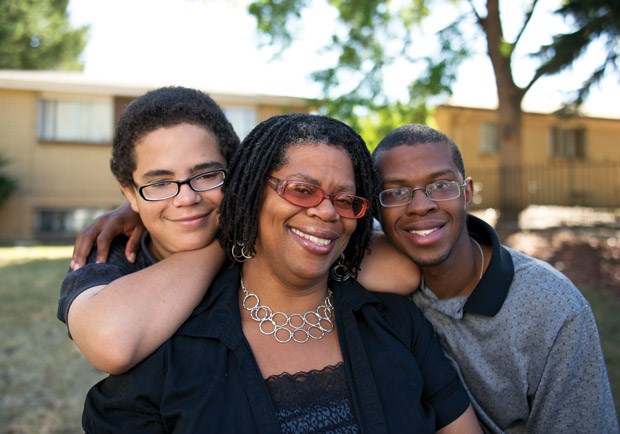
When Kimberly Banks unexpectedly lost her job in 2006 and her job search stretched from weeks to months, she became despondent. Living in a Denver motel, she would frequently wake at 3 A.M. and cry out to God in prayer as her two sons slept soundly nearby. "I was always a woman who said I can take care of my own. There were some nights that I didn't want to keep living because I felt like less than a mother, like my kids were better off somewhere else," Banks recalls. "I didn't know what to do."
But getting involved with Denver's innovative Family and Senior Homeless Initiative (FSHI) changed all of that. Banks was matched with a mentoring team from a local church. They met regularly for financial counseling, support, and encouragement. The church paid the first month's deposit on an apartment and helped her furnish it.
A year later, the outlook for the Banks family was hugely brighter. Banks started college full-time and she didn't have to move. Success stories like hers give FSHI leaders reason to think their ministry model could be useful in solving the nation's growing problem of family homelessness.
In the past seven years, the initiative has helped about 1,100 families, beating its original milestone of aiding 1,000 in 10 years. Some 86 percent of the families who take part in the initiative still have the same housing after one year.
"It's almost double the average," says Colorado governor John Hickenlooper, who was mayor of Denver in 2005 when he and religious leaders launched the program. "Look at the bang for the buck. This is one of the highest-yield philanthropic activities you can do."
Rising Homelessness
Word of FSHI's success has spread beyond Colorado. Since the recession of 2008, underlying causes of homelessness have changed. The number of homeless families nationwide grew 30 percent between 2007 and 2011, says Dennis Culhane, a University of Pennsylvania professor who has studied homeless populations for 24 years.
Job loss, major medical expenses, or both are top reasons why heads of households and their dependent children become homeless. Rather than go to a shelter, many families seek to "double up." But that only works for so long.
Prior to 2008, being homeless was more an affliction for single adults without jobs or children. Not anymore. The Metropolitan Denver Homeless Initiative's 2012 "Point in Time" report (a one-day survey conducted every January) revealed that the total homeless population not only grew, but two-thirds are now from families, a sizable shift from the 2005 report, when 60 percent were single adults without children.
One case in point is Shawnee Fleming, a Denver resident. She lost her job as an office manager of a health-care billing business in late 2008. Despite her best efforts to keep herself and her preteen twin daughters in housing the following year, Fleming found herself in a shelter on Christmas Eve 2009. While the daughters lived temporarily with their father, Fleming "doubled up," staying on couches with family and friends.
Those welcomes eventually ran out. Fleming looked frantically for a full-time job, while doing in-home nursing and selling perfume along the way. When the city's seventh-coldest December on record unfolded, she was forced out of her car and into a shelter.
After making contact with FSHI, Fleming and her daughters moved into an apartment. She still works as an in-home nurse, but she's applying for financial aid to take classes for a job in medical billing and coding. "God just opened doors," she says.
Stories like Fleming's show FSHI fills an urgent need, says Don Reeverts, president of the Denver Leadership Foundation, an influential civic group. Reeverts worked closely with Hickenlooper to get FSHI off the ground. "The kernel of the idea came before the tsunami of economic crisis," says Reeverts. "We have people who never dreamt they would be on the streets. If we hadn't done this, it would have been a disaster."
Since its launch, FSHI has fielded inquiries from cities nationwide, including ones in Tennessee, South Dakota, Florida, and Virginia. All have undertaken efforts similar to the FSHI model. Earlier this year, Memphis leaders launched a program modeled after FSHI. In that Tennessee city, family homelessness is driven by lack of education, inadequate job training, and weak support networks for families.
Colorado plans to roll out FSHI-inspired programs statewide. "It's presenting a huge open door to the local church," says Brad Hopkins, FSHI's director. "There's a crisis, partly economic, partly the breakup of the family. There's a greater sense of urgency to mobilize the church to intersect with this need."
'Magic in the Bottle'
A key turning point in addressing homelessness occurred back in 2005. Cities were abuzz over the vision of Philip Mangano, then executive director of the federal Interagency Council on Homelessness. Mangano called on policymakers to end, not manage, homelessness in 10 years.
Article continues below
In the Mile High City, the response was "Denver's Road Home," a large-scale plan linking together agencies, nonprofits, and organizations toward that ambitious goal. As Hickenlooper headed to the Colorado Prayer Luncheon that year, he considered ways for the region's religious community to collaborate more completely in helping needy families. A 2005 research report revealed that more than 1,000 Denver families had recently stayed with family or friends, rented cheap motel rooms, or slept in cars or under bridges.
Hickenlooper wondered whether every church, synagogue, and mosque would volunteer to mentor one homeless family each. Reeverts signed on to Hickenlooper's idea and organized a group of clergy. Within weeks, Protestant, Catholic, Jewish, and Islamic leaders agreed to serve as an oversight council.
Attention quickly turned to the Denver Rescue Mission, a full-service, evangelical agency for the homeless since 1892. In the mid-1990s, the mission had taken under its wing an outreach program for homeless families. Brad Meuli, the rescue mission's chief executive, agreed to use that program as the infrastructure for FSHI. Reeverts says this dynamic alliance formed between city leaders, clergy leaders, and the rescue mission is "magic in the bottle" to overcome homelessness.
FSHI's community coordinator, L. Shawn DeBerry, herself an ordained minister, helps keep everything coordinated at the grassroots. "You pull from sources, depending on what you need," she says. Requests from a needy family might go in any number of directions since there are such a large variety of resources linked together. This approach, unmatched on this scale anywhere in the country, brought strong results. More than 350 churches, seven synagogues, and one mosque are involved; together they hope to help 500 additional families by 2015.
The program's overall cost is $475,000 a year, with $170,000 paid by the city to fund staffing; the rest is obtained from federal sources, grants, and money that the Denver Rescue Mission raises.
New Relationships
FSHI director Hopkins, a graduate of Dallas Theological Seminary, was drawn to work at the Denver Rescue Mission in part because of the famous "Jesus Saves" marquee at its downtown location.
Article continues below
A significant challenge for evangelicals is that FSHI, like other government programs, prohibits volunteer mentors or staff from proselytizing. Mentors can discuss spiritual matters only if the family brings them up. This stipulation put leaders of non-Christian faiths more at ease, broadening the overall reach. There has been tension over where to draw the program lines and a few groups dropped out over time. But that's rare.
'Look at the bang for the buck. This is one of the highest-yield philanthropic activities you can do.'—John Hickenlooper, governor of Colorado
Leaders from other faiths say the program works. "Because it's each individual congregation's effort that is coordinated through the rescue mission, you don't have to get involved with anything interdenominational," says Rabbi Joel Schwartzman, a Denver clergy council member whose synagogue is involved. The program motto is "One Congregation, One Family."
As the program grew, new relationships between Denver's Christians, Jews, and Muslims also emerged. Homeless families and civic leaders gained favorable impressions of church leaders.
"From a broad-based perspective, the city can't favor one faith over another," Hopkins says. "We're trusting God to do his work through us. The Denver Rescue Mission is involved because we knew churches would step up."
Congregations recruit volunteers and with FSHI assistance, screen, train, and place them into teams. Volunteers agree to mentor at least one family, although many take on more. Mentor teams are paired with a family that FSHI has already selected. Over six months, the mentors meet with the family at least seven times, providing financial counseling, parenting tips, and encouragement.
In return, the family in need receives $1,200 upfront from the church (alternative funding is available to churches that can't provide it) to pay the first month's rent and a security deposit. The program provides families additional incentives, such as grocery gift cards, upon completion of counseling, and again after a year if the family remains in its housing.
"Relationship really is the overall goal," DeBerry says. "When you live out what you say you believe in, in front of a family that's hopeless, and you say you have hope, it transfers."
When healthy mentoring relationships are formed, everyone benefits. A Denver couple, Pat Long and her husband, Jim, became mentors six years ago. Active at the Greenwood Community Church, the couple teamed with two other women from their Bible study to mentor a young single mom. The woman had a daughter who was 8 years old at that time. Both had been abused at the home where they were living. When they fled that situation, they became homeless.
Article continues below
"Our expectation was we'll go in, get her into housing, do the six or eight meetings, and that would be it," says Long, a retired schoolteacher.
The woman soaked up the financial counseling and parental guidance. Six months came and went. The woman asked to keep meeting. Five years later, they still do. The woman recently bought her first home. She expresses interest in their faith, Long says, and they have found a church that she hopes she will try soon. "We've helped her, but boy, we've learned a lot," Long says. "She's certainly enriched our lives."
For pastors, FSHI presents an ongoing way to empower everyday Christians to put their faith in action, says Tom Melton, senior pastor of Greenwood Community. "The mentors often say they are the ones who are blessed," Melton says. "In that atmosphere, the Lord has unique ways of working."
Spiritual Reawakening
Looking back over the past six years, Kimberly Banks has seen enormous change in her own life. She was skeptical before meeting her FSHI mentors. "I was very proud as a black woman. I wanted to do it myself and not get anyone's help," she says.
But her boys told her it was worth a try. Banks says that by the end of their first meeting at a McDonald's restaurant, "I couldn't hold back the tears. People just wanted to help us. Not for any reason, but just to help."
Banks, 43, spent years working in the food service and hospitality industries. When she filed a sexual harassment claim against a co-worker, she was let go a few months later. The mentoring program helped her begin anew. The men from the mentoring team took her boys on fishing trips and to Air Force football games, while the women counseled and encouraged her as she pieced her life back together. She still calls them her "moms."
By 2008, she says, she started to reawaken spiritually. Now she and the boys are active in Prince of Peace Church of God in Christ in Aurora, Colorado. She's pursuing studies that will help her go into ministry, and she regularly counsels women and families living at the Crossing, the Denver Rescue Mission's transitional housing community.
"Now that I look back, I can say, 'God, you were working on me the whole time. I'm not ashamed to tell people I was homeless. It's going to bring somebody else up,'?" Banks says. "The glory of God has to be put out there."
Matt Branaugh is director of editorial for Christianity Today's Church Law & Tax Group.
Have something to add about this? See something we missed? Share your feedback here.
















 While we pray for peace, we need moral clarity about this war.
 We’ve got little information on Jesus’ appearance and personality. But that’s the way God designed it.españolFrançais
 After lobbying from fellow Southern Baptists and Christians affected by the war, the House speaker moves a package forward.






