God is science. If you're a man of science, then [science] is the only faith we need." Since a character uttered those words three seasons ago on Fringe, now in its final season on Fox (Fridays, 9/8c), the crime show spent its first four seasons crafting an engrossing and personal rebuttal of that declaration.
Last season's finale—which one critic called the show's "ultimate statement on scientific hubris"—made it clear that Fringe's main arc was always about the motivations and consequences of playing God. As the series ends, it will be remembered as perhaps the most captivating and nuanced exploration of science and faith ever shown on television.
Having made that ultimate statement on the arrogance of playing God,Fringehas now moved onto a short 13-episode final season where the show has completely switched gears—"freezing" its characters for more than 20 years in a strange substance to awaken them in a totalitarian society where they are the world's only hope.
Co-creator J. J. Abrams (Alias, Lost) conceived Fringe as a marriage between mythology- heavy but ratings-light serials (the kind you have to watch every week to keep up) and Nielsen-juggernaut crime procedurals (the kind you can jump in at any time and still "get" it). Fringe had decent ratings the first year, but as the show moved from cleanly-resolved crime-of-the-week episodes into deeper, serialized mythology, the ratings began to slip. Fox kept Fringe on the air thanks to critical praise, a cult following, and hopes of reaching the traditional threshold of 100 episodes for syndication—thus earning back some of its lost money. (The finale will be episode number 100.)Now that it no longer has to make good ratings to survive, Fringe has gone off the rails into deep mythology—with no sign of it's old case-of-the-week structure.
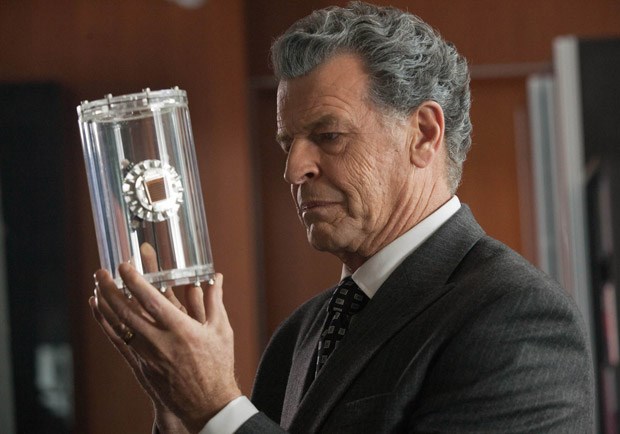
For the first four seasons, Fringe followed a federal task force called the Fringe Division, which investigated crimes committed by "mad scientists" who crossed moral lines by abusing peripheral sciences like nanotechnology, parallel universes, and psychokinesis. FBI agent Olivia Dunham (Anna Torv) led the team, assisted by eccentric scientific genius Walter Bishop (John Noble) and his jack-of-all-trades son, Peter (Joshua Jackson).
Unlike a typical crime show, Fringe's bad guys weren't itching to get rich or take over the world. Instead, the villains were a parade of broken people trying to control things that humans normally can't—in essence, trying to play God. A clear message: the use (or misuse) of any gift or ability begins in the heart, with all of its motives and emotions—pure or otherwise.
At the center of it all was Walter Bishop, a reformed mad scientist with a conscience—and a poignant foil to each week's baddie. Humbled, broken, and seeking forgiveness for a long-ago trespass, Bishop now uses his mind for good. But 20 years ago, he was arrogant, convinced that anything the human race could achieve should be achieved. He believed his intellect made him a god; morals had nothing to do with science. When wrecked by terrible tragedy, Bishop used his knowledge of parallel universes to commit a heart-wrenchingly awful act—and it changed him. "Before [that], I had never believed in God," he later revealed. "But it occurred to me …that my actions had betrayed him."
Eventually, Bishop swings from hating God for letting bad things happen to desiring his forgiveness, pledging to never violate his will again. Today's Bishop, then, is defined by a self-imposed penance—and a startling twist on Jesus' metaphor of plucking out your eye if it causes you to sin.
Bishop's journey came full circle last season when a former lab mate—out of personal pain and spite for God—brought to fruition unthinkable ideas spewed by the old Bishop. "I grew cancer," said the former colleague. "And [if] God made us in his image—if we are capable of being gods—then it is our destiny to do so."
The man wasn't merely playing God; he believed he was God. Such is the man that Bishop—who once believed that science was "the only faith we need"—might have become. But, Walter Bishop eventually learned the fallacy of such thinking and discovered the necessity of faith—in loved ones, in self, and in a creator. And while the show has changed gears in its final adventure, there are hints that it will again display how technology and science—with our inner demons behind the wheel—can drive us to go to unthinkable lengths for control, for power, for revenge.
But once again, I suspect Walter Bishop's hope, love, and faith will win the day.
Have something to add about this? See something we missed? Share your feedback here.
















 While we pray for peace, we need moral clarity about this war.
 We’ve got little information on Jesus’ appearance and personality. But that’s the way God designed it.españolFrançais
 The founder of Concerned Women for America was credited by President Ronald Reagan with “changing the face of American politics.”






