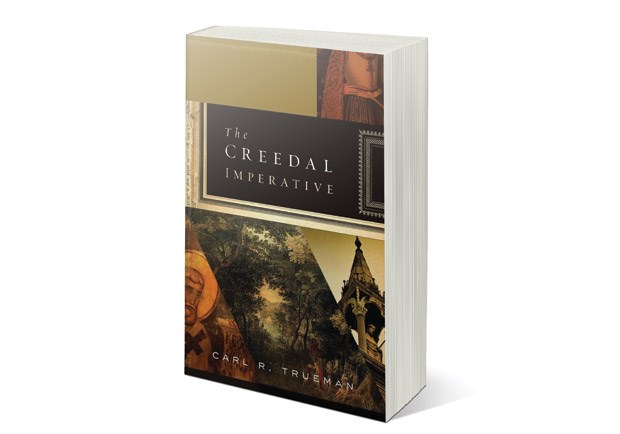
Our church has a need for a creed. In The Creedal Imperative (Crossway), Westminster Theological Seminary's Carl R. Trueman presses the case that "creeds and confessions are vital to the present and future well-being of the church."
It's not just that a creed (a public, established statement of a church's most important beliefs) is a useful tool for teaching doctrine, holding leaders accountable, defining the boundaries of church membership or cooperation among churches, and telling the world what a church stands for. Creeds do all that. But this book is not about the handy helpfulness of creeds; it's about the creedal imperative. A church that obeys the Bible should follow the injunction of the apostle Paul's pastoral epistles to Timothy, and resolve to guard "a form of sound words transmitted by eldership … ensuring good management of the household of God."
Trueman builds up this biblical case for creeds, layers over it the historical case from both the patristic church and confessional Protestantism, and puts the burden of proof on what he calls the "'No Creed but the Bible!' brigade." Given this biblical and historical trajectory of churches using creeds, "the question is not so much 'Should we use them?' as 'Why would we not use them?'"
Trueman acknowledges that there is a case to be made against creedalism, but he thinks that case is spurious because it is entirely cultural: The spirit of our age ignores history, distrusts institutions, values emotions more than words, and hankers after novelty. For moderns, the loftiest goal is to be authentic, to speak spontaneously from the heart, giving voice to unique insights from our own points of view. For this mindset, the idea of reciting a set of ancient words in public agreement with a group is, if the word be allowed, anathema.
As a result, anti-creedal evangelicalism is, ironically, "not countercultural, but culturally enslaved." Trueman is passionate and eloquent about how creeds enable churches to dig in their heels and stand with the great tradition, pushing against the modern temperament.
One of Trueman's most deft arguments is that every Christian and every church already has a creed in the sense that they all "think the Bible means something and that its teaching can be summarized" in different words.
He continues, "The only difference is whether one writes the confession down, so that others may scrutinize it and judge whether its teaching is consistent with Scripture, or whether one refuses to do so, in which case one's beliefs are essentially identified with the teaching of Scripture and placed above such scrutiny."
It is the anti-creedalist, in other words, who trumps the Bible with an unassailable (because unstated) tradition.
Ironies like this are delicious to the already persuaded, but they are unlikely to change minds. Trueman almost always avoids what he calls the "rather distasteful, not to mention sinful, tendency among many confessional writers to look down with scorn and derision on those who are not confessional." But he does lecture from a rather high seat, and at times he makes it clear that all God's ways tend toward a good Presbyterian church.
But what about evangelicals not already convinced by confessionalism? Perhaps, for them, the most helpful parts of The Creedal Imperative will be the section on the biblical foundations of creedalism and the delightful chapter on "confession as praise." Trueman's fine book may actually give them a glimpse of the high helpfulness, if not the necessity, of creeds.


















 While we pray for peace, we need moral clarity about this war.
 As my doubts about his teachings grew, so did a secret fascination with Jesus.
 Beyoncé’s right. Whether listening to Cowboy Carter or reading theology, diversity is a good thing.






