A Free People's Suicide: Sustainable Freedom and the American Future
Author
Os Guinness
Publisher
IVP
Release Date
July 10, 2012
Pages
224
Price
13.37
A Free People's Suicide: Sustainable Freedom and the American Future (InterVarsity Press) is what the old Puritan divines used to call a jeremiad. Which means that it is a thundering indictment of a congregation—in this case, modern Americans, all 300 million or so of them—for backsliding from their first principles, tinged with glimpses of what horrendous results are likely to follow, but closing with the assurance that because only those who have grace can fall from it, restoration is possible if a specified regimen of repentance is followed.
Surprisingly for author Os Guinness, who wears the mantle of his one-time mentor, Francis Schaeffer, as an evangelical cultural critic, this is not a book about restoring Christianity. (Jesus Christ is actually remarkable for his absence from it.) It is about what Guinness calls sustainable freedom, and restoring the republican political vision of the 18th century. What Guinness means by sustainable is easier to discern than what he means by freedom, since it's not until fully one-third of the book has passed us by that a workable definition of freedom appears. Even then, it's couched simply in terms of the polarity described by Isaiah Berlin, of negative and positive liberty (negative liberty being freedom from restraint, and positive liberty being the freedom for accomplishing what is right). What has created a crisis—a "day of reckoning"—for the American political system has been a falling-away from the intricate balance of negative and positive liberty embodied in the U.S. Constitution.
On the one hand, argues Guinness, the Constitution created a negative framework of laws which was designed largely to prevent massive and threatening concentrations of power in the new federal government (whether in the executive, the legislature, or the judiciary). But the authors of the Constitution also expected that citizens of the republic would infuse the negative-liberty scaffolding of the Constitution with a positive-liberty sense of civic obligation and self-denying virtue. The first would prevent concentrations of power; the second, by popular agreement, would prevent any remaining concentrations of power from becoming morally leprous. All this has now gone by the boards, Guinness complains. Freedom has now become exclusively construed as negative liberty, in the form of an enervating moral hedonism and a rampant consumerism which conceals its lust for power behind a bleat for "free markets."
This neatly positions Guinness to call a bipartisan pox down on all the modern political houses—Democratic, Republican, Libertarians, Occupiers—and to a small degree, he does lay the switch heavily on big corporations, the imperial arrogance of "regime change," government-sponsored "faith based initiatives," and even credit cards. This much will gladden the hearts of Jim Wallis and Tony Campolo. But the real fire in Guinness's boilers is lit by his heartfelt resentment at the slow drift of Americans from a democratic republic into the "soft despotism" of the nanny-state. He has no use for the cultured despisers of the Constitution and American history, and even less for the secularists who struggle to create the perfect social democracy where everybody has to be fed and nobody has to be good. And though Guinness names no names, Left evangelicals, for whom compassion serves mostly as a vehicle for acquiring elite prestige and good bookings, will understand that Guinness sees them as a problem more than a solution.
The Danger of Forgetfulness
Guinness is not a historian, although his book is littered with Cassandra-like quotations from Cicero, Burke, Montesquieu, Churchill, Polybius, John Adams, Thomas Jefferson and Patrick Henry. Even the title is a historical allusion, to Abraham Lincoln's 1838 Lyceum Address, warning that the chief threat to American liberty would come, not from "some transatlantic military giant," but from within. "If destruction be our lot, we must ourselves be its author and finisher. As a nation of freemen, we must live through all time, or die by suicide."
The operative danger, for Guinness as for Lincoln, is forgetfulness. Americans, lamented Lincoln, used to have "a living history" all around them, in the form of the veterans of the Revolution, who "could be read and understood alike by all, the wise and the ignorant, the learned and the unlearned." In 1838, the problem was that this "living history" was dying off. "What invading foe‑men could never do, the silent artillery of time has done." In our times, the forgetfulness is less accidental. Public schools confect curriculums built out of the cotton-candy of self-esteem, guided by grotesque legislative mandates which assume that the principal aim of schooling is the production of worker-bees. Politicians hungry for power dismiss constitutional restraint as inefficient gridlock. University faculties in search of novelty (or egged on by envy) make students ashamed that they ever pledged allegiance to a flag so deeply dyed in oppression, exploitation, and racism. With friends like this in their midst, Guinness proclaims, Americans do not need enemies.
Article continues below
What we need, he continues, is that good old constitutional religion: civic education, a civil public square, and a virtuous dedication of citizens to the common good. Yea and amen, I say: and yet there remains the nagging fact that Lincoln was worried about these problems in 1838, and the republic somehow survived them long enough for Os Guinness to be worried about them again in 2012. There have been jeremiads about American decline in circulation since George Washington's first term as President; no one, in fact, was better at ginning up head-wagging over America's shortcomings than the Progressives, in order to persuade us that American society had become too complex and interdependent to be ordered by an 18th-century constitution. Yet, we muddled through them, and a monstrous civil war, pretty much intact. When does the jeremiad become simple crying-wolf?
The Complications of Freedom and Virtue
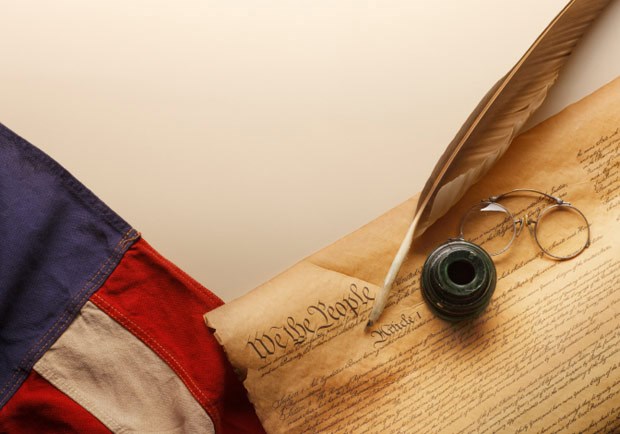
It is not difficult to sympathize with Guinness's anger that virtue has been eliminated from most descriptions of the good society, to be replaced by the self-serving immorality of the feel-good society. But Guinness has less room for complaint than he realizes, since he never identifies what he means by virtue in the first place. I can suspect, and even agree with, what forms the substance of that virtue. But Guinness should know as well as anyone else that American Christianity has been too fissiparous to take over that role publicly, which leaves "virtue" to become a kind of lowest-common-moral-denominator system of ethics, a religion which dare not name itself. Nor is Guinness entirely correct to suggest that the Founders expected virtue to walk hand-in-hand with the Constitution as its enforcer. The Constitution says absolutely nothing about virtue, and its principal architect had been so well-schooled in Calvinist notions of original sin and total depravity that he had no confidence that virtue had the strength to beat out self-interest. This is why the Constitution is not a charter of virtue, but a cantilever of self-interest against self-interest, so that by canceling each other out, the people would be left unmolested to pursue virtue by their own lights.
Article continues below
In that respect, Guinness is correct to see the Constitution of 1789 as very much a document of negative liberty. "Those who won our independence," observed Justice Brandeis, "believed that the final end of the State was to make men free to develop their faculties," not to develop those faculties for them or to arbitrate which faculties deserved cultivation. Nor is the cultivation of negative liberty the only demon at work in our present discontents. The Progressive Party's platform of 1912, and Franklin Roosevelt's "Second Bill of Rights" are very much documents of positive liberty—and a very tightly prescribed, rigidly bureaucratic liberty at that, fed by a tempting stew of entitlements and redistribution, and of just the sort Guinness deplores.
This is not, however, the same thing as saying that the American people can get along nicely without any concern for virtue; merely that government is no more the proper agency of arriving at the virtuous society than a drunk is the proper host for a wine-tasting. People look to government because the problems of mass society seem so far beyond the ability of individuals to cope with that nothing less than government's great hand can impose order and efficiency upon them. That might have been a permissible conclusion in the heyday of Progressivism. But every decade since World War II has testified that governments are actually clumsy and single-size in their prescriptions, and their intervention comes at the cost of aggrandizing power to themselves. Anyone who imagines that governments exist to create benevolence, efficiency, compassion, and fairness is deliberately refusing to see (with Shakespeare's Macbeth) Great Birnam Wood in motion toward high Dunsinane Hill.
Freedom is not, as Lincoln insisted in his great debates with Stephen A. Douglas, merely an end in itself; it is a means to realizing the fullest possible exercise of our natural rights to life, liberty, and the pursuit of happiness. This was why Lincoln was so appalled at Douglas's dictum that he did not care whether slavery was voted up or voted down, so long as the vote was legal. That, for Lincoln, was the death of democracy, not its health. Guinness is not wrong to be possessed of the same urgency. One could only wish that he had been better informed historically, had waded deeper into the complications of freedom and virtue, identified more clearly what must be done, and perhaps even named a few names.
Allen C. Guelzo is the Henry R. Luce III Professor of the Civil War Era and director of Civil War Era Studies at Gettysburg College. He is the author, most recently, of Fateful Lightning: A New History of the Civil War and Reconstruction (Oxford University Press).
Our Rating
Book Title
A Free People's Suicide: Sustainable Freedom and the American Future















 While we pray for peace, we need moral clarity about this war.
 As my doubts about his teachings grew, so did a secret fascination with Jesus.
 Beyoncé’s right. Whether listening to Cowboy Carter or reading theology, diversity is a good thing.





