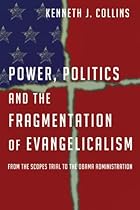
Power, Politics and the Fragmentation of Evangelicalism: From the Scopes Trial to the Obama Administration
Author
Kenneth J. Collins
Publisher
IVP Academic
Release Date
August 27, 2012
Pages
299
Price
5.49
We are neck deep in yet another general election season, and religion is again playing a prime role in shaping the political conversation. Despite the focus both campaigns have given to the flagging economy, issues of religious value and liberty continue to simmer below the surface. And evangelicals again find themselves in the thick of things, whether it's evangelical colleges suing the federal government over mandated coverage of birth control, an evangelical congressman injudiciously clarifying his unyielding stance on abortion, or the entire evangelical electorate facing the (overwhelmingly likely) prospect of giving the lion's share of its vote to a prominent Mormon bishop instead of to the only avowed Protestant on either ticket. Love them or hate them, no one can doubt that American evangelicals are an enmeshed feature of American politics.
Especially since the 1976 election of "born again" Baptist Jimmy Carter, a great many books have been written trying to understand the quality and character of evangelical activism in American public life. The latest such book comes from Wesleyan scholar Kenneth J. Collins, who explores what he sees as an evolving evangelical relationship to power over the past century. In Power, Politics, and the Fragmentation of Evangelicalism: From the Scopes Trial to the Obama Administration (IVP Academic), Collins considers American evangelical participation in politics since the early 20th century, arguing that evangelicals during this span effectively exchanged a broad and healthy pursuit of cultural influence (positive power) for a narrow and divisive quest for worldly political power (negative power). This shift has resulted in an evangelical public witness that's been both deeply compromised and hopelessly fragmented.
False Dichotomy
In his serviceable narrative of American evangelicalism, Collins posits that 19th-century evangelicals, refined by the revival fires of the Second Great Awakening, amassed a great stash of cultural capital that they used beneficently to shape societal mores, institutions, and cultural practices. These latter-day evangelicals stand as models of "positive" power, and conspicuously reflect many key Wesleyan ideals. But Collins contends that, as they entered the 20th century, evangelicals dramatically lost their cultural standing, turning toward a "negative," more coercive brand of power as a way to reassert their once-prominent public voices and to reestablish cultural relevance. As they did, they began to mistake the secular political realm for the kingdom of God.
Various factors contributed to the decline of evangelical cultural influence, but none for Collins was more important or more smothering than the rapidly growing bureaucracy of the federal government. From early 20th-century progressives to New Deal liberals, from Lyndon Johnson's "Great Society" to Barack Obama's Affordable Care Act, Collins paints a darkly disturbing picture of an ever-swelling, liberty-sucking secular state that effectively "displaced" traditional Protestant authority through its ambitions to reach into every dimension of human life. For Collins, the ideological splintering of evangelicalism and its resort to coercive power politics was, at least in part, a misguided and corrupting response to the expanding reach of government muscle.
Collins spends most of his book evaluating (and applying a great deal of political theory to) the calamitous results of evangelical efforts to speak in an increasingly "political idiom," especially during the past generation. He explains how leaders of the evangelical Left like Tony Campolo and Jim Wallis adopted the ideals of distributive justice informed by the modern welfare state, and gradually brought their moral sensibilities on issues of sexual ethics into conformity with the secular Left. On the other end of the spectrum, many conservative evangelicals fell into line with the "religious Right" of Jerry Falwell and Pat Robertson, who readily aligned with an ethos of American nationalism and free market capitalism. Although he levies a substantial critique of each expression of "negative" power, Collins reserves his sharpest words for the evangelical Left, which he believes more completely capitulated to modern liberalism and more willingly self-censored their religious convictions in deference to the all-powerful state.
By reading their current status in American public life through the lens of history and political theory, Collins has rendered a valuable service to his fellow evangelicals. His mixture of contextualizing and commentary is both thought provoking and, on occasion, compelling. (I must admit, however, that I found his decision to plunk an extended analysis of Intelligent Design midway through the book simply mystifying.) However, at least a couple of snags in his analysis should be addressed.
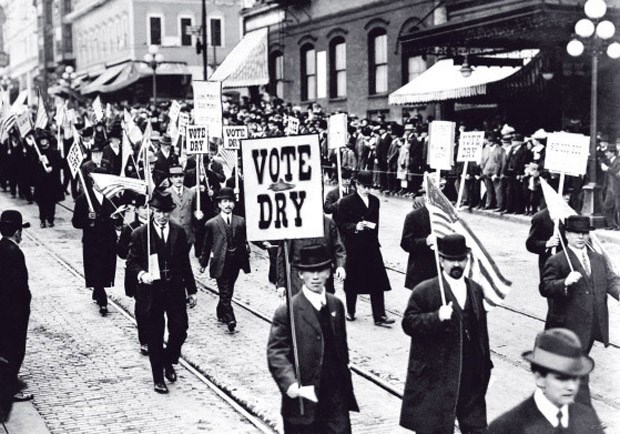
First, the distinction Collins postulates between the "cultural influence" wielded by 19th-century evangelicals (good power) and the "power politics" they practiced during the 20th (bad power) constitutes a false dichotomy and a virtually meaningless contrast. Evangelicals during the 19th century were hardly the unified movement of benevolent influence he suggests. (No mention is made of the fact that all Protestant denominations split during the century over the political and moral implications of slavery.) These same evangelicals entered the fray of political hardball at regular intervals to shape legislation, electioneer for their causes, lobby among the masses, and generally press for the advancement of their own interests (sometimes violently!). From the Anti-Saloon League to the New York Society for the Suppression of Vice, these evangelicals knew something about power politics. As for speaking in a "political idiom," James Dobson and Brian McLaren are rank amateurs compared to Anthony Comstock and Theodore Dwight Weld, to say nothing of John Brown and Carrie Nation.
Article continues below
The real difference between the two eras of evangelical history has little to do with differing ideas of power—one self-denying and loving, the other coercive and worldly—but rather with differing levels of success in translating political activism into genuine cultural change, and radically dissimilar contexts for attempting such feats. Undoubtedly evangelicals lost much of their cultural influence and credibility through the 20th century, but there were plenty of factors along the way to account for this decline, including but not limited to exponential population growth, mounting ethnic and religious pluralism, the rise of corporate capitalism, rapid industrialization and urbanization, accelerating rates of social and geographic mobility, and, yes, the increasing reach of the modern liberal state. Reducing the issue to an altered vision for power doesn't take seriously the radical structural changes brought about by modernization.
Reflexive Libertarianism
Second, although Collins encourages evangelicals to move "beyond ideology" as a solution to our current impasse, the cumulative effect of his own persistent grievances against the modern secular state amounts, in the end, to a book-length argument on behalf of an almost reflexive libertarianism. In other words, the central concern that seems to animate Collins's book isn't the divided soul of evangelicalism as much as the moral (il)legitimacy of the modern liberal state. I waited in vain for Collins to advance (or at least acknowledge) some semblance of a Christian case for the state as a God-ordained institution, established to do his bidding, even when its goals and methods are unholy and its thirst for expansive power unquenchable. (Consider the regime the apostle Paul was living under when he penned the 13th chapter of his letter to the Romans.) Treating the robust exercise of state power as little but oppressive, or denying that participation in "power politics" can result in anything but corruption, seems to undervalue or simply ignore the extent to which all such activity is done under a sovereign God as an extension of his good government.
Article continues below
I sincerely appreciate Collins's admonitions against evangelicals shilling for or baptizing secular political ideologies, as well as his warnings against confusing political movements with God's kingdom. I do not, however, believe that his persistent libertarian contempt toward government power provides a very helpful path forward. I think he meant to gesture toward a public code for evangelicals leavened by a Wesleyan ethic of love and self-denial, which is attractive in many ways. But his analysis reads more often like a treatise on behalf of what David Brody has called "Teavangelicalism"—an alliance between evangelicals and Tea Party conservatives. If we hope to support a robust Christian vision for public life, we must be properly wary of government propensities toward tyranny. But we must also ingest a healthy dose of realism that understands coercive power not as a unique invention of modernity, but as an intrinsic and complex feature of the human condition.
Jay Green is professor history at Covenant College in Lookout Mountain, Georgia.
Our Rating
Book Title
Power, Politics and the Fragmentation of Evangelicalism: From the Scopes Trial to the Obama Administration














 While we pray for peace, we need moral clarity about this war.
 As my doubts about his teachings grew, so did a secret fascination with Jesus.
 Eastern Orthodox poet Scott Cairns reflects on his new collection, his journey of faith, and poetry’s capacity to apprehend inexhaustible realities.





