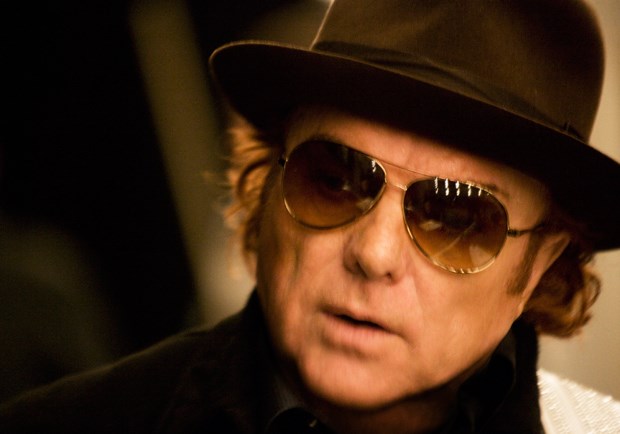
Van Morrison has a new album, Born to Sing: No Plan B. Virtually no one will care, a fact that continues to mystify me as much as the man himself. It is, like the preceding 34 albums, a mix of soulful R&B, jazz, Irish mysticism, and ruminations on love carnal and divine. And, like those other albums, it is wholly original and eccentric, an album that could only have emerged from the fertile mind of Van Morrison.
Image: Van Morrison
Van Morrison
Those of you who know Morrison casually, who think of him only as the soulful singer of "Moondance" or "Brown Eyed Girl," may be surprised by the evolution of his music since the early 1970s. The hippies claimed him, and he made his best-known music during that era, but he never fit easily into the counter-cultural stereotypes. Brooding, moody, and entirely too devoted to his own unconventional path to fit in with established societal or musical trends, Morrison simply made the music he wanted to make. That music was influential enough to merit his inclusion in the Rock and Roll Hall of Fame, but much of it since then has been willfully uncommercial, the product of a man who cares not a whit about the prospect of hit singles and awards and accolades. Almost all of it has borne witness to a man on a quest for something deeper and more satisfying than the usual sensual, hedonistic pursuits. That the quest has led him down some unlighted byways and dead ends is undeniable, but few songwriters have documented their spiritual discontent and restlessness as painstakingly or as accurately as Van Morrison.
What Morrison is after—the elusive Muse that he's pursued in a career that dates back to the early 1960s—is the ineffable. By its very definition it's a slippery word, one that is impossible to pin down by creedal statements or doctrinal catechisms, but Morrison has offered a number of clues that outline its general contours. It's the lost sense of innocence and peace that he hearkens back to again and again in his songs about an idyllic childhood in Belfast, Northern Ireland. It's being fully alive to the moment, attuned to the sense of wonder that can break through on even the grayest and most banal of days. It's the untrammeled romanticism of Blake and Coleridge, Wordsworth and Yeats—writers Van Morrison namechecks again and again in his body of work—and the insistence on the supremacy of spiritual experience over theological proposition. By definition, it cannot be named. But it can be sung. And for Morrison, that is the nature of soul music in all the best and most inclusive senses of the term.
It can only be sung. If the album and song titles don't give the game away—Inarticulate Speech of the Heart, The Healing Has Begun, A Sense of Wonder, Beautiful Vision, and No Guru, No Method, No Teacher—then the voice itself is a constant reminder of the primacy of the ineffable in Morrison's worldview. Nowhere is that better illustrated than on "Listen to the Lion," an impossibly idiosyncratic track from his 1972 album St. Dominic's Preview. For more than eleven minutes Van wrestles his lyrics like a dog working a bone, repeating the same phrases over and over in an incantatory prayer; whispering, moaning, cajoling, pleading, and ultimately breaking free of language altogether, soaring off into a scatting, stuttering frenzy, and finally roaring like the lion of the title before settling down again and morphing back to his normal, enigmatic self. I know people who hate the song, who find it annoyingly self-indulgent. But for my money it's the quintessential Van Morrison moment, the most thrilling and thrillingly strange soul music, in all sense of the term, ever recorded. It is the sound of a man casting off all earthly bounds and battering down the gates of heaven.
Morrison's music is both far more and far less than that, of course. Sometimes a love song is just a love song, and when Van sings "She's as sweet as Tupelo honey," there's no reason to think he's singing about anything or anyone other than a woman. Still, there are dozens of songs, scattered throughout an immense and daunting catalogue, that speak of a life in search of God. There are moments of ecstatic bliss, of profound peace and assurance. There are moments of regret, of missed opportunities, of failure. "When Will I Ever Learn to Live in God?" (from 1989's Avalon Sunset) is not only a representative song title, but also a lament that will sound familiar to any follower of Christ. On the
same album, Morrison offers his most straightforward gospel affirmation:
Heals the sick and heals the lame
Says you can do it too in Jesus' name
And he lifted you up, and he turned you around
And he put your feet back on higher ground
Reach out for him, he'll be there
With him your troubles, you can share
Oh, you can use his higher power
Every day in any hour
To be fair, Morrison mentions other religious traditions with equal favor, and there are times when he seems to reject it all. No Guru, No Method, No Teacher is not only the name of one of his best albums, but it's a fair summary of the contents therein. But like all writers who bear witness to their spiritual struggles and spiritual victories, Morrison allows the rest of us to watch over his shoulder and learn from the process. Some will turn away from the opportunity because of a perceived lack of orthodoxy on the part of the singer and songwriter. It's likely that Van Morrison doesn't care.
Article continues below
Morrison, notoriously distrustful of trends and fads, merely carries on in his iconoclastic way. On Born to Sing: No Plan B, he offers a typically head-scratching mix of love songs, political diatribes, travelogues, spiritual meditations, and remembrances of old radio programs. When he goes through the motions—and he is far from going through the motions on his latest album—he remains a consummate, soulful singer and songwriter. And when he's "on"—when he locks into the groove and loses himself in the music—the hairs stand up on the back of my neck. He's yet to release a bad album, although he's released a few mediocre ones. I'll certainly live with those odds.
The title of his new album has it exactly right. What else should Van Morrison be doing but singing? And in singing, he does what the best poets have always done: He gives voice to our unspoken questions and inarticulate longings.












 While we pray for peace, we need moral clarity about this war.
 As my doubts about his teachings grew, so did a secret fascination with Jesus.
 Leader explains why the movement is seeing its biggest membership bump in 30 years and its mission for the years ahead.





