Ideological political documentaries in election years are nothing new. A few have crossed the threshold to box office success, but most are lost to obscurity. Anyone remember 2004's Going Upriver: The Long War of John Kerry?
Al Gore found a recipe for success in 2006 with his Academy Award-winning An Inconvenient Truth. Michael Moore has made a name for himself with a series of films that extol liberal themes and uncover alleged conspiracies. Moore's biggest blockbuster, the 2004 release Fahrenheit 9/11, was a scathing indictment of George W. Bush's foreign policy that grossed $119 million in theaters.
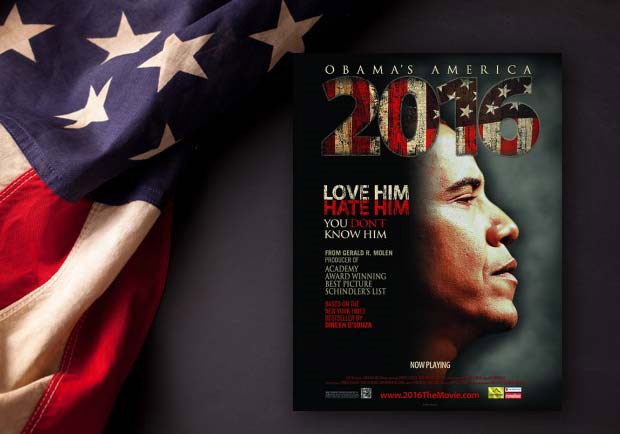
This year, the tables have turned, and a conservative documentary is raking in the dollars. The unlikely source is Dinesh D'Souza, who recently moved from the world of conservative think tanks to the presidency of a Christian college.
D'Souza has built a career writing ideological and polemical books and sparring in debates. A public intellectual who is quite gifted in his craft, D'Souza is a sharp and pointed writer who makes forceful arguments. He also knows how to evoke strong reactions and capture attention.
D'Souza is more polished than Michael Moore and makes smarter arguments, but he borrows many pages from the controversial liberal filmmaker's playbook. D'Souza follows Moore's formula by releasing the film in an election year and tailoring his message and emotive appeals to draw a particular ideological segment of the electorate.
Like Moore, D'Souza makes himself the central figure of his film. Not only does he narrate the film, he portrays himself on an intellectual journey that he invites the audience to share. As he presents his rather inventive retelling of Barack Obama's life story, he offers up his own life as a counter-narrative to Obama's.
My central concern about this film (a concern I share about Michael Moore's documentaries as well) is the blurring of facts and opinion to create powerful emotional appeals. The label "documentary" suggests non-fiction, but in reality such films often cross genres. D'Souza presents many facts in the film, but he intertwines these facts with conjecture, telling us some of the "who, what, when, and where" with the same authority with which he offers his version of the "why."
Those who want to check the facts will find some inaccuracies and incomplete information. But much of what the movie communicates cannot be confirmed or repudiated. D'Souza writes a narrative; he crafts a story and makes inferences that we can't verify. He offers his opinion, outlines some facts, introduces the audience to some scholars who share his views, and intertwines this content with visuals and a swelling score that help viewers connect the dots.
And herein lies the problem. As Christians, we need to test the truth of claims, both the facts that are stated and the message that is implied. In a word, we need discernment.
Consider one representative example from the film. D'Souza notes that upon assuming office, President Obama returned a bust of Winston Churchill to the British government. As D'Souza explains on his blog:
That bust now sits in the home of the British ambassador. The film explains Obama's hostility to Churchill by noting that he was a champion of colonialism and ordered a crackdown on an anti-colonial rebellion in Kenya in which Obama's father and grandfather were both detained. So we know what Obama did, and we know why he might have wanted to do it.
D'Souza is factually correct about the return of the bust, but his speculative explanation fails to mention an important point. The Churchill bust was a loan from Prime Minister Tony Blair to George W. Bush for the duration of his presidency. Bush's successor returned the loaned artwork; another copy of the same sculpture remains in the White House residence.
In this example, as in many places in the film, D'Souza skillfully blends facts and inferences to create a powerful narrative. He offers facts—sometimes partial and incomplete facts—and then ascribes motivations. It is possible that the White House curator's office returned the bust because the President was hostile to Churchill, but is equally if not more plausible that it did so because the terms of the loan expired. Either way, the issue of what statue is in what location in the Oval Office is tangential to the much more important question of evaluating Obama's foreign policy since he assumed office.
Instead of spinning a tale that presents one interpretation of what might motivate Barack Obama, it would be far more prudent to devote time, effort, and research to analyzing the President's record in his first term in office. Much of what D'Souza offers is conjecture. We don't need to wonder what the President might be thinking when we can ask concrete questions about what he and his administration have been doing. What policies has he proposed? What positions has he taken? What have been his greatest domestic and foreign policy successes? What have been his greatest failures? Do we approve of the path he has charted or not?
Article continues below
If D'Souza had wanted to educate more than indoctrinate, he had plenty of material at his fingertips. David Remnick's The Bridge and Michael Sugrue's Not Even Past are two worthy reads that add significant detail and nuance to the story D'Souza crafts. But he chose a different and more lucrative path. American voters want entertainment more than information; they like their political views reinforced, not challenged.
As Christians, I believe we are called to a different kind of politics. We need to be discerning. We need to be willing to ask hard questions. "Documentary" films of this type make such interaction and questioning more difficult. They are designed to be an experience, to sweep viewers into an alternative universe and tell them a story.
2016: Obama's America is unlikely to sway voter opinion. Romney supporters will likely leave the theater with a bit more confidence in their step; Obama supporters will leave shaking their heads. Christians can model a better way and respond to the film by exercising discernment, digging deeper, comparing the two political paths Romney and Obama propose, and ultimately casting an informed vote.












 While we pray for peace, we need moral clarity about this war.
 We’ve got little information on Jesus’ appearance and personality. But that’s the way God designed it.españolFrançais
 Beyoncé’s right. Whether listening to Cowboy Carter or reading theology, diversity is a good thing.





