When I visited the Dead Sea Scrolls Exhibit in Philadelphia in June, I started fidgeting almost immediately. The exhibit (at the Franklin Institute, running through October 14) begins by walking visitors through a display of archeological treasures (some 600, according to the publicity) from Israel's history, dating from 1200 B.C. to A.D. 68. I had come to look at the Scrolls, and here I was wading knee deep through the ancient archeology.
There is a method in the exhibit's madness, of course. For one, such history puts the Scrolls in the larger historical context. I'm guessing that the curators also recognized that having non-Dead Sea Scroll treasures would attract visitors who may not have much interest in the Scrolls alone.
All well and good, but I'd come for the Scrolls—where the heck were they?
From Cave to Museum
Scholars asked a similar question when they were first discovered in 1947—where had they been all this time?
Well, they sat in caves dark and numinous near the Dead Sea. One day a Bedouin shepherd threw a stone into a cave, and he and his cousin heard the sound of pottery breaking. But descending darkness prevented exploring the cave immediately. Some days later, the cousin, Muhammed edh-Dhib, returned and discovered seven scrolls in pottery jars, which later were identified as the Isaiah Scroll, Habakkuk Commentary, and the Community Rule. He took them back to the camp to show to his family, hanging the scrolls on a tent pole until they figured out what to do with them. Eventually, he took the scrolls to a dealer in Bethlehem, who thought them worthless, but he finally found a buyer for three of the scrolls (for which he received the equivalent of about $30 U.S.). Within months key manuscripts were in the hands of experts, who recognized their ancient origin.
For the next decade, archeologists and Bedouins descended on the area known as Qumran to investigate the many caves that lay in that stretch of dry, desert climate near the Dead Sea, the search finally coming to an end in 1956. When all is said and done, they found (depending on who's doing the counting ) over 100,000 fragments, from pieces the size of a fingernail to scrolls many feet long, that make up some 900 separate documents.
The scrolls are mostly extra-biblical documents, but about 20 to 25 percent are the earliest known surviving copies of some portion of every book of the Hebrew Bible. They are dated between 250 B.C. and A.D. 68, and are written in Hebrew, Aramaic, Greek, and Nabataean, mostly on parchment, some on papyrus, and one on copper. The scrolls were the property of a religious community, the ancient Jewish sect called the Essenes, though some scholars have other ideas about the nature of this community.
Today the vast majority of the Scrolls are housed in Israel at the Rockefeller Museum in Jerusalem, but eight can be seen at Southwestern Baptist Seminary and another five at Azusa Pacific University, among other places. From time to time, the Israeli authorities put the Scrolls on display, and at the Franklin Museum in Philadelphia, the display is said to be "the largest collection of ancient artifacts ever to tour outside of Israel."
Reverent Hush
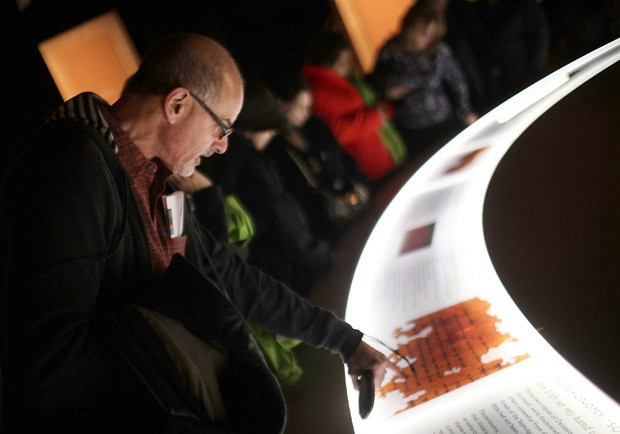
I rushed through the vast bulk of those ancient artifacts—iron arrowheads from 8th century Lachish, pottery fragments from 10th-century B.C. Jerusalem, and a clay altar from 10th-century B.C. Hazor, among others—and final found myself in a room, dark and numinous. The few Scrolls on display were set in a large circular glass case, framed in individual panels, gently lit from the sides. To one side of the Scroll was an enlarged copy of the Hebrew text, which on the Scroll original could only be barely discerned, so murky and small were the fragments in some cases.
A reverent, musuem hush filled the room, as visitors circled the Scroll case, as if we were now in the holy of holies of archeology—which we were. In a secular world, being in the presence of written artifacts two millennia old is to have an experience of transcendence, perhaps not divine transcendence but certainly historical. Human beings are fascinated with looking at, and if possible, touching things that have been touched by human beings two millennial ago. We love to feel history in our hands. It puts us in communion with the dead, which is only one step away from the Christian idea of the "communion of saints." In this case, it was more like the communion of scribes.
Protestants, especially evangelicals—people of my tribe—are supposed to be less enamored with such experiences. We're people of the word, not people of the ancient manuscript. Who cares how the word comes to us as long as it faithfully reproduces the words of the text?
But there is something about seeing a Dead Sea Scrolls fragment of Scripture up close—even if protected by a glass panel and barely visible in low light. In a few instances, you see whole sections of a scroll, like the Psalms scroll, but what I remember most is those little scraps of parchment with a few indecipherable letters. It was Hebrew to me. But nonetheless impressive. The question is why?
Article continues below
There is this business of historical transcendence. One imagines the scribe hunched over parchments, the original to his right, his copy to his left, dipping his pen in an inkwell, meticulously reproducing each and every letter of the original, day after day, month after month. A writer can appreciate that.
Another fascination is this: These biblical scrolls and fragments are by far the oldest manuscripts we have of the Hebrew Bible. I was looking at something that is over 1,000 years closer to the original manuscripts of Scripture. The oldest manuscripts of the Hebrew Bible have been dated to about the turn of the first millennium. Now we have manuscripts ten centuries closer to the so-called original inerrant autographs.
On Original Autographs
As with many doctrines, evangelical scholars are not necessarily in agreement about what we exactly mean by "original autographs," and in what sense they are "inerrant." Some imagine a solitary author writing out a book under the unique inspiration of God. Others say that some books show signs of having been authored by a community of scribes, who together were inspired. Some say these first copies were inerrant in all matters, including scientific ones. Others say they were inerrant only in matters of faith and practice. Of course, others wonder how you decide which passages are matters of faith and practice and which are not!
All well and good for scholars to have an honest if spirited debate about such matters. But most evangelical scholars agree on this: the copies of Scripture that we work with today are awfully close to the originals. They know this from studying the history of manuscript transmission. And they know it, now more than ever, from the discovery of the Dead Sea Scrolls.
Until that discovery, the oldest complete manuscript we have of the Hebrew Bible dates from over a thousand years after Christ's birth—the Codex Leningrad, about A.D. 1000. That is 1,600 years after the time when the book was first written (sometime in the 7th century B.C.). That seems like a lot of time for copies of copies to start showing significant differences from the original. But the Isaiah Scroll, which has a date from about 100 B.C., shows that the difference between that copy and that of the Middle Ages are hardly anything to talk about. For example, in the medieval version, what is called the Masoretic text, Isaiah 53:1-3 reads (KJV):
Article continues below
Who hath believed our report? and to whom is the arm of the LORD revealed?
For he shall grow up before him as a tender plant, and as a root out of a dry ground: he hath no form nor comeliness; and when we shall see him, there is no beauty that we should desire him.
He is despised and rejected of men; a man of sorrows, and acquainted with grief: and we hid as it were our faces from him; he was despised, and we esteemed him not.
In the Qumran version, it reads like this (with differences in italics):
Who hath believed our report? and to whom is the arm of the LORD revealed?
For he shall grow up before him as a tender plant, and as a root out of a dry ground: he hath no form nor he hath comeliness; and when we shall see him, there is no beauty that we should desire ourselves.
He is despised and rejected of men and man of sorrows, and he knows grief: and we hid as it were our faces from him; and despised him, and we esteemed him not.
So, at one level, it may be immaterial whether we ever find the original autographs, because what we have is nearly perfect as it is. On the other hand, it's something that amazes one to think, that in looking at the Great Isaiah Scroll from Qumran, we're another 1,100 years closer to looking at the original autographs.
Well, sort of.
Parchment Abuse
In fact, the Scrolls have in many cases deteriorated significantly since their discovery, more so in the last half century than they had in the two thousand years they sat in the caves. Thank goodness someone took photographs of them soon after they were discovered. And praise be to infrared technology and computer enhancing techniques today.
Apparently, we didn't know much about the science of preservation in 1948. We have old black and whites of scholars studying the fragments in a room where the bright sun is beaming through a wall of glass on to the precious documents. And the scholars are smoking while examining the fragments! Adhesive tape was used to join fragments (sometimes right over letters) and to cover cracks. The aging of the adhesives and the pressure of the glass under which they were placed caused the skins to darken, so that in some cases, the texts are no longer legible. In a few instances, the edges have completely gelatinized.
Yikes! Who let these people into the Scroll rooms?
Article continues below
There has been much breast beating about such procedures, so that today, the Scrolls are treated like the delicate things they are. For example, they are exposed to light only in the most limited way—in fact, the Scroll fragments at the exhibit have been swapped out half way through, with new scrolls on display while the others are put back into the safety of darkness.
Still that means that the most accurate, least inerrant (so to speak), most legible editions of the scroll are either photographs or digitized files. The Israel Museum has partnered with Google to make five major scrolls available online, employing the most advanced imaging technologies. James Charlesworth, director and editor of the Princeton Dead Sea Scrolls Project, has said that the new images allow him to decipher in 30 minutes fragments that once took 14 hours to analyze when he handled the original parchments.
But none of us circling the exhibit came to see photographs of the Dead Sea Scrolls, let alone digitally enhanced versions--even though the photographs and the digital versions are a more faithful rendition of what the Scrolls actually say! No, instead, we've come mostly to squint at mostly dark and illegible pieces of parchment.
Scholars wax eloquent about what these documents tell us about first century Jewish religious life, that they are crucial for understanding early Christian history, that they shed light on the New Testament, that they confirm the faithful reproduction of Scripture through the ages, and so on and so forth. All well and good, but that is not was draws us to the museum.
We're not particularly interested in reading them, for very long anyway—and again, we don't need to go to the museum to do that. Yes, we'll spend a few seconds reading a scroll portion, at least the English translation, but we'll spend many minutes just staring at the scroll fragment, as if it were an object of veneration.
Even we Protestants do that. We say we are people of the word, but sometimes we act like people of the parchment. Even if we're not believers in inerrancy, we're fascinated with originals, or with copies that are closer than ever to the originals.
But why do we care about getting back to the originals? Why do we think the originals are more pristine, more truthful, more authentic?
Instinctual Primivitists
We don't think that about all originals.
For example, the first version of any written work is what we call a "first draft." Nobody thinks a first draft is a mature piece of work. Nor the second draft. And so on. These days, it's hard to tell which draft is which, given the ease of self-editing. But it is fair to say that most written works don't see the light of day until ten or twenty significant revisions have taken place. And then, depending on the nature of the book, it might be revised for second, third, and forth editions. Nobody except historians cares much about the original edition of Calvin's Institutes, a thin little book compared to the later editions. What we study to discern Calvin's mature thought is the final edition.
Article continues below
Why do we Protestants instinctively believe that the best, truest, most mature versions of Scripture are the earliest? Why do we assume that God only inspired those? Perhaps he inspired copyists as well, all down through the centuries. Perhaps the "errors" some of them introduced were really God's editing of previous copyists mistakes. Maybe the latest manuscripts are actually the most divinely inspired.
There are many reasons, of course, for our stubborn fascination with originals, especially when it comes to Scripture. But one is less a reason than an assumption, a basic hermeneutic by which we operate. Protestants are fundamentally primitivists—meaning we give great authority to the "primitive," that is, to things that are "the first or earliest of the kind or in existence." The Reformation is a primivitist movement, an attempt to correct what we considered to be later additions and corruptions of the faith. Catholics instinctively thought of these "additions" as divinely guided developments of doctrine (though that idea wasn't framed formally until the 19th century with John Henry Newman). But Protestants argued that authority rested not in later tradition but in the Bible as it came to us through the original prophets and original apostles. This instinct for the primitive is part of our DNA, so much so that most don't even think about it.
This assumption is not arbitrary, but is supported by our reading of Scripture: "Long ago, at many times and in many ways, God spoke to our fathers by the prophets, but in these last days he has spoken to us by his Son…" (Hebrews 1:1). The New Testament is that collections of books that are the earliest and most faithful witnesses to the life, death, and resurrection of Jesus, and the good news of the gospel he came to proclaim and make a reality. Very early in our history, the church determined to guide itself by these witnesses, so that even in those Reformation debates, Catholic scholars also argued from Scripture. Catholics still leave room for the development of doctrine, for the Holy Spirit's bringing us into all truth. But Protestants are suspicious of any so-called Holy Spirit truth that isn't supported strongly in the pages of the original Scriptures. We look not just to the New Testament but also to the Hebrew Scriptures, what we call the Old Testament. Why? Because Jesus and the early apostles considered these Scripture—"breathed out by God and profitable for teaching, for reproof, for correction, and for training in righteousness."
Article continues below
And we Protestants want to be as close to the breath of God as possible.
In the Presence of an Artifact
Much occurs psychologically when we stand in the presence of an historic artifact. We are bodily people, and so matter matters. When touching a coin from ancient Israel, we touch something that has been touched by people long, long ago. We are tangibly connected with men and women of another time and place, so distant and different, and yet one of us. We imagine what life was like for them, as best we can, and wonder about what we cannot imagine. Such ruminations often prompt thoughts of our own mortality, and the smallness of the individual in the grand sweep of history. Archeology exhibits always leave me wistful, reminding me that my life is but a breath (Job 7.7). In the presence of an artifact, we stand before the mystery of life.
When we do this before an ancient piece of parchment, on which a passage of Holy Scripture is written, even more is going on. We also know the communion of saints as we ponder the work of a fellow believer across time, admiring his faithful dedication to his task, that because of his labors, the Scriptures have come to future generations, to the likes of me and mine.
And then there is this—the notion shared by all Christians even as we differ on how biblical inspiration actually occurred: I'm looking at a word that at some point in some place was breathed upon by God, like the glorious moment lost in the mist of history when the divine breath made the first man a living soul.
When I meditate on a Dead Sea Scroll biblical manuscript in that perfect glass circle of light and darkness, of explanation and mystery, more is going on than archeology and even psychology. I'm traveling through time, and at moments find myself a millennium closer to the very breath of God.
Mark Galli is senior managing editor of Christianity Today.
In "SoulWork," Mark Galli brings news, Christian theology, and spiritual direction together to explore what it means to be formed spiritually in the image of Jesus Christ.
Mark Galli is former editor in chief of Christianity Today and author, most recently, of Karl Barth: An Introductory Biography for Evangelicals.














 While we pray for peace, we need moral clarity about this war.
 As my doubts about his teachings grew, so did a secret fascination with Jesus.
 Interview with leader of new evangelical alliance describes his escape from Khartoum and the pressure to pick a side.





