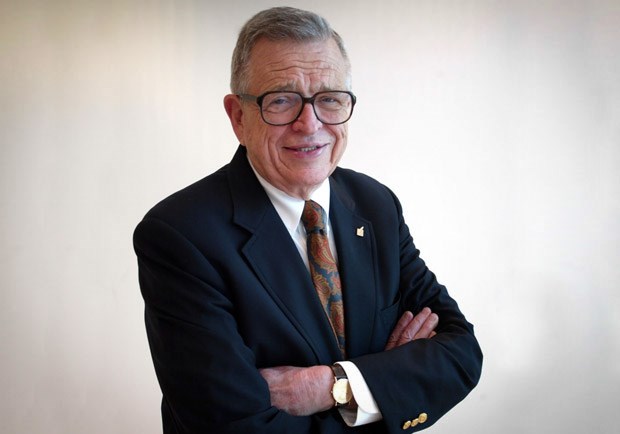
Two years ago, Chuck Colson asked me to join him in writing this long-running column with the idea that I would one day become its sole author. But with Chuck's departure for heaven last spring, that assignment has come due much sooner than I expected.
Chuck once described how the title for this column, Contra Mundum, occurred to him. He was reading a letter John Wesley wrote to the abolitionist William Wilberforce, one of Chuck's great heroes. Writing four decades before the English slave trade was finally abolished, Wesley compared Wilberforce to Athanasius, who had stood with courage "against the world" on behalf of the doctrine of the Trinity in the fourth century. Chuck was a genuine Christian contrarian in the line of Wilberforce and Athanasius, and in this column, I want to keep advancing that tradition.
Christians are invariably caught in the crossfire of two competing value systems, 'kingdoms in conflict,' as Chuck Colson put it.
You can sum up the life of Athanasius in two sentences: "Truth matters. Courage counts." As a young 20-something, Athanasius represented the church of Alexandria at the Council of Nicaea, where he defended the deity of Jesus Christ against the popular watered-down version of Arius. For the rest of his life, Athanasius struggled on behalf of the orthodox faith. Like Luther and Calvin during the Reformation, the word contra titled his writings—against the Arians, against the pagans. When one day the whole world found itself in the grip of the Arian heresy, Athanasius found it necessary to stand contra mundum.
Athanasius served as the bishop of Alexandria for 45 years, from 328 until 373. During that time, he was sent into exile five times at the command of four different Roman emperors. C. S. Lewis recommended that Christians today read Athanasius, "with a pipe in their teeth and a pencil in their hand." It is the glory of Athanasius, Lewis wrote, that "he did not move with the times; it is his reward that he now remains when those times, as all times do, have moved away."
Perhaps there is some irony in the fact that a doughty champion of gospel truth such as Athanasius would also be an advocate of Christian unity. Unity and truth seem to pull in opposite directions. People often promote Christian unity at the expense of truth, or truth claims with no regard for the imperative for unity. In John 17 Jesus says to the heavenly Father, "[Y]our Word is truth," and also asks that those who have believed in him would all be one. Both are necessary. We cannot be faithful followers of Jesus unless we heed both parts of his prayer.
People sometimes called Chuck a culture warrior—a term he neither sought nor accepted. Standing squarely within the Augustinian and Reformed traditions, he believed that Christians are invariably caught in the crossfire of two competing value systems, "kingdoms in conflict," as he put it. In this struggle, neutrality is not an option. The decision to swim "against the stream" is never easy. Nor does it always end well from a human perspective, as Dietrich Bonhoeffer's story shows.
There was nothing romantic or sentimental about Chuck's Christianity. He was a realist to the core, but he was no pessimist. He knew that Jesus Christ had once and for all conquered Satan and his pomp at Calvary, and he believed that the lordship of Christ extended to every arena of human endeavor. At the heart of Chuck's vision for renewal in society was the church, not the church as it so often appears to our eyes—moribund, complacent, compromised—but the church that is the body of Christ, renewed by the power of the Spirit. He loved to quote Russell Kirk: "Without Christian culture and Christian hope, the modern world would come to resemble a half-derelict fun-fair, gone nasty and poverty-racked, one enormous Atlantic City."
Richard John Neuhaus, one of Chuck's closest friends and cofounder with Chuck of Evangelicals and Catholics Together, once gave an explanation of the phrase contra mundum that Chuck liked very much. We are "against the world," he said, precisely in order to be "for the world." Our primary message to a fallen world is one of grace and redemption, God's great yes in Jesus Christ.
But there are occasions, as Karl Barth reminded us, when, in order to be faithful to the whole counsel of God, we must also say "no" to the world. We earn the right to say no only when we first have engaged in washing feet. As the founder of a worldwide ministry for prisoners and their families, Chuck demonstrated the love of Christ to those most scorned by the world. He had a prophetic voice because he first had a servant's heart. He was against the world for the world.
Have something to add about this? See something we missed? Share your feedback here.
Charles Colson was the founder of Prison Fellowship Ministries, an outreach to convicts, victims of crime, and justice officers. Colson, who converted to Christianity before he was indicted on Watergate-related charges, became one of evangelicalism's most influential voices. His books included Born Again and How Now Shall We Live? A Christianity Today columnist since 1985, Colson died in 2012.
Timothy George is the dean of Beeson Divinity School at Samford University and a member of Christianity Today's Editorial Council. His books include Reading Scripture with the Reformers and Is the Father of Jesus the God of Muhammad? Like Colson, George has been heavily involved in the Evangelicals and Catholics Together discussions. George began cowriting "Contra Mundum" with Colson in 2011.
















 While we pray for peace, we need moral clarity about this war.
 A Christian reconciliation group in Israel and Palestine warned that war would come. Now the war threatens their relevance.العربيةFrançais
 The Grammy-winning artist was found dead at her home in Nashville at age 47.






