The decline in biblical literacy and the loss of a "faith culture" is no longer news, but it is somewhat shocking. Twelve years ago, New Testament professor Gary Burge reported the results of a survey given to students at Wheaton College, the premier evangelical higher education institution. He found that one-third of the students tested could not put the following in sequential order: Abraham, the Old Testament prophets, the death of Christ, and Pentecost. One-third could not identify the Book of Acts as the location of Paul's missionary travels; half did not know that the Christmas story was in Matthew.
Many studies since have only confirmed these findings. Combine this with increasing anxiety over the church's loss of the younger generation, and we can understand the church's growing need for fresh resources to disciple not just youth but Christians of all ages. To put it in terms that feel a little old-fashioned, at the core we have a growing sense that we need to learn again how to catechize.
I believe we need to resurrect this old word—catechesis—and the big idea it encapsulates. The word has too long been associated with the more formal and liturgical traditions, and has been more or less ignored by evangelicals. But according to the New Testament, to catechize is more than just a matter of passing along essential information about the good news of Jesus Christ. It is instruction in the "way of the Lord" (Acts 18:25). As suggested by J. I. Packer and Gary A. Parrett in their book on catechism, Grounded in the Gospel, this means aiming at "sound workmanship, thoroughness of construction, solidity, stability, and utility," producing the "living stones [who] are being built up as a spiritual house, to be a holy priesthood, to offer spiritual sacrifices acceptable to God through Jesus Christ" (1 Pet. 2:5, ESV).
Catechesis has waxed and waned throughout history, but today many evangelicals show a growing interest in the biblical origins of catechesis. More and more are looking to the catechetical work of the early church fathers, its recovery among the Protestant reformers, and its renewal among leading evangelists and pastors like John Wesley and Jonathan Edwards.
We are also rediscovering some not-so-distant pearls of wisdom, like the little-known The School of Faith: The Catechisms of the Reformed Church, by Scottish theologian and pastor Thomas F. Torrance, first published in 1959 and now reissued by Wipf and Stock.
This book is clearly Reformed in its framing, combining all of the classic catechisms of the Reformed tradition, from Calvin's Geneva Catechism of 1541 to the Larger Westminster Catechism of 1648. But the book is useful for those in other traditions mainly because of its provocative introductory essay, which, among other things, explains how these Reformed texts have succeeded and failed in making disciples of Jesus Christ.
Torrance, who died in 2007, deeply appreciated this Reformed heritage, but thought it needed a theological check-up. He wanted to examine the historic catechisms in light of both his work in the Church of Scotland and his broadly ecumenical work. Torrance wrote with penetrating insight on how to set forth Christian teaching so that it would be comprehensive, compelling, and transformative for all Christians. He called for an exposition of the gospel that is locally adapted, yet consistent from age to age and for the whole "communion of saints." This meant that instruction had to serve the "one, holy, catholic, and apostolic church" and the one God—Father, Son, and Holy Spirit. For this reason, Torrance praised the catechisms of Calvin, John Craig, and others, which follow the ancient pattern of the Apostles' Creed.
The content of this common-roots faith is crucial, but Torrance was just as concerned with the method of instruction. At the intersection of medium and message, we see his most valuable contribution to the school of faith today.
At its best, catechesis has always begun by recognizing that the Christian life is as much about union with Christ as receiving the benefits of his saving work. It's about "getting saved," yes, but also growing in him. The more we apprehend the fullness of his humanity and divinity and the unity of who he is and what he has done for us, the more we come to know "Christ clothed with the gospel."
Catechesis begins by recognizing that the Christian life is as much about union with Christ as receiving the benefits of his saving work. It's about 'getting saved,' yes, but also growing in him.
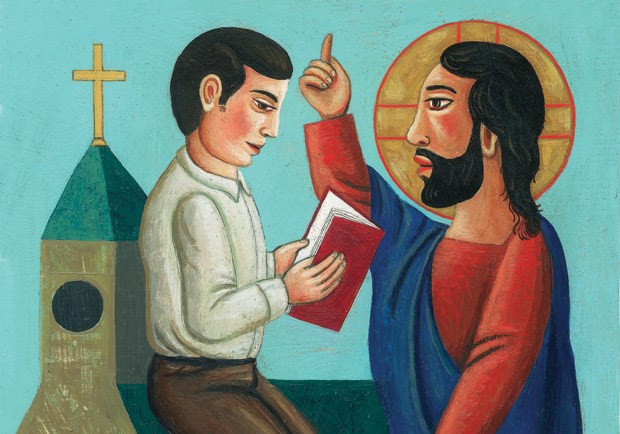
We begin to see the Truth (always capitalized by Torrance) in his person and know it in his message. At the same time, we find ourselves reconciled to and in communion with him through his living Word. This sets up a personal dialog between the Teacher, who has become flesh, and the disciple, who by the Holy Spirit receives what is offered. In this way we are "adapted to the Truth by the Truth."
Article continues below
According to Torrance, "the nature of the content must be allowed to condition not only the form but the method of instruction." Among other things, this means that catechists (those who teach) and catechumens (those who learn) are never alone. They are actually in personal conversation with the Truth, the Lord himself, who helps the teacher to speak and the student to hear.
Torrance lists seven dimensions of a truly biblical catechesis:
1. The message of Christ is communicated first and foremost in personal relation to Christ. This means that the idiosyncrasies of our denominational traditions, curricula, and those who teach take a back seat to the primary goal: bringing seekers across the threshold of faith to Christ. Second-order reflection, no matter how biblical and "orthodox" in pedigree, must yield to first-order engagement with the living Word. Only in this way will catechisms be truly evangelical.
2. It takes a church. Catechesis is typically associated with venerable churchly traditions, so this point may come as no surprise. It is in the church—especially in its prayers, praises, and thanksgiving in worship—that we learn the "grammar of faith," the words and symbols that refer to the nature of Christ, and the narratives that remind us of his saving actions in history. The sacraments (or ordinances) that he instituted hold it all together, becoming effectual signs of his ministry of reconciliation.
3. Catechesis requires a response of self-awareness and self-denial. Since the Truth approaches us in the form of a person—Jesus Christ—we hear his distinct call for personal decision. He encounters us just as we are: rebellious creatures who are captive to sin. He then offers himself, a way of cross-shaped surrender and salvation on his terms, in accordance with his person and work. Catechesis clarifies and expounds each stage of this saving encounter. It makes us more acutely aware of our alienation, and it even shows us how our needs, wants, and expectations may prompt us to reset the terms. But the Truth resists our efforts, showing us that there is only one way, truth, and life. Catechesis is always confrontational, even offensive, until we yield to its life-saving message in the crucified, resurrected, and ascended Lord Jesus.
4. Revelation and reconciliation are inseparable. A peculiar kind of disposition is required to receive and make sense of the message. This responsiveness does not come naturally but is itself a gift from God—a spiritual gift needed for real communication to take place. It breaks old habits of heart, opens our minds to receive instruction, and points us in a new direction. Only then can reconciliation occur between persons in the community of God.
Article continues below
5. You must be born-again. Torrance reminds us that "knowing the Truth and being recreated in the Truth are inseparable." The reconciliation just noted is more than good news about our status before God; it is also a reality that penetrates our whole being. It is not just about gaining new powers or capacities, but a new life in the Truth. This is what happens as we find ourselves adapted to the very nature of the One we seek to know, recalling Christ's words to Nicodemus: "Except a man be born again, he cannot see the kingdom of God" (John 3:3, KJV, emphasis mine). For this reason, in the catechesis of the gospel, to know is to become.
6. Catechesis is a work of the Holy Spirit. Jesus also spoke of the necessity of the Spirit in his conversation with Nicodemus (John 3:5-8). Since the Spirit of Truth is sent from the Father to bear witness about the Son (John 15:26), we can rest assured that we are given all that is required to apprehend his person and message. It is tempting to try to do the work of the Spirit ourselves, through our winsomeness on the one hand or force of indoctrination on the other. Instead, we are called to wait upon God in prayer to hear the Spirit's utterance of Christ.
7. Intake (reception) of the Truth leads to out-take (witness). Catechesis is passed on in faithful witness. The learner becomes a teacher. Torrance goes so far as to say that the "learner does not really learn unless he learns also from his learning how to teach the Truth to others." New disciples will, of course, require reconciliation with the Truth and, as a result, will find themselves at variance with the competing truths of the world. So this exchange, as a "reconciling operation," is never automatic, never free of the tensions inherent to surrender and obedience.
Too often, catechisms have neglected these personal dimensions. It is especially tragic when they have failed to communicate "Christ clothed in the gospel." We're not just learning about Christ in catechesis. What is Christ's has become ours: his faithfulness, righteousness, and, yes, identity too. That is the really good news! If we frontload catechesis with human systems, with a logic or master key that unlocks all the mysteries, or weigh it down with secondary issues, like our denominational traditions, we may very well miss the point—and the point is the person of Jesus. If we think this encounter depends on our moral status, or even our faith, we won't see the One who has chosen to meet us where we are by taking on our very nature.
Article continues below
Thomas Torrance reminds us that the building-up of believers into the fullness of Christ must always be grounded in who he is as much as what he has accomplished for us, in a dynamic, personal relationship with him as well as an intellectual grasp of his work for us. This is what catechesis has done at its best in church history. It is indeed the path—the way of the Lord—that is a truly biblical school of faith.
Philip Harrold is associate professor of church history at Trinity School for Ministry in Ambridge, Pennsylvania. Go to ChristianBibleStudies.com for "What Every Christian Should Know," a Bible study based on this article.
Have something to add about this? See something we missed? Share your feedback here.















 While we pray for peace, we need moral clarity about this war.
 As my doubts about his teachings grew, so did a secret fascination with Jesus.
 After lobbying from fellow Southern Baptists and Christians affected by the war, the House speaker moves a package forward.






