Analogies have persuasive power, a suggestive force that operates on an almost unconscious level. To say that A is "like" B is to suggest that everything we associate with A should also be associated with B—whether good, bad, or ugly.
So, for example, if I describe American soldiers as "crusaders," I have just painted them with an analogical brush that colors them as religiously motivated warriors guilty of the worst bigotries of the West. The analogy is loaded with a moral depiction that exceeds what's actually said. So all the disdain we have towards our (usually caricatured) understanding of the Crusades is now overlaid on our perception of military operations in Iraq or Afghanistan.
Conversely, if I describe the proponents of my cause as "prophets" or "martyrs," I have loaded the perceptual deck with images of heroism and purity. Just by the analogy, we get to don our white hats and claim the moral high ground. Or if we describe our regime as "Camelot," we associate ourselves with romance and royal privilege. Never underestimate the power of an analogy. And never simply accept it.
We are all Galileans now
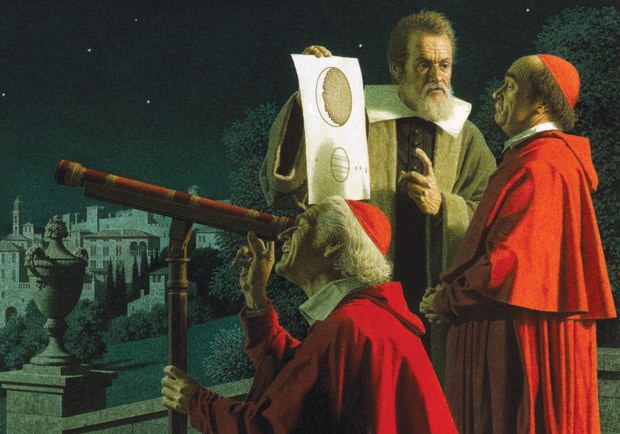
There is a particular analogy often invoked in current discussions about the relationship between Christian faith and science. Ours, we are told, is a "Galilean" moment: a critical time in history when new findings in the natural sciences threaten to topple fundamental Christian beliefs, just as Galileo's proposed heliocentrism rocked the ecclesiastical establishment of his day. This parallel is usually invoked in the context of genetic, evolutionary, and archaeological evidence about human origins that challenges traditional Christian understandings.
Historical analogies like this are often particularly loaded because our age is characterized by chronological snobbery and a self-congratulatory sense of our maturity and progress. Since we now tend to look at the church's response to Galileo as misguided, reactionary, and backward, this "Galilean" framing of contemporary discussions does two things—before any "evidence" is ever put on the table.
First, it casts scientists—and those Christian scholars who champion such science—as heroes and martyrs willing to embrace progress and enlightenment. Second, and as a result, this framing of the debate depicts those concerned with preserving Christian orthodoxy as backward, timid, and fundamentalist. With heads in flat-earth sand, any who voice hesitation or skepticism about the "assured/obvious" implications of evolutionary evidence are cast in the villainous role of Galileo's putative persecutor, Cardinal Bellarmine.
Seeing Beyond Science: A 'Galilean' framing of conversations on faith and science stacks the deck against the claims of faith.
It bears mention, of course, that the conventional Galileo narrative—pitting narrow-minded, inquisitorial clerics against a courageous champion of open scientific inquiry—partakes in large part of historical myth. Careful scholars of science and religion have come to reject this simplistic picture of church dogma stifling what today we might call "academic freedom."
But even if the Galileo myth was factually accurate, it should hardly supply the symbolism that governs all subsequent dialogue between theology and science. The "Galilean" framing of these conversations assumes a paradigm in which science is taken to be a neutral "describer" of "the way things are." Consequently, it treats theology as a kind of bias—an inherently conservative take on the world that has to face up to the cold, hard realities disclosed by the natural sciences and historical research. Christian scholars and theologians who (perhaps unwittingly) buy into this paradigm are often characterized by deference to "what science says." They become increasingly embarrassed by both the theological tradition and the community of believers who are not so eager to embrace scientific "progress" and an updated faith.
Such "Galileans" are not looking to reject the Christian faith tout court; indeed, they will often emphasize their commitment to the "essentials." In fact, they take it upon themselves to help us sift through what is and is not "essential." Sure, Galileo challenged our geocentric picture of the universe—which required re-reading passages of Scripture that seemed to suggest the sun revolved around the earth. But geocentrism was not "essential" to Christian faith. This is precisely why the church of Galileo's day looks so foolish now. Who among us would deny that the earth revolves around the sun?
You can see where this goes: Just as Galileo's telescope taught us to give up on what wrongly seemed "essential" to the faith, so today's fossil record and genetic evidences press us to give up clinging to a historical couple or a historical Fall. Apart from any assessment of the evidence or consideration of alternatives, the analogy does its own persuasive work. Do you really want to be the Cardinal Bellarmine of the future? Does anyone really want to be that guy—the one who committed himself to an "orthodoxy" that not a single Christian would later believe?
Article continues below
Part of the Solution
Christians today feel what Canadian philosopher Charles Taylor calls a "cross-pressure" on our faith: The scriptural witness seems to tell us one story about the world while evolutionary science seems to tell another.
But the Galileo analogy doesn't help us work through that tension because it says too much too fast. To invoke the Galileo analogy is to have already made up our minds. When we construe current debates about human origins in "Galilean" terms, we rhetorically position ourselves as if the implications of common descent were "as obvious" as the earth revolving around the sun. The Galileo analogy is a conversation stopper. It effectively suggests that resistance is futile.
Underneath the analogy is a more serious problem. These "Galileans" exhibit an essentially "whiggish" stance toward the theological tradition—an underlying confidence in progress and the unquestioned assumption that "newer is better." At work here is a sense that faith needs "updating," and that clinging to historic concerns and formulations is merely "conservative," as if seeking to preserve historic doctrines were just a matter of fearing change.
The result is that the Christian theological tradition is seen to be a burden rather than a gift that enables the Christian community to think through such challenges. The Galileans never entertain the possibility that some of our ancient theological and confessional traditions might actually be a resource in contemporary debates—a wellspring of theological imagination to help us grapple with difficult questions. Instead, they suppose that the cross-pressure between theological tradition and contemporary science can only be alleviated by "updating" the tradition. On this account, our orthodox theological heritage—including the creeds and confessions—is part of the problem rather than a valued resource for articulating a solution.
The Chalcedonian Breakthrough
Perhaps most glaringly, this "Galilean" framing of the conversation barely references Jesus the Galilean. Even Christian scholars operating within this paradigm tend rarely to see any implication for central Christological affirmations. Instead we get discussions of "creation" with little or no reference to Christ—as if his role in creating and sustaining the world (Col. 1:16-18) were irrelevant to conversations about "nature." But as Mark Noll argues in Jesus Christ and the Life of the Mind, Christian scholarship should not be rooted in a functional deism. Rather, the proper place for Christians to begin serious intellectual labor "is the same place where we begin all other serious human enterprises. That place is the heart of our religion, which is the revelation of God in Christ."
Article continues below
This is why Noll points to the Council of Chalcedon (A.D. 451) as one of the first encounters between the church's faith and (then) contemporary science. When Christians wrestled with questions about the Incarnation and Christ's divinity, they were grappling with the "science" of their day—paradigms of personhood and nature. In this task, the "Chalcedonian definition" of Christ's identity, which affirmed at once his full humanity and full divinity, represented a major breakthrough. By awakening imaginations to an awareness of what Noll calls "doubleness"—the possibility of apparent contradictions masking deeper harmonies—Chalcedon promoted a creative response to the conflicting testimonies of science and revelation.
There is a model to follow here: Early Christians mined the mysteries of the faith to grapple with the challenge of the day rather than whittling down what's scandalous to fit the expectations of the day. Guided by the Chalcedonian consensus, church leaders did not have to settle for a merely defensive or conciliatory posture. They were not reduced to looking for nooks and crannies in the reigning scientific paradigms that left room to make religious claims. Instead, their central conviction of the lordship of Christ over all creation gave them a courage and confidence to theorize imaginatively and creatively. They didn't look for ways to blunt or downplay the particularities of the gospel. Animated by the conviction that all things hold together in Christ, early Christian theologians forged new models and paradigms which we now receive as magisterial statements of the faith—the heart and soul of the "Great Tradition."
Article continues below
We 21st-century Christians have a lot to learn from our 4th-century forebears. Unfortunately, the Galilean story coddles our contemporary smugness and encourages us to look down our nose at those unenlightened generations that preceded us.
But unless—and until—we are willing to recognize the creative wisdom of Chalcedon, or generate any kind of sympathy for Cardinal Bellarmine, we can't have much hope for authentic Christian witness in these contested areas. Instead, contemporary conversations between faith and science will continue to be dichotomous bartering games that simply try to "update" the faith ("I'll give up original sin if you let me keep the Resurrection," etc.).
Chalcedon shows us otherwise. We can boldly, imaginatively, faithfully, creatively tackle the most challenging issues, secure in the conviction that all things hold together in Christ. "Thick" theological orthodoxy and serious engagement with contemporary science are not mutually exclusive. We just need to foster the Christian imagination to underwrite more creative approaches.
That would require, first, remembering and appreciating that the Christian intellectual tradition is uniquely "carried" in the practices of Christian liturgy, worship, and prayer. It is in the prayers and worship of the church that we are immersed in the Word and our imaginations are located in God's story. It is in worship that we are constantly invited to inhabit the conviction that all things hold together in Christ. Intentional liturgical formation must be the foundation for rigorous, imaginative, and faithful Christian scholarship.
Second, and relatedly, we need to approach the Christian theological heritage—rooted in the Word and articulated in the creeds and confessions of the church—as a gift, not a liability. After all, the church was wrestling with faith-science tensions well before Galileo.
Our sensibility (following the late Robert Webber) should be an "ancient-future" one: The church will find gifts to help it think through postmodern challenges by retrieving the wisdom of ancient Christians. The goal is not to simply repeat ancient formulations while sticking our heads in the sand; rather, the contemporary church—and contemporary Christian scholars—can learn much from the habits of mind that characterized church fathers like Athanasius and Augustine.
Guided by these convictions and practices, we might be less inclined to congratulate ourselves for following Galileo and more concerned with following the Galilean in whom God has reconciled all things to himself.
James K. A. Smith is professor of philosophy at Calvin College and senior fellow of the Colossian Forum on Faith, Science, and Culture (colossianforum.org). His new book, Imagining the Kingdom: How Worship Works (Baker Academic), will be published in February 2013.
Have something to add about this? See something we missed? Share your feedback here.















 While we pray for peace, we need moral clarity about this war.
 A Christian reconciliation group in Israel and Palestine warned that war would come. Now the war threatens their relevance.العربيةFrançais
 We must always be people of the Word, but we’ll have to reimagine deep engagement with Scripture.






