One Nation without God?: The Battle for Christianity in an Age of Unbelief
Author
David Aikman
Publisher
Baker Books
Release Date
September 1, 2012
Pages
208
Price
14.0
Patrick Henry once said, "It cannot be emphasized too strongly or too often that this great nation was founded, not by religionists, but by Christians; not on religions, but on the gospel of Jesus Christ!" Or at least many evangelicals believe Henry said that. It is actually a line from a 1956 magazine article commenting on Henry's faith, but popular Christian writers subsequently attributed the quote to Henry himself. The misquote stuck. Even though countless websites have debunked it, this bogus statement still routinely appears everywhere from Twitter to Facebook to books on America's founding, including presidential aspirant Newt Gingrich's A Nation Like No Other. And Gingrich has a Ph.D. in history!
The eager reception of spurious quotes about our Christian origins is telling. It illustrates the fact that religion's role in the founding is among the most controversial historical debates in America today. Into that debate enters David Aikman's One Nation Without God? The Battle for Christianity in an Age of Unbelief (Baker). Did I not know Aikman, a longtime writer and reporter for Time magazine, who now teaches at Patrick Henry College, I might guess that the book would be the latest of many Christian titles lamenting how America is going down the spiritual tubes. But in Aikman's capable hands, the book turns out to be a wide-ranging, lively survey of the historical background and contemporary relevance of our Christian roots.
New Angles
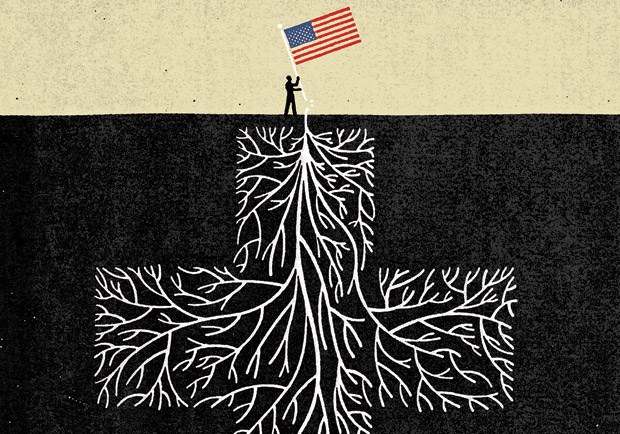
Aikman leaves no doubt that Christianity has played a strong role in American history, and that modern secularists' efforts to remove every hint of religion from the public square are misguided. But Aikman also shows that our spiritual past was not as uncomplicated and rosy as more polemical Christian writers tell us. Moreover, whatever Christian (or Judeo-Christian) identity we may have once had is at risk today. Aikman thoughtfully addresses whether we were once a Christian nation, but more provocatively, what America will be like if, culturally, we become "one nation without God."
Aikman has read widely, and is conversant with much of the best scholarship that would help us answer these questions. Chapter by chapter, he considers new angles: from the history of religion and the founding, to contemporary conflicts over religion in public life, to the secularization of the American academy. Along the way, he introduces readers to experts that every thoughtful Christian should know but whose work they may not have personally read, including sociologists Christian Smith and Peter Berger, and historians George Marsden, Mark Noll, and James Hutson.
In the chapter on history (the longest section of the book), Aikman reviews modern Christian providentialist literature, led by books such as Peter Marshall and David Manuel's The Light and the Glory, that portrays the American founding as uniquely directed by God. He contrasts this approach with that of academic Christian historians such as Noll and Marsden (my doctoral adviser), who criticized the providentialist approach in their book The Search for Christian America (co-written with another accomplished historian, Nathan Hatch). Aikman seems satisfied neither with the providentialists nor their academic critics. He chides Noll and Marsden for seizing on moral failings of the colonial and Revolutionary Founders as evidence that America never was a "properly" Christian nation. In Aikman's view, the Puritans and Patriot Founders had many faults—as do we all—but these do not fundamentally detract from their accomplishments and the Christian quality of their efforts.
Aikman thoughtfully addresses 'whether' we were once a Christian nation, but more provocatively, what America will be like if, culturally, we become 'one nation without God.'
Aikman might have noted that Marsden, and especially Noll, have written much more on the founding era than The Search for Christian America, which was admittedly contentious. It was written as a response to the rise of the Moral Majority, and in the context of personal debates with popular Christian philosopher Francis Schaeffer over the providential significance of the founding (the story of Noll and Marsden's correspondence with Schaeffer is found in historian Barry Hankins's Francis Schaeffer and the Shaping of Evangelical America). Its authors were in a combative mood, but Noll's Christians in the American Revolution, among other books by these historians, makes it abundantly clear that religion played a major, if sometimes problematic, role in the era of the Revolution.
Aikman prefers to sketch the religious character of the colonial, Revolutionary, and early national periods, letting readers see the good and the bad, the religious and the worldly, and decide for themselves whether it all amounted to a "Christian nation." Jamestown, the first enduring English colony, was clearly founded for business reasons, yet faith played a strong role there. The Pilgrims and Puritans, however, self-consciously created covenant-based societies, fully devoted to biblical principles in matters of both church and state. The Great Awakening reinvigorated the lagging Puritan ethos, setting the stage for a revolution that was religiously diverse, yet undergirded by powerful religious principles.
Article continues below
Aikman maintains that, despite the quote-bending contortions of popular Christian writers, key figures such as Franklin and Jefferson were Deists, not Christians. While rejecting many tenets of biblical orthodoxy, including the divinity of Christ, they affirmed belief in a Creator God who endowed his creatures with a range of rights and liberties. They were not, then, atheists or secularists, and they helped frame some of the essential religious principles that animated the Revolution. Among those principles were religious liberty, God's providential role in history, and the need for moral virtue to sustain the republic.
Revival Is Possible
In a move that conventional Christian doom-and-gloomers would not make, Aikman concludes with a hopeful chapter on "Countertrends," contending that revival and renewal are always possible, even in contemporary America. He reminds readers of the remarkable successes of the evangelical revival in Britain that began with the work of John and Charles Wesley and George Whitefield in the 1730s. This movement not only revitalized Britain's Christian commitment, but also fed the great antislavery campaign led by William Wilberforce. England was substantially re-Christianized during this century of revival, leading Aikman to believe that no process of religious decline and secularization is irreversible.
Among Aikman's contemporary countertrends are new awakenings proceeding around the world, not least in China, a country where he has done extensive reporting (see his 2006 book Jesus in Beijing for the fruits of those labors). Aikman reveals that many Chinese intellectuals are becoming convinced that Christianity offers the moral order and spiritual succor lacking in communism. He also finds hopeful signs among college students and young professionals in the United States, including the burgeoning generation of Calvinist-minded believers described by Collin Hansen as the "young, restless, and reformed."
One Nation Without God? ends with a Chinese economist, Zhao Xiao, reminding Americans that their peculiar national strength lies in their spiritual heritage. Zhao leaves us with an irony: Just as legions from Beijing to Brasilia are discovering how vital faith in Christ both saves the individual and offers moral ballast to culture, many Westerners have jettisoned and ridiculed that same faith. Perhaps global South believers will help Americans appreciate the value of their own spiritual legacy.
Article continues below
Thomas Kidd is senior fellow at the Institute for Studies of Religion at Baylor University, and the author most recently of Patrick Henry: First among Patriots (Basic Books). He is presently working on a biography of George Whitefield, to be published by Yale University Press.
Have something to add about this? See something we missed? Share your feedback here.
Our Rating
Book Title
One Nation without God?: The Battle for Christianity in an Age of Unbelief


















 While we pray for peace, we need moral clarity about this war.
 A Christian reconciliation group in Israel and Palestine warned that war would come. Now the war threatens their relevance.españolالعربيةFrançaisрусскийУкраїнська
 NIL deals in college athletics present new challenges—and opportunities—for colleges and students.






