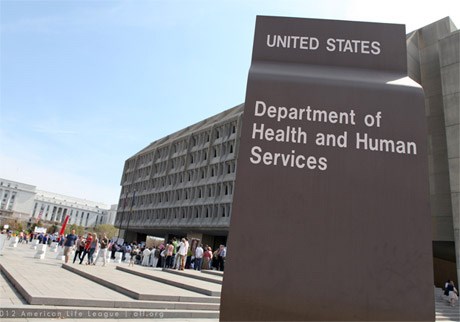
Changes announced today by the Department of Health and Human Services (HHS) to its contraceptive mandate are likely to focus attention even more on for-profit companies that object to the mandate on religious grounds.
While several churches and religious nonprofits are likely to continue their protests against the mandate, today's announcement says they don't have to directly provide full contraception coverage to their employees. But for-profit companies have no exemptions, even if they're religious.
The battle over the mandate—and the emergency contraception it requires—has long been over personhood. Is a fertilized egg a person? Do the emergency contraceptives stop eggs from uterine implantation, ending a person's life?
But now the legal battles against the HHS employer contraceptive mandate are shifting to very different questions of personhood: Are for-profit corporations "persons" in such a legal sense that they have religious rights? And do their religious liberties allow them to avoid the mandate?
Several for-profit corporations have brought their cases against HHS on the basis of the First Amendment and the Religious Freedom Restoration Act (RFRA). The 1993 federal statute states, "Government shall not substantially burden a person's exercise of religion even if the burden results from a rule of general applicability" without compelling government interest.
Until now, HHS cases have largely fought over the term "substantial burden"—essentially debating the political version of the youth-group perennial, "How far is too far?" But now that appeals courts are weighing in, the conversation may shift to another of the RFRA's terms.
"The question is whether corporations are a person under that statute," said Howard Friedman, professor of law emeritus at University of Toledo.
Avoiding the issue
Thus far, courts have avoided the issue of a corporation's religious rights, Friedman says. In some cases, judges have ruled that plaintiffs have not demonstrated "substantial burden," simply because it's easier than weighing in on the First Amendment and RFRA rights of companies, he said.
If one or more of the cases against the employer contraceptive mandate is successfully appealed to the U.S. Supreme Court, justices will face a tricky set of intertwined issues: whether or not a corporation can practice religion; whether or not a corporation has the same religious freedom as its owners; and whether or not being required to cover contraceptives violates a corporation's—or its owners'—religious freedom.
"It's one of the most difficult legal questions I've seen, in terms of all the issues that are intertwined," said Friedman, who runs the Religion Clause blog and wrote about the issue last month. "There really haven't been any [courts] that have said corporations themselves have religious rights. They've either avoided the issue [by finding no substantial burden] or said the corporation can assert the owners' rights."
One such ruling occurred when the Tenth Circuit Court of Appeals denied an injunction to one of the highest-profile corporations in the HHS dispute, Hobby Lobby, which is owned by a family of evangelical philanthropists. The court concluded that the Green family's concerns that "funds [might] subsidize someone else's participation in an activity condemned by plaintiff[s'] religion" were not a substantial burden to the Greens' religious exercise.
"The problem here is that there are not very many situations where the right to religious freedom means not participating in somebody else's doing something," Friedman said.
The Supreme Court denied the Greens' particular claim when they appealed the ruling to the Supreme Court within the week. However, Justice Sonia Sotomayor did acknowledge that the Court "has not previously addressed similar RFRA or free exercise claims brought by closely held for-profit corporations and their controlling shareholders alleging that the mandatory provision of certain employee benefits substantially burdens their exercise of religion."
Lower court judges have ruled in four other cases that there is "no substantial burden" on the business owners, citing a separation between the business and the individuals. When a court reaches that conclusion, it does not proceed to analyze the rest of the RFRA or First Amendment claims.
Whose free exercise?
Eugene Volokh, professor of law at the UCLA School of Law, says the legal notion that organizations and corporations have constitutional rights dates back to the 1930s and 1940s. Nothing in the law prohibits individuals organized in a corporate form from exercising constitutional rights.
"Businesses have rights because people—individuals—have rights," he said. "It's nothing odd … for the government to say [that] if a few individuals own a business through the corporate form, they can raise their religious freedom rights through a claim by the business."
Article continues below
And the majority of courts agree: 10 of the 14 religious plaintiffs who have obtained court rulings against the mandate have been granted injunctions on the basis of RFRA claims.
"Is it the exercise of the individuals or the businesses? I'm not sure that it matters all that much," said Kyle Duncan, general counsel for the Becket Fund for Religious Liberty, which represents many of the religious plaintiffs against the HHS. "The business owners have the right to exercise their religion in the way they exercise their business."
Duncan says the Seventh Circuit Court of Appeals' December 2012 ruling in Korte v. Sebelius zeroes in on the right issues. In its decision in favor of K&L Contractors, a Catholic-owned construction company, the Court found that the owners' religious freedom is violated by K&L's "coerced coverage of contraception."
The ruling also goes a step further: It states that the family's decision to operate as a corporation does not override their claim of religious freedom violations. The ruling references Citizens United v. Federal Election Commission, the controversial 2010 Supreme Court ruling on corporate constitutional rights. In that decision, the court cited the First Amendment's protection of speech in its 5–4 decision that the government could not ban financial contributions by corporations to certain political campaigns.
The issue in the Citizens United case was government regulation of certain types of speech for all businesses—not regulation for a subset of businesses whose owners object to something on religious grounds, Volokh says. If a case against the employer contraceptive mandate reaches the Supreme Court, the ruling likely will be quite narrow, more limited than both Citizens United and the ruling to uphold the individual mandate last summer.
All pending cases seek to overturn only the employer mandate at most. But Duncan says a narrower ruling would be fine, even if it means that the Court settles the claims by creating an exemption under RFRA rather than setting a precedent for corporations' religious rights under the First Amendment.
"A win against the mandate would be ensuring that it cannot apply to religious objectors," he said.
Article continues below
A lurking danger?
But Friedman says the suing corporations could face a problem down the road if they argued too strongly that the owners' religious values and the company's religious values are naturally one and the same. One major reason business owners form corporations, he notes, is to avoid connecting themselves too much to the companies for purposes of liability. To ask courts to view the owners and their corporations as synonymous is known as "piercing the corporate veil"—which he says could be dangerous for smaller employers who align themselves too closely with their companies.
If an owner pierces the corporate veil to avoid covering contraceptives, he or she risks being held responsible if the company were to go bankrupt or face charges of fraud, Friedman says.
Similarly, the Oklahoma District Court maintained the view that a corporation and its owners should be viewed separately when the court ruled to deny Hobby Lobby's claim for a preliminary injunction in November 2012.
The court stated, "General business corporations do not, separate and apart from the actions or belief systems of their individual owners or employees, exercise religion. … Religious exercise is, by its nature, one of those 'purely personal' matters … which is not the province of a general business corporation."
But Eric Rassbach, deputy general counsel for the Becket Fund, says "piercing the corporate veil" may not be the right analysis. When a person or family chooses to organize as a corporation, he or she takes advantage of limited liability protections created by state law for a specific purpose: to encourage financial investment.
"There's no reason to think that because you take advantage of state level rights you are deprived of your constitutional and federal rights [to free religious exercise]," Rassbach said. "The limited liability protections will limit financial liability, not liability for how an owner invests his values."
Matt Bowman, general counsel at Alliance Defending Freedom, agrees.
"The 'corporate veil' is not a 'moral veil.' It's a limited legal veil," he said. "A mandate on [a family's] business is a moral requirement for them personally.That has no implication on the legal liability that is limited in a corporate form."












 While we pray for peace, we need moral clarity about this war.
 As my doubts about his teachings grew, so did a secret fascination with Jesus.
 The Grammy-winning artist was found dead at her home in Nashville at age 47.





