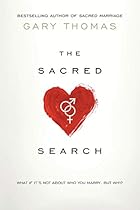
The Sacred Search: What If It's Not about Who You Marry, But Why?
Author
Gary Thomas
Publisher
David C Cook
Release Date
January 1, 2013
Pages
256
Price
35.86
What were you thinking when you chose to marry this person? If honest, those are the thoughts most pastors have had when counseling a couple in crisis. We may never actually say it aloud. But we think it.
The thought is moot, of course. By that point it is too late. No longer is it a "start over" mission, especially for the pastor who will fight for redemption, not divorce. Thus, for the pastor who believes in lifelong covenants, it is a "miracle of redemption" mission. In those situations, the point is to find the renewal only the gospel can provide and to point that couple toward to the gospel at every turn. And yet, when a couple comes to you for help but won't stop bickering across the couch, those moot thoughts can flood your mind. If only they could have backed up and started this off right! If only they knew what they were getting into when they were dating! I wish this was pre-marital counseling, not divorce avoidance counseling!
What if we could turn back the clock and help singles discover the path of wisdom with regard to choosing a spouse? What would I say?
One of the ways to strengthen marriages is to parachute, so to speak, into a person's life before they are married, in order to guide their motives, emotions, purposes, and vision of what marriage is all about. Only in that light, after all, can we gain insight into whom they should marry. This is essentially what Gary Thomas is after in The Sacred Search (David C. Cook), a book that follows upon his well-known Sacred Marriage. Thomas wrote this book as a ministry to help singles realize that why and how they find a spouse is a fundamental ingredient in the health of the future marriage. Like a golfer that realizes the success of the shot is in the swing, so a marriage must be set up right by the heart, motives, passions, and vision one uses to choose a spouse in the first place. "It's not," he writes, "that the "who" doesn't matter (in fact, it matters very much); it's just that asking and settling the "why" question first will set you up to make a wise choice about the "who."
Let me pose two questions before proceeding. First, does the world really need another book like this? Well, in many ways Thomas does not say anything new. I believe he would freely admit that. As a co-author of a book on relationships, I felt called to contribute another entry into to this genre because individual books have shelf lives, and certain writers tend to attract certain audiences. Some people will read a book on an important topic because they like the author. Thus, that person is now exposed to helpful truth. So, yes, I think it is important that books like this keep coming into the market, with a fresh voice and a fresh readership. Second, do books like this handle Scripture in a way that Scripture was meant to be handled? I found Thomas's handling of Scripture and theological themes appropriate and in accord with the authorial intent of those passages. One may not agree with every nuance, and I will get to some of my cautions in this review, but I believe books like Sacred Search are valid expressions of the truth and the point of Scripture.
That said, here is what I found helpful about The Sacred Search.
Thomas makes a critical point in simply saying that the most important aspect of discovering who you should marry is the convictions you have about marriage prior to ever entering a relationship. The sub-title says it all: What if it's not about who you marry, but why? That is worth the cost of the book. In particular, he is careful to question the common motive for entering a long-term, marriage-directed relationship: namely, emotion. I really appreciated how Thomas incisively critiqued, via Scripture, reason, and data, the dysfunction of letting emotion-driven infatuations govern lifelong choices, especially the one of marriage. This sets the stage for the remainder of the book, which advances the argument that big Biblical truths, while not emotion-less, are better arrived at by clear-headed, progressive decisions and thoughtful self-examination.
For instance, a major theme is that of character. One's spouse should be spiritually mature and emotionally healthy. If one is a serious Christian, then one should find someone committed to the mission and truths of gospel-driven life. From there, Thomas also suggests the wisdom of finding a spouse who shares secondary priorities as well, such as views on gender roles, parenting, and overall lifestyle. He also reminds us that the choices we make in marriage partners not only affect us, but future children, other family members, and our wider community.
The book ends with a tough challenge. Thomas invites readers to consider ending said questionable relationships that are not based in the truths for which he has been arguing. He states quite clearly that it is better to go through a messy dating break-up than enter into a lifelong marriage that is full of pain.
Article continues below
While I really appreciated Thomas's practical wisdom and penchant for clear-cut admonitions, let me identify areas where I would have preferred some additional nuance. First, Thomas makes a fairly large point that God does not have one person in particular set aside for us. He makes this point to discourage his audience from preoccupation with a specific person, rather than a godly and wise process of waiting and finding. However valid the ultimate point, it needs to be noticed that Thomas is making a significant theological claim. Now, when it comes to the prospect of God setting someone aside for us to marry, I would not suggest beating the drum of meticulous providence. But I would recommend against specific claims of how sovereignty factors into the big choices of life, one way or the other, just so no one gets sidetracked by a disputed point of theology. Thomas may end up distracting certain Calvinist-leaning young people, many of whom are spiritually and theologically predisposed to read this book and benefit from it.
Second, I would have preferred that Thomas anchor some of his arguments more explicitly and robustly in the gospel of grace. To be fair, Thomas does bring in the gospel at key points. But since we may never make perfectly clean choices, we need the good news that God is still faithful to redeem our poor choices, and an additional section to this effect would have strengthened the book. At moments I felt Thomas was being a bit too optimistic in his approach to the marriage search. While I agree with almost everything he suggests, life is messy, and even the most well-made marriage choices unite two sinners who must fight for faith and fight for grace, with and for each other. Since even the godliest marriages are fallen and finite, Jesus is the key, not good behavioral instincts.
In no way do I think Thomas was commending a legalistic, behavior-centered approach. But readers less initiated in filling in the gospel blanks may come away with something like that impression. Also, I would have appreciated a bit more on what it looks like to be led by biblical truth and wisdom, and to find someone who really is a potentially good spouse, but who is still in the throes of spiritual growth. What does that look like? How does one tell between someone who should not be pursued and someone who is a good choice but has not arrived yet? I can see that many thoughtful young people might wrestle with what seems to be over-simplicity at points.
Would I give this book to the young people of my church? Yes, I would. To my children? Indeed. Like I said at the beginning, I am glad this book is on the market, and I am thankful for the vision-shaping truths it conveys.
Jay Thomas is pastor of Chapel Hill Bible Church in Chapel Hill, North Carolina. He is the co-author, with Gerald Hiestand, of Sex, Dating, and Relationships: A Fresh Approach (Crossway).
Our Rating
Book Title
The Sacred Search: What If It's Not about Who You Marry, But Why?















 While we pray for peace, we need moral clarity about this war.
 A Christian reconciliation group in Israel and Palestine warned that war would come. Now the war threatens their relevance.españolالعربيةFrançaisрусскийУкраїнська
 Beyoncé’s right. Whether listening to Cowboy Carter or reading theology, diversity is a good thing.





