There is a section of Woodward Avenue—the spinal street of Detroit that runs 27 miles up to Pontiac, Michigan—that looks like a patch of quilt stitched in from Europe. Rows of neo-Gothic churches glisten in the dappled October sun, their limestone stairs and multicolored glass panes reflecting the prosperity of former times. There's Metropolitan United Methodist, built in 1926 in ochre granite imported from Massachusetts. There's the Cathedral of the Most Blessed Sacrament, finished in 1930 to seat the archdiocese of Detroit, its wrought-iron gates preserving the church's gleam over the past century. St. John's (formerly North Woodward Congregational) boasts an unusual Gothic red-and-white brick design, as well as the honor of being the first black church on Woodward Avenue. Together these and other churches earned this stretch of Woodward the name Piety Hill. It's a neighborhood that once pulsed with spiritual vibrancy and stability in a city rocked by economic and social upheaval.
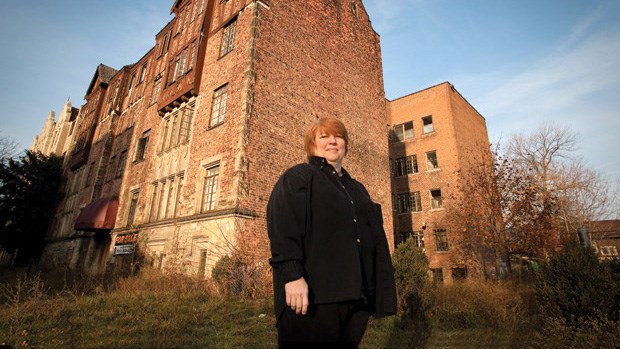
"See that church?" says Piety Hill resident Lisa Johanon. She points to a Gothic beauty whose blood-red doors promise life inside. "For $125,000, it's yours."
Like many churches on this street, Woodward Avenue Presbyterian (later Abyssinia) watched its upper-middle-class members, both black and white, leave the city of Detroit starting in the 1950s. After a series of mergers, expensive repairs, and a pastor's death in 2005, the church got locked in court battles. Its leaky roof ate away its wooden floors, and vandals scrapped its pipe organ in 2009. While it served as the set of a recent Tyler Perry movie, it is foreclosed and in ruins.
Johanon knows Abyssinia and the other churches well. Her nonprofit emerged from a partnership between seven of them 18 years ago. Central Detroit Christian (CDC) Community Development Group was launched to serve the poor in the Boston-Edison Historic District, the onetime neighborhood of Henry Ford. But all the founding pastors have left; two of the churches have closed. "We've just faced such random, massive abandonment that it's unreal," says Johanon.
Living in Piety Hill for 25 years, Johanon and her husband have faced massive personal loss as well. In 1989, they paid $29,000 for a 100-year-old home charmed with all the original wood-work and a built-in fireplace. They watched its value climb (it reached $122,000 by 2006) but, like countless other U.S. homeowners, watched it plummet as swiftly as it grew. Fellow Detroit development groups have dwindled from 36 in 2007 to 7 in 2012. About 103 vacant homes, many of them gutted and turned into drug or prostitution hubs, pock the eight blocks around the CDC's offices.
"We came here because it was one of the most devastated areas," says Johanon, who stayed even when her former employer, Youth for Christ, ended its Detroit ministry in the early 1990s. "We worked for 14 years only to have the economy fall out in 2008. Now we're in worse shape than we were 18 years ago. If that doesn't give you cause for pause, I don't know what does …. Yet you press on."
Many Christians whom CT interviewed for this story explained their commitment to Detroit using an analogy from church history. (This story focuses on Christians in central Detroit; our online reporting will cover the work of Christians in Detroit's suburbs.) When the plague ravaged Rome in the 2nd and 3rd centuries, inciting an exodus of citizens, many Christians rushed in to care for the sick and dying, joining the many who were already there, refusing to leave. As church father Dionysius wrote in A.D. 260, "Most of the Christians in our city showed unbounded love and loyalty, never sparing themselves … drawing on themselves the sickness of their neighbors and cheerfully accepting their pain." (Rodney Stark famously argues that such outlandish compassion helped spur Christianity's meteoric rise throughout the empire.)
This is the story of Christians like Johanon—Christians whose faithful presence in a ravaged city is sowing seeds of hope in the shell of a once-towering empire.
A City on the Move
To grasp just how radical it is to stay in Detroit, one first must understand how un-radical it is to leave.
Detroit (from le detroit du Lac Erie, "the strait of Lake Erie") was settled by the French nearly a century before America's founding. After the Erie Canal opened in 1825, Detroit became a major producer and exporter of goods such as stoves, railcars, and steam ships, and grew into a global industrial center just decades after the Civil War. When the automobile and, with it, Ford's assembly line debuted in 1898, both drew incredible wealth to the city as well as new residents who could secure a middle-class existence doing factory work. That included waves of black families from the South, looking to escape Jim Crow-era injustices.
Article continues below
"Detroit was one of the few U.S. cities where African Americans could become wealthy as blue-collar workers," says Harvey Carey, senior pastor of Citadel of Faith and a Detroit resident for nine years. "When the auto industry began to boom, people flooded from the South and were able to build an unbelievable lifestyle here."
The lure of prosperity drew more than half a million new residents in the 1920s alone, making the Motor City the fourth-largest U.S. city in population, behind Los Angeles, New York, and Chicago. By 1929, Detroit had burgeoned to 1.6 million people, many of whom were immigrants or first-generation residents. In 1950, its population peaked at 1.8 million.
Not surprisingly, Detroit was also one of the first cities to take up federal plans for an interstate highway. New roadways allowed home and business developers to build outside the city limits, which "sow[ed] the seeds of the suburbanization and sprawl that eventually would empty the city core," notes journalist Scott Martelle in Detroit: A Biography. As the city's population grew and cars became commonplace, more residents and businesses relocated to surrounding suburbs.
But underlying prejudices played a major role in their departure. Deed restrictions in many Detroit suburbs barred selling or reselling property to blacks. Racial and ethnic tensions simmered in factories and mixed neighborhoods, bubbling up into a riot in 1943 that killed 34 over three days. Paradise Valley, Detroit's oldest, most dynamic black neighborhood, was demolished in the early 1960s to expand the Chrysler Freeway. By this time, auto-industry jobs had begun moving overseas. Then a police raid on a party the morning of Sunday, July 23, 1967, ignited a torrent of brutality and vandalism that lasted five days and took 43 lives. The "riot"—or "uprising"—was the nail that sealed many Detroiters' long-ago decision to leave for supposedly safer neighborhoods, better schools, and shorter commutes.
"Businesses left, the tax base left, and what was left was Detroiters to lead a city," says Carey. "[Today] you have about 700,000 people paying taxes for a city sized for 2 million." And the tax base may shrink further: An October 2012 Detroit News poll found that 40 percent of those 700,000 current residents plan to leave Detroit in the next five years. Lack of jobs, struggling public schools, crime, and dire reports from national media understandably have driven away would-be taxpayers.
Article continues below
In the 1970s and 1980s, the Big Three—Ford, Chrysler, and General Motors—faced intense global competition and soaring fuel prices, and fewer working-class Detroiters looked to auto-industry wages for their livelihood. Detroit's security depended—some say too much—on the rise and fall of the U.S. auto industry. When President Obama made the contested decision in 2009 to lend $80 billion to bail out GM and Chrysler Group, he was also in part bailing out Detroit.
The bailout seems to have helped, as much as one can. This year saw the strongest domestic auto market since 2007, and "General Motors is alive!" became a catchphrase in Obama's re-election campaign. But Detroit's unemployment rate hovers around 18 percent—about double Michigan's and over double the country's. And the numbers don't reflect the realities for many on-the-ground Christians.
'One Bite at a Time'
"Detroit is my esperanza—my hope and new beginning," says Stacey Foster, lead pastor of Life Changers International Ministry for 17 years. A onetime drug addict who came to Christ through Teen Challenge, Foster relocated to Detroit from Florida to pastor one of three then-new Assemblies of God churches. "Our church used to be 60 percent black and 40 percent white and Hispanic," says Foster, 49. "Now I can think of one Hispanic family and no whites. The job factor and fear factor since 2008 have driven people out."
Economic development—"from welfare to work"—is one of Life Changers' ministry pillars, and the church plans to buy up and develop vacant properties along Wyoming Street, where it still worships. But Foster is contributing to Detroit's common good far beyond the church walls.
Foster and his wife first lived in the city when they came to Detroit in 1987, but moved to a southern suburb six years later when their two children were young. Then Foster read John Perkins, the grandfather of the Christian community development movement. Around the same time, Johanon's CDC had bought a gutted home from the city, and was busy rehabbing it. The Fosters decided to buy it from CDC and have lived there since 2003.
Article continues below
'Detroit's gone through some tremendous transformation. We're hoping that better days are coming. If we don't all have hope, there is no point in being here.'—Lisa Johanon, founder, Central Detroit Christian Community Development Group
"God has called me to minister to a broken city," says Foster, who has received job offers from the Willow Creek Association and Compassion International. "God has not forsaken this place, and neither will I." He ministers to those hurt by Detroit realities: the gang and homicide squads of the Detroit Police Department. Four hours a week since 1999, he counsels officers who face longer hours, pay cuts, torn marriages, and numbed spirits from the routine violence. Yet Foster thinks the city needs police and emergency crews living in the city now more than ever.
"The city of Detroit made a mistake a couple years ago when they let policemen and firefighters live outside the city limits," says Foster. "It would be like having a mayor live outside the city."
One of Foster's neighbors, in fact, became the first police officer to return to the city under mayor Dave Bing's bid to lure officers back. Project 14, launched in 2011 and named after police code 14—"return to normal operations"—entices officers to move back by helping them with down payments. When Detroit native Ernest Cleaves heard about the program—especially that it meant a $154,000 renovation by CDC to a lovely corner-lot home in Boston-Edison—he signed up.
"I signed the purchase agreement before even seeing the inside. Sometimes I look at it and still can't believe it's mine," says Cleaves, who joined the police squad's special operations unit in 2001. Since he moved from a southern suburb in 2011, he says, neighbors tell him they feel safer and are more likely to stay. "I wanted to come back to help the city get better. The only way to do that is from the inside."
'We can't let businesses or the government be responsible for the soul of the city. That's what Detroit is known for—its soul.'—Harvey Carey, pastor, Citadel of Faith
Perhaps no Detroit ministry knows this better than Johanon and CDC. The eight- by three-block area under its purview showcases the group's narrow but deep investment in central Detroit. Rehabbing homes is its cornerstone work. It uses federal funds to buy properties at public auctions, and recruits suburban Christians to install vinyl siding, replace stolen pipes, and complete other maintenance projects to restore the property. Then it locates families who need a home and can afford to maintain it. One Boston-Edison block alone features $3 million in CDC investments. But CDC wisely does more than housing.
Article continues below
"So many [community development groups] put all their eggs in the one basket of housing," says Johanon. "When the housing market crashed … their construction loans and tax credits dried up, so their funding streams went away." CDC, on the other hand, boasts an array of local businesses: Peaches & Greens produce market, Higher Ground Landscaping, Restoration Warehouse home supply store, Solid Rock Property Management, and Cafe Sonshine, a "healthy soul food" restaurant. Together these add jobs and bring commercial value to Piety Hill. Their three neighborhood gardens named Faith, Hope, and Love will soon see another food venture, an aquaponics farm, in a veritable food desert. The CDC Farm and Fishery will raise tilapia in the basement of a onetime liquor store, and then use the fish excrement to fertilize a first-floor herb garden. (Johanon wanted to name it "Urban Herbs" but wondered if "herbs" carried the wrong connotation.)
Faith, Hope, and Love have all been put to rest for the winter, their beds harvested and ready to receive new life this spring.
"It's all about community transformation—how do you eat an elephant? One bite at a time," says Johanon. "That's how you create change. The little things add up to big things.
"Detroit's gone through some tremendous transformation. We're hoping that better days are coming. If we don't all have hope, there is no point in being here."
Soul City
Glimmers of hope—economic hope, at least—have begun flickering throughout the Motor City. Start-ups pushing tech innovation and sustainability have flocked to Detroit, drawing young entrepreneurs from New York City and Silicon Valley. Stik.com moved its headqurters from San Francisco to the M@dison Building (purchased by billionaire Dan Gilbert) recently. A Whole Foods is slated to open in the hip Midtown area early this year.
Among these giants, young entrepreneurial Christians are joining Detroit's slow turnaround. Margarita Barry, a Detroit native, has at age 26 launched three start-ups: 71-Pop, a retail store that carries locally designed clothing and wares; Detroit Design Lab, a web development firm for local nonprofits; and I Am Young Detroit, a website that spotlights other entrepreneurial Detroiters and will this year begin offering them microgrants.
Article continues below
"I want to empower young people to pursue their passions within the city, so they're putting their dollars in the city and creating jobs," says Barry, who came back to Detroit in 2007 after earning her bachelor's degree in Ohio. "You don't have to be a Donald Trump to change Detroit."
Diallo Smith was "bent on making money" as a financial analyst in Houston when, he says, God intervened and redirected him to pastoral ministry. When he and his wife returned for a wedding in 2006, "we both felt God calling us back to Detroit," says the pastor of Awakenings, which meets at the Detroit School of Arts in Midtown. But Smith found that "newer churches in urban centers [face] sustainability issues, because economic realities are different than in the suburbs." To both bolster the downtown economy and offer a unique third space for locals, Smith is launching a table tennis social club, the first of its kind anywhere.
"Imagine Kanye West playing Ping-Pong with Tony Blair with dubstep playing in the back-ground, surrounded by a café and wine boutique—that gives you a sense of what Drive is." Located in a downtown commercial hub, Drive will operate much like a bowling alley, charging visitors per hour per table, or for unlimited membership. Smith says the model is strategic in more ways than one, allowing Christians to form relationships with Detroit entrepreneurs, which is what has happened at Awakenings' art gallery.
"We Christians need to be at the forefront of being imaginative, creative, and innovative in bringing economic viability for cities that are hurting," he says.
The key for Christians, though, will be doing so in a way that rightly remembers their city's history—and their neighbors.
"Newcomers come in without a sense of history and act as though Detroit is a blank canvas," notes Mark VanAndel, pastor of discipleship at Citadel of Faith. Pastor Carey remembers watching Detropia, a new documentary about postindustrial Detroit. "One interviewee said, 'I'm an artist and could never afford to live like this anywhere else; if this doesn't work out, we don't lose anything because we're at the bottom.'
"When he said that, it was like a knife went through me," says Carey. "This is 'the bottom'? You can't imagine the grief a person feels when this is the place that is home."
Article continues below
"I didn't realize how deeply I'd be offended when other people, even Christians, would joke about Detroit," says Foster. "It's like they were making fun of my kid."
Carey and Foster say that as Detroit adjusts to a new set of migrants—those with hope, creativity, and incredible privilege—Christians in Detroit must keep a city with a battered soul spiritually intact.
"Who advocates for Grandma, who has worked here forever, who loves this city but is unable to fix her roof?" says Carey. "What about the young man who has gone through the public schools and still can't read and is now approaching 20 with no source of income? Who speaks for them?
"We can't let businesses or the government be responsible for the soul of the city. That's what Detroit is known for—its soul."
A drive along Woodward Avenue might suggest that Detroit's soul has left the building. But stay awhile and drive through Boston-Edison, through Piety Hill, along Wyoming Street, in the places where Christians have chosen in faith to stay instead of leave. There, you'll find an empire fallen but far from forgotten.
Katelyn Beaty is managing editor of Christianity Today and editorial director of This Is Our City.
Have something to add about this? See something we missed? Share your feedback here.

















 While we pray for peace, we need moral clarity about this war.
 We’ve got little information on Jesus’ appearance and personality. But that’s the way God designed it.españolFrançais
 NIL deals in college athletics present new challenges—and opportunities—for colleges and students.






