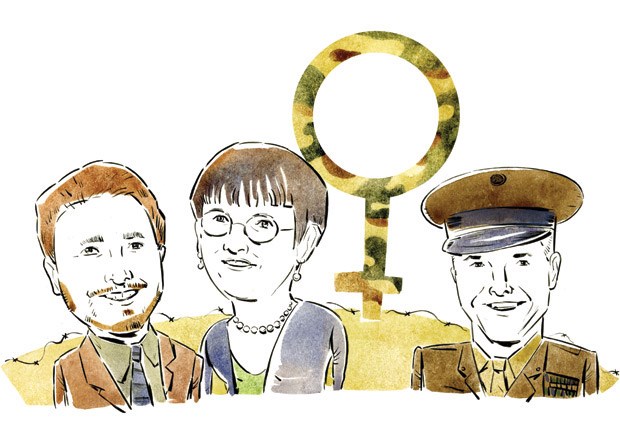
Owen Strachan is a contributing writer for the Gospel Coalition and executive director of the Council for Biblical Manhood and Womanhood.
Recently, the Marine Corps Gazette published a bold op-ed on a hot topic: women in combat. This essay was not written by a patriarchal jarhead, however. It was authored by Katie Petronio, Marine captain.
Petronio, a former college hockey player, shared that after five months on the frontlines in Afghanistan, "I had muscle atrophy in my thighs that was causing me to constantly trip and my legs to buckle with the slightest grade change." Eventually, Petronio lost 17 pounds and was diagnosed with polycystic ovarian syndrome. She concluded, "There is no way I could endure the physical demands of the infantrymen whom I worked beside."
This experience confirms the fears of evangelicals who have concerns about women in combat. Scripture teaches that woman was made from man, a truth that grounds her dependence on him (Gen. 2:21-22). It details how Adam failed to own this responsibility and protect his wife. For this reason, God addressed him first after the forbidden fruit was eaten: "Where are you?" (Gen. 3:9). Adam was a self-crippled man.
This tragic pattern continues in different places in biblical history, leaving courageous godly women like Deborah and Jael to lead in place of men. When Barak quails at the thought of battle against the Canaanites, Deborah promises that this abdication "will not lead to your glory, for the Lord will sell Sisera into the hand of a woman" (Judges 4:9, ESV). We hear her scorn loud and clear, even as we hear the pounding of Jael's tent peg into Sisera's skull (4:21).
David, whose kingship begins with his stunning defeat of Goliath, is supported during his reign by his "mighty men," something of an Israelite SEAL Team Six (1 Chron. 11:10-47). David's sacrificial valor anticipates the warrior-savior, Jesus Christ, whose death on behalf of his people was an act of war against Satan (Isa. 53; Eph. 4:8). Jesus was a self-sacrificial man.
Men receive their marching orders from this Christlike example. Paul teaches that husbands "ought to love their wives as their own bodies." In these and other texts, we see that the Bible consistently shows men protecting women, whether in home, church, or broader society.
The Bible teaches textually what common sense tells us naturally—and physiological study confirms scientifically. According to scientists Anne and Bill Moir, authors of Why Men Don't Iron, men are generally larger, stronger, and faster, and have greater lung capacity, a faster metabolism, and roughly 11 times the testosterone of women. God's design for men and women is good. We ignore it at our own peril.
If men will not own this responsibility, then women will be forced to take it on as did biblical women such as Deborah and Jael (and the extrabiblical figure Judith). Many modern men fail to mirror Christ in leading, providing, and protecting. In the cries of fatherless children, the strained voice of working mothers desperately seeking "work-life balance," and the Marine Corps Gazette, we hear echoes of the Bible's first question, addressed to a self-crippled man: "Where are you?"
Gender Doesn't Matter
Jan McCormack, USAF Chaplain, Lieutenant Colonel (retired), is director of the chaplaincy and pastoral counseling programs at Denver Seminary.
Yes, women should be allowed to serve in combat roles. Sacrificial love is a core principle of Christianity—as is compassionate protection for those who are not able to protect themselves.
These are principles that apply to all of us, regardless of gender or the times in which we live. They demand courage and often break with the mores of the culture for a greater good. Esther was willing to sacrifice herself by braving the wrath of the king even unto death, in order to save her people. Mary knew that becoming pregnant by the Holy Spirit, not by her fiancé Joseph, could get her killed, yet she obeyed God's will for her.
In the Bible's patriarchal society, we read of heroines who engaged in combat in desperate times. Judith was not a warrior, yet she beheaded the Assyrian king's general. Deborah, a prophetess and a judge of Israel, guided her people during peace and war. When war and oppression came, she battled against the superior Canaanite army herself and led her male troops to victory. Sisera, the enemy general, then fled the battlefield towards Kedesh, where he was received by his ally Heber's wife, Jael. After he fell asleep, Jael killed him with a tent peg. She was hailed a heroine by the pursuing Israelite forces.
Before the modern state of Israel existed, Jewish women served in combat roles in what would become the Israel Defense Forces, because "every Jewish male or female" needed to be "prepared and trained to fulfill the obligation of national defense." In 2000 women were readmitted to combat roles; those trained as combat soldiers serve a longer mandatory term and stay in the reserves longer than their noncombat sisters (though most are exempted from reserve duty after marriage or having children). Both men and women can be exempted from military service for religious reasons.
Article continues below
In America, during World War II military women did not serve in combat roles. Like men, they returned to their civilian lives at war's end. With the draft's repeal, women entered noncombat service as a voluntary career. Increasingly, combat has become much less hand-to-hand. Today, despite prohibitions against women serving directly in combat roles, the Gulf wars have shown that the line between combat and noncombat has all but disappeared. Whether it is through terrorist attacks, guerrilla tactics, or aerial bombings, women are as exposed to combat injuries or being killed in action as men are, regardless of their job.
"Greater love has no one than this, that he [or she] lay down his life …" (John 15:13, NIV 1984). In all things, we are to respond to the Lord's call on our lives. No one should automatically be excluded on the basis of gender alone.
Gifts are what counts
Alan "Blues" Baker, Rear Admiral and Chaplain of the Marine Corps (retired), served on staff at Menlo Park Presbyterian Church and is currently principal consultant at Strategic Foundations.
Christmas week of 2006, as I climbed into a helicopter on my way to a combat zone deep inside Iraq, I noticed two machine gun barrels protruding from the helo in anticipation of hostile fire.
One of the gunners with dark goggles took a finger off the trigger, turned to face me, and gave me a thumbs-up while handing me a note: "Chaplain Baker, my name is Sgt. Elizabeth Walker. I was stationed on the USS Harry S. Truman with you from 2001-2003. Glad to see you again." Knowing my fellow shipmate was defending our group gave me confidence to focus on my mission of encouraging the Marines whom we visited on the ground.
Earlier in my career, I was responsible for the safety of 30 crewmembers as the officer-in-charge aboard an 80-ton training vessel. When caught in an offshore squall, the entire crew became seasick and I felt as if I were the only one left to steer the boat.
Article continues below
I was relieved to see five crewmembers gain the resolve and iron will to maintain their posts in spite of their illness. As a small team, we brought the vessel safely into port. All five of these tough sailors were women. Once the males saw their female colleagues in action, not only did any doubts about the women's abilities disappear, the whole crew grew stronger as well.
Aboard this boat, I noticed that the women tended to work twice as hard, perhaps because of lingering stigma. The men seemed to need to compete with each other and with the women, so they also brought their best to the same mission. It became symbiotic. These experiences demonstrated to me that a woman can be as successful as a man whether she is leading a helicopter squadron through the Euphrates River Valley or a software company in Silicon Valley. In my experience, I have seen women not only being as successful as men, but often more successful.
As Christians, we should seek to serve where we are gifted. We should support those who are best qualified for combat, whether male or female. I find this similar to Paul's proclamation in Galatians 3:28: "There is neither Jew nor Gentile, neither slave nor free, nor is there male and female, for you are all one in Christ Jesus." Whether it is a playing field or a battlefield, all who are called should have the opportunity to serve without reservation.
I saw a verse painted on the side of a building in Kandahar province, Afghanistan: "Then I heard the voice of the Lord saying, 'Whom shall I send? And who will go for us?' And I said, 'Here am I. Send me!'" This verse from Isaiah reminds me that God calls us to places of significance by his design and for his purpose, regardless of whether we are male or female.
Have something to add about this? See something we missed? Share your feedback here.
















 While we pray for peace, we need moral clarity about this war.
 We’ve got little information on Jesus’ appearance and personality. But that’s the way God designed it.españolFrançais
 Leader explains why the movement is seeing its biggest membership bump in 30 years and its mission for the years ahead.






