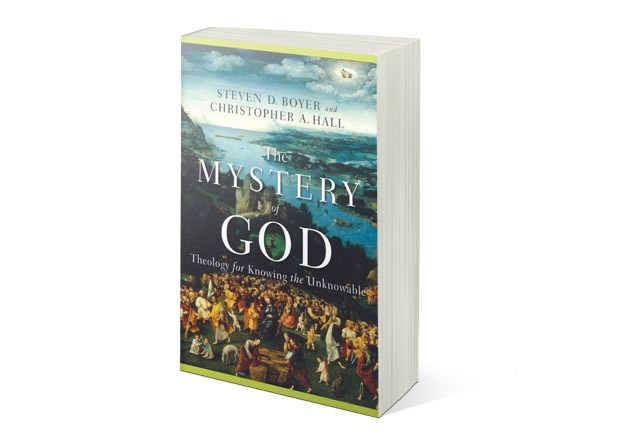
The Mystery of God: Theology for Knowing the Unknowable
Author
Steven D. Boyer; Christopher A. Hall
Publisher
Baker Academic
Release Date
November 1, 2012
Pages
264
Price
5.49
Although it is a dangerous business to select a passage from a Shakespeare play and hold it up as a mouthpiece of the poet, there are nevertheless a few key passages that seem to express the bard's own thoughts on the creative process. In Act V, Scene I of A Midsummer Night's Dream, for example, Theseus, King of Athens, offers a mini-dissertation on the surprising similarities between lunatics, lovers, and poets. Of the poet's art in particular, he says: "Such tricks hath strong imagination, / That, if it would but apprehend some joy, / It comprehends some bringer of that joy."
Dictionaries, even the Oxford English Dictionary, offer little help at understanding Shakespeare's distinction between apprehend and comprehend. If we read the lines, however, in the context of Theseus's full speech, the following distinction emerges: To apprehend is to perceive some force or feeling that transcends our ordinary human faculties. To comprehend, by contrast, is to create some rational or artistic framework for making sense of, and thus "containing," the very force or feeling which seems to defy description. Thus, in the poet's case, an apprehended feeling of unbounded, free-floating joy is comprehended, through the device of poem-writing, into a single, concrete bringer of that joy.
In The Mystery of God: Theology for Knowing the Unknowable (Baker Academic), Steven Boyer and Christopher Hall seem to translate (unconsciously) Theseus's distinction into the realm of theology. Too often, they argue, theology attempts to put into concrete words and images an experience that is finally too large for us to take in—and not just quantitatively (there is too much of God for us to grasp), but qualitatively as well (as Uncreated Creator, God is wholly other than his creatures and cannot be contained in logical categories). When we try to force the essence of the eternal, omnipresent Creator into our own structures of thought, we often find that we have not so much explained him as explained him away. At this juncture, one might expect Boyer and Hall either to treat theology as a branch of subjective poetry—beautiful, perhaps even awe inspiring, but incapable of expressing universal truth—or to give up on putting into words (comprehending) that glory, majesty, and holiness of God that we can only barely apprehend.
'Revelational Mystery'
Thankfully, they resist both options, instead offering a different distinction that maintains both the otherness and mystery of God and our capacity, through theological exploration, to reliably know his nature. Too often, modern theologians, especially pluralists, think of God as an "investigative mystery." If we are to understand him, we must amass scattered clues and then figure out how they might fit together. The Bible and traditional Christianity, in contrast, present God as a "revelational mystery." God has revealed himself to us through the Law and Prophets, the Old and New Testament, and Christ himself. We haven't been left to search in the dark. Still, because the God who reveals himself is beyond our comprehension, the mystery remains and cannot be fully contained in doctrinal statements.
This distinction allows the authors to avoid the extremes of modernist rationalism, which attempts to explain all aspects of God in logical terms, and "postmodern" mysticism, which says that we can only know what God is not, never what he actually is. Boyer and Hall work hard to preserve the true, ungraspable mystery of God, while making sure that we do not fall into "using 'mystery' in a despairingly investigative sense, as describing our sheer, hopeless ignorance." Those who hide behind such ignorance often appear to be (and may truly be) humble, but such a position inevitably leads to relativism and agnosticism. The fact is that God wants to be known and has revealed himself to us thorough the written and incarnate Word.
Our true position is like that of a Flatlander who lives in a two-dimensional world and is suddenly presented with a sphere. He cannot, of course, perceive the sphere in any empirical or even rational sense. Such a figure will seem logically impossible, just as the Trinity and Incarnation seem logically impossible to three-dimensional creatures for whom three cannot also be one and a single person cannot be simultaneously human and divine. But let's say the Flatlander receives trustworthy revelation that there is a greater, radically transcendent world where spheres do exist. Though such a revelation will not allow the Flatlander to comprehend the sphere within the limits of his two-dimensional space, it will enable him to recognize his limits and embrace the mystery. "The things of God are not internally self-contradictory," the authors explain, "but what we say about God would be self-contradictory if we were speaking of the ordinary things of our world."
Article continues below
Such simple but profound statements allow Boyer and Hall to navigate the dangerous strait between mystery-free rationalism and content-free mysticism. They also allow the authors to mediate between a static, "Platonic" view of orthodoxy and one that leaves greater room for historical development. Yes, the authors admit, it took the church several centuries to define such key doctrines as the Trinity and Incarnation, but that does not mean they made them up out of whole cloth. Once we accept a "revelational" paradigm of mystery, we will realize "that the historical development of orthodoxy is a crucial part of our genuine understanding of orthodoxy." We do, in a sense, follow the clues, but those clues are revealed to us and lead us, slowly, toward greater understanding. Often, we find that a doctrine like the Trinity is not only important in itself, but has the power to illuminate other aspects of God, ourselves, and our world. The fact that God is a community of Love that includes an eternal relationship between Father and Son sheds light upon human marriage, family, and friendship, even as the fact that Jesus was fully God and fully man sheds light on our own composite, incarnational nature.
Boyer and Hall set themselves a difficult course indeed, but they are able to stay on an orthodox course by reminding us of something too often forgotten in seminaries: namely, that theology must ever go hand in hand with worship. When we finally realize that God is not impersonal and unintelligible but radically personal and supra-intelligible, our proper response should not be to trade our theology for an empty pluralism that says all religious claims are equally valid, but to fall to our knees in praise of the Creator whose ways are not our ways and whose thoughts are not our thoughts.
Impressive Teachers
Boyer, professor of theology at Eastern University, and Hall, chancellor of Eastern University and dean of Palmer Theological Seminary, are both excellent scholars, but they are even more impressive as teachers. Though the authors take us on a whirlwind tour of Christian theology, focusing on such heady topics as the problem of pain and predestination (Calvinism) vs. free will (Arminianism), they never once fall prey to jargon. Quite to the contrary, they hold their reader's attention from beginning to end, never missing a step or hiding behind opaque academic language or scores of technical notes. In terms of lucidity, choice of analogies, irenic tone, nuanced common sense, and connection to the practical, day-to-day life of the man in the pews, they come very close to reaching the bar set by C. S. Lewis.
Article continues below
The authors succeed brilliantly in focusing our eyes on the central mystery of our faith: that we are made in the image of a God whose actions, though freely chosen, are constrained by his very nature, "with the result that full, meticulous sovereignty can be sustained right alongside full, libertarian freedom." Where else in our contentious age of soap-boxing and spin can the "mere" Christian reader find an honest appraisal of the strengths and weaknesses of Calvinism's Logic of Sovereignty and Arminianism's Logic of Freedom? And where else, in an age that daily blames God for war and natural disasters and that treats prayer like an ATM machine, can we be reminded that the kind of shalom God seeks is not mechanical (where faulty parts are thrown out and replaced) but personal (where flawed human beings are not replaced, but healed).
All Christians know that the God of the Bible is personal, but few have gone as far as Boyer and Hall in drawing out the full implications of God's radical, transcendent Personhood.














 While we pray for peace, we need moral clarity about this war.
 As my doubts about his teachings grew, so did a secret fascination with Jesus.
 The Grammy-winning artist was found dead at her home in Nashville at age 47.





