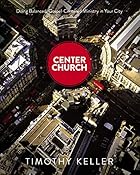
In an era when many thoughtful Christians struggle to adapt their message to a post-Christian world, without selling their doctrinal birthright for the sake of cultural relevance, Timothy Keller has steadfastly maintained that the gospel can bloom in the unlikeliest of places. In Center Church: Doing Balanced, Gospel-Centered Ministry in Your City (Zondervan), Keller, pastor of New York City's Redeemer Presbyterian Church, draws on decades of pastoral experience and cultural reflection to outline a theological vision for engaging modern urban societies. Chris Castaldo, director of the Ministry for Gospel Renewal at Wheaton College's Billy Graham Center, recently spoke with Pastor Keller about how the church can plant seeds of genuine gospel transformation in even the hardest of soil.
Why did you write Center Church?
The book is an accumulation of the kind of material that I've been teaching since the mid-1980s, when I was on faculty at Westminster Theological Seminary. As the years unfolded, I began to realize that in between our doctrinal confession and church programming is a "middle space." It is here, in this space, where we reflect upon the relationship of theology and culture to comprehend how they mutually impact ministry. In Center Church, I call this integrated reflection "theological vision." Simply put, it refers to a faithful restatement of the gospel with rich implications for life, ministry, and mission in a specific culture and historical moment.
Is this book only for people who minister in the city?
It has been remarkable to observe how many people outside of the city have benefited from the lessons that we offer urban leaders through the Redeemer City to City project. The main reason, I believe, is that late modern culture presents non-urban communities with many of the same challenges. These are the issues to which Center Church is addressed. If you live in a small college town in the middle of Iowa, for instance, you probably face many of the same opportunities for gospel witness that we encounter here in New York.
IfThe Village Voiceoffered you a feature article in which to articulate Redeemer's vision for serving the Big Apple, what would be the gist of your message?
I would expect the Voice to be hostile to the notion that evangelical Christians would have a significant presence (to say nothing of a prophetic voice) in the city. Unfortunately, we're not viewed as part of the beautiful mosaic that is New York. In such a newspaper, I would lead with three things: First, that Christ changes the way we use wealth and power. Our understanding of work must reflect what Robert Bellah (from his book, Habits of the Heart) describes as a contribution to the common good. Along this line, I'd express a desire to populate the city with people who embody this vision. I'd want to see an explosion of philanthropy, in which we don't spend money on ourselves, but instead cooperate with others who want to make the city a desirable place to live. Much like Wilberforce did in the early part of 19th-century England, we would pursue healing and redemption.
Second, I would address artists and thought-leaders, emphasizing that Christians have a positive outlook for the future over and against the dystopian pessimism that so often characterizes evangelicals. We are not naïve about suffering and evil, but we have a long term hope for society that can seize an ordinary life.
Third, we'd like to encourage growing civility and true pluralism in our society, that is, to counteract anger and contribute to the creation of an atmosphere of mutual respect among people of differing beliefs.
Monsignor Richard Figliozzi is a self-identified "evangelical Catholic" from the Archdiocese of New York. After reading your section on the "catholicity" of "gospel ecosystems," he proposed collaboration on a weekly luncheon aimed at presenting Jesus to post-Christian executives. How would you respond?
If by "presenting Jesus" the Monsignor means reporting on what is happening in churches, the state of Christianity in the city, the idea of truth, social teaching, apologetics, marketplace ethics—in other words, if it's about having a conversation, I would gladly participate. If, on the other hand, presenting Jesus means evangelism, then I would need to be free to elucidate my particular beliefs concerning biblical authority and the way in which salvation is appropriated (i.e., by faith alone). In such a scenario, I'd feel responsible to explain the difference between the Catholic and Protestant traditions. I am happy to go anywhere to proclaim the gospel, so long as I have the liberty to present the message with integrity.
Why must the church pursue "gospel renewal," and where in the US do you observe such movement?
We earnestly need gospel renewal as individuals and, on a larger scale, in our churches and communities. With regard to the latter, I have in mind an especially vigorous season of preaching, conviction of sin, prayer, joy, worship, and evangelistic activity—what we typically mean by the word "revival." Think for instance of 1 Corinthians, where Paul applies the gospel to churches. He first addresses the problem of relational divisions and factions. Then he deals with immorality and divorce, declaring that we Christians are not our own. In chapter ten, where he confronts the practice of meat sacrificed to idols, Paul undermines cultural norms by announcing that we are free, but not completely so because we're supposed to sacrificially love one another. Chapters twelve and fourteen go into worship issues. Notice, in all of this, the apostle doesn't say "here are the rules." He routinely goes back to the gospel, connecting the dots between salvation in Jesus and the particular issues before God's people. In Center Church we consider such examples from church history to see that these are the ways and means by which God brings gospel renewal.
Article continues below
On a personal or local church level, yes, I see evidence of renewal. Thankfully, there are always pockets of the world in which the Spirit at work. But in terms of an expansive movement where the church is growing at a faster rate than the population, I am unaware of such a movement today, at least in North America or Europe. Years ago, I read a volume of sermons on the New York revival of 1857-59, where 80,000 people joined the church during those years (ten percent of the 800,000 people living in the city). That is an example of gospel renewal. And while we may not observe it at present, we maintain that miracles from the past instill hope for the future, where good seed penetrates hard soil and dry places wait in expectation for a coming deluge.













 While we pray for peace, we need moral clarity about this war.
 A Christian reconciliation group in Israel and Palestine warned that war would come. Now the war threatens their relevance.العربيةFrançais
 The Grammy-winning artist was found dead at her home in Nashville at age 47.





