Russell Moore, dean of the School of Theology at Southern Baptist Theological Seminary, recently talked with Religion News Service about why adoption has become his personal cause and why more evangelicals should be joining him. On the eve of the 40th anniversary of theRoe v. WadeSupreme Court decision that legalized abortion, Moore said adoption fits evangelicals' anti-abortion values, even as he maintains adoption isn't right for every family.
The interview has been edited for length and clarity.
You have written on a range of pop culture, political and social issues, so why have you made adoption—and specifically Christian adoption—your big cause?
My wife and I went through several years of infertility and miscarriages and found ourselves going through the process of adoption and we felt very much alone. So I started to write about the issue of adoption really to address people who are in the same situation that we were, which is not understanding and seeing the meaning of that rich metaphor of adoption in Scripture, not understanding how adoption makes a real family.
What do you see as the biblical metaphor of adoption?
Scripture says that Christians have been adopted into the family of God, and so regardless of background, regardless of past, everyone who is in Christ is part of the family.
With gay marriage legislation moving ahead and not as many victories as they would like on abortion, is this a cause where evangelicals could see more success?
I don't really see success in terms of legislative or cultural victory. I see it more in calling evangelical Christians back to a commitment that we've always had to shelter the vulnerable.
Are you suggesting that evangelical churches specifically or churches in general be more involved?
At the level of the common good, this is something that all people should be concerned about. But it's consistent for evangelical Christians to be pro-orphan.
What most churches want, when they start to think about this issue, is a preprogrammed initiative, a set of instructions. I don't think this issue works that way. It has to be organic. It has to be flexible. It has to create a culture within a congregation.
It will be congregational cultures that start to change with the inclusion of the families who are adopting and fostering and caring for orphans. I think that's a long-term project over a generation, not something short-term.
Could this be a form of evangelism—the idea that children adopted by evangelicals may become evangelicals themselves?
Adoption and orphan care and foster care are not a covert means of evangelism any more than Christians having babies is a form of reproductive evangelism. It's simply Christians love children, and part of what it means to love children is to share the gospel.
Prospective parents often think of having children that look like them and have all 10 fingers and 10 toes. But should adoption be a nondiscriminatory calling?
Absolutely. That's one of the reasons why you have many Christians who are particularly adopting special needs children who are in all sorts of points of vulnerability, from AIDS to cleft palate to fetal alcohol syndrome. I also think that any family that's adopting needs to understand that this child is a person and not a project. Someone who believes that adoption is simply going to meet some void within that person's life is not someone who should adopt.
Do you think the connection between the anti-abortion movement and the pro-adoption movement has grown?
I think it has grown because the pro-life movement has grown. You see that, for instance, in terms of crisis pregnancy centers, which now are expanding to minister to women in all sorts of ways, ranging from child care to job training.
You are living this out—how many children have you and your wife adopted?
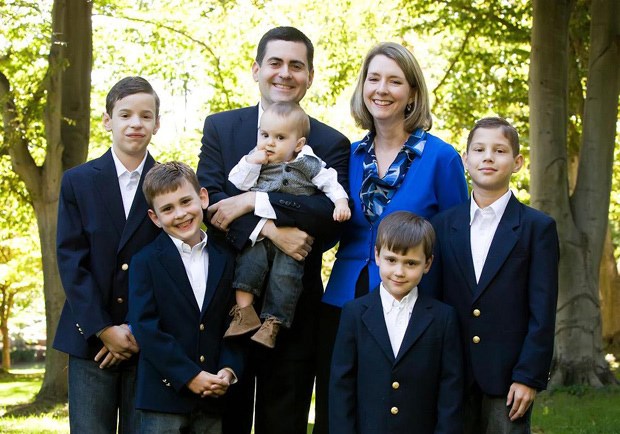
We have five children. We adopted our first two from an orphanage in Russia; they were a year old at the time, and they're now 11 years old.
What's the greatest benefit of being an adoptive parent?
The adopting of our two sons demonstrated to us something of the love of God for us and gave us a relationship that we never would have found on our own. We love our sons and they've brought so much to our family that we never could have planned out ahead of time.
And the greatest challenge?
The greatest challenge is confronting the idea that there's somehow a difference between adopted children and biological children in terms of affection, in terms of the structure of the family, which is not true. There's no such thing as adopted children. There are only children who were adopted. In a biblical understanding, "adopted" is a past-tense verb, not an adjective. So once someone has been adopted into the family, that person is part of the family with everything that that means.












 While we pray for peace, we need moral clarity about this war.
 As my doubts about his teachings grew, so did a secret fascination with Jesus.
 After lobbying from fellow Southern Baptists and Christians affected by the war, the House speaker moves a package forward.





