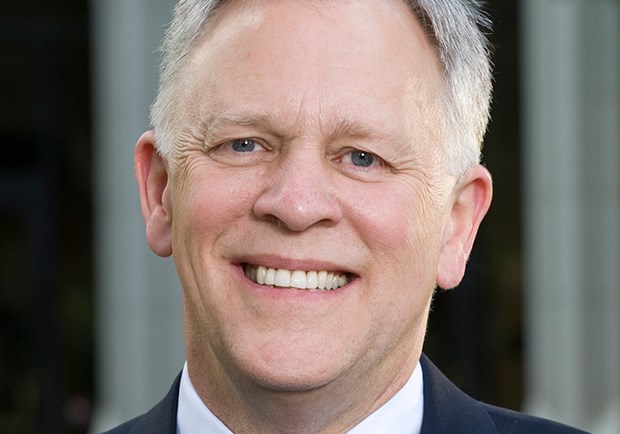
Fuller Theological Seminary announced today that its board of trustees has elected Mark Labberton as the school's next president (complete details here). Labberton, who currently serves as director of the Lloyd John Ogilvie Institute of Preaching at Fuller, will take over in June when current president Richard Mouw retires.
CT spoke with Labberton this morning about his new role and his vision for Fuller.
How do you feel being selected as Fuller's only third president in more than 50 years?
Well, it's thrilling and daunting both. It's thrilling because it's an exciting and wonderful institution with a rich, rich legacy. It's daunting because my two predecessors have been men of such stature and because the challenges that the seminary faces in 2013 and beyond are substantial. It's an exciting but challenging time, so I'm delighted and deeply honored.
Your experience is as a pastor and professor of preaching. What are the differences between being an effective preacher and an effective seminary president?
In both cases, I hope the thing they hold in common is a faithful proclamation of the gospel of Jesus Christ. I think that the leadership roles are quite different. Obviously, one is teaching and encouraging students more directly, and the other is shaping the overall life of the seminary; but the purpose of that is for the overall shaping of the many, many denominations that Fuller serves.
It's an extraordinary thing that Fuller has 100 denominations and 70 countries represented in its student body, so it's certainly the case that, being the president, you're trying to affect the church and serve the church in whatever ways Fuller can best do that in the U.S. and around the world.
One of the constant challenges that evangelical institutions struggle with is the issue of "identity." Mouw helped to re-establish Fuller as an evangelical school. How do you see the school's future identity?
Fuller's taproot is deep evangelicalism—a Christ-centered, Bible-trusting, Trinitarian, Christian orthodoxy. That is Fuller's identity. And the reality of that Good News is encompassing. That is, it is extensive in mercy and grace and justice.... I hope that what Fuller does is retain and continue to grow in its taproot, but is a seminary that fosters the church in a way that grows it into greater maturity. That's less about partisanship and much more about the peculiarity of a Kingdom-oriented love.
Fuller said in its job description of the presidency that it "seeks to advance the intelligent and constructive Christian vision needed to lead the church and world through the pressing problems of our time." Mouw made interfaith and ecumenical engagement, such as with Mormons and Catholics, one of the hallmarks of his presidency. Based on your own experiences and strengths, what do you hope to focus on as president?
I'm aware that we're living at a time when the church is undergoing some of the deepest changes it has faced in quite a while. The culture and the church are changing faster than seminary education has really kept up with. There's significant work to be done to determine how to serve a church that is changing in so many ways.
Because I've been a pastor for the better part of 30 years, I have a deep sense of what the local church is about. Because I served in a creative, dynamic place—in Berkeley, California—for most of those years, I have a sense of the way that culture is changing. I come to this responsibility as a pastor who cares deeply about the local church for the sake of its ministry in the culture and in the broader world. That's the main intersection where I hope my leadership can make a real difference.
Fuller was also looking for someone to support Fuller's regional and global influence, and you've "apprenticed" yourself with Global South leaders, including Ugandan bishop Zac Niringiye. What have you learned and how will this influence your presidency?
I have a number of deep international friendships and I'm in daily contact with a number of them. Through that experience of deep, trusting friendship, I have had an invitation to see the world in terms that are radically different than my world would otherwise be as a white, North American male.
To be befriended, trusted, and spoken to honestly by friends whose experience of the world is so radically different from my own enlarges my imagination for the kingdom of God. It deepens my empathy for the needs of the world, and has grown my heart and mind in ways that I hope are part of how I just live in the world, but also certainly are part of how I hope to lead.
I'm eager to try to make sense of a gospel that has to work in North America, but it also has to work in terms dramatically different from the North American cultural context. It's very easy for faith to become a small box that is much more about culture and sociology than about the intrinsic nature of the Kingdom. And while there isn't such a thing as a culture-free zone, we can begin to live in a larger picture of the world, and I think the gospel is meant to enlarge our imagination and our heart for love and justice and mercy.
Article continues below
Fuller recently did a report on the "seminary of the future." Of the concerns it points out, what challenge is the most important for Fuller to acknowledge and address?
For many, it is the increasing number of people who are the "nones"—people who have come not to disregard faith, but to disregard the church. Many nones that I know are people who care deeply about the globe, about their own lives, the world they're part of, and the suffering of many around the world. They just have the sense that, whatever the church is doing, it is distant and disconnected and embroiled in itself. So, one of the challenges is how do you raise up Christian leaders—pastors and others—who will stimulate a new kind of Christian imagination?
The other thing, in a more systemic sense, is the way higher education is facing the technological disruption of the internet. The possibilities of distributed education that [the Internet] opens are very exciting, but also raise questions about how to … stay committed to spiritual formation, which is a much less internet-transferrable quality. Fuller is growing its online courses and is in process of re-designing its M.Div. I can't yet speak as to whether Fuller will offer a full online M.Div, but we are going to go a long way down that road. We are already a long way down that road.
Institutions are under more scrutiny these days, not just from millennials who are suspicious of institutions, but from leaders in the wider culture. What is the role of institutions, specifically of seminaries, in the 21st century, and how will Fuller convince the wider marketplace that a seminary education has value?
While there's understandable scrutiny, and disregard in many quarters, there's also rejuvenated interest in the role of institutions … helping us to reflect again about how substantial Christian investment in institutions needs to be. The skepticism comes from sense that institutions are non-responsive and dull and fundamentally ineffectual, lost in themselves rather than remaining open and engaged and creative. A seminary like Fuller needs to demonstrate that it is open and engaged.
Fuller has done a good job telling its story. Rich Mouw's leadership has done a marvelous job conveying our commitment to civil dialogue and the wider public square. The question now is, if you're forming leaders to build church institutions, how does Fuller demonstrate that that's a legitimate thing? That's where the sense that Fuller is an entrepreneurial institutions and has tried to stay as close to the culture as possible while remaining faithful to the gospel, that it tries and is a very nimble organization in being able to do that.
Article continues below
I hope that will lead us to creative decisions about how we can offer education and training for the church in the real world—the real church in all its diversity and current array of expressions.
Speaking of problems that need creative solutions, one criticism of seminary education is that it costs a lot for a job that pays little and creates a lot of student debt in a highly competitive field. Is there a seminary bubble? What is Fuller doing regarding costs/debt?
I would say without qualification that I think there is a seminary bubble. Student costs are one of the great problems facing every seminary. … It doesn't help people to get a great education and to graduate with an unrealistic debt. We're working very hard behind the scenes, taking those issues with the greatest seriousness. … We're carefully looking at cost structure and our credit demands, trying to figure out how it is that those things can be brought … into greater alignment with the people we're seeking to serve.
As a student of Fuller myself, my own life has been deeply affected by the creativity of Fuller in the season that I was a seminarian. I hope that, in this next season, that same kind of dedication and creativity can be marshaled in such a way that it will continue to be within the power of a Fuller education to change and help people and the world.












 While we pray for peace, we need moral clarity about this war.
 We’ve got little information on Jesus’ appearance and personality. But that’s the way God designed it.españolFrançais
 Eastern Orthodox poet Scott Cairns reflects on his new collection, his journey of faith, and poetry’s capacity to apprehend inexhaustible realities.





