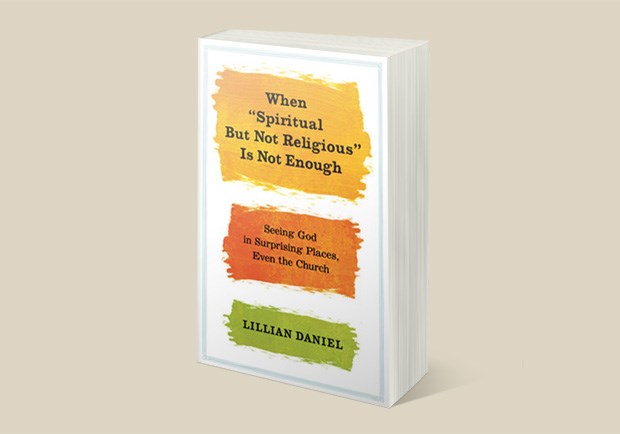
When "Spiritual but Not Religious" Is Not Enough: Seeing God in Surprising Places, Even the Church
Author
Lillian Daniel
Publisher
Jericho Books
Release Date
January 15, 2013
Pages
224
Price
13.99
"Religion" has become a dirty word in today's society. "Institution" is another verbal no-no, and we all know that the word "preachy" is entirely absent of positive connotation. Don't let the monosyllabic simplicity of "pew" fool you, either. It may seem like an innocent enough word for some. But many of those unmoored from the ecclesial harbors of their childhood will stiffen at its mention, instantly tormented by memories of sitting up straight on hard varnished planks while some preachy, institutionally-vetted clergyman pushed his religion on them.
And it is not just the secularists who dislike "religion." Anti-religious sentiment is so pervasive in our culture that even among Christians, criticizing the church and its varied institutional trappings is in vogue.
"Spirituality," however, is quite reputable—even popular. The preferred public profession of faith for a massive swath of our society—"I'm spiritual, but not religious."—is so common that it would not be surprising if it became a category on religious affiliation surveys. Participants could check Catholicism, Evangelical Christianity, Mainline Christianity, Buddhism, Hinduism, Islam, Atheism, Agnosticism, or Spiritual/Not Religious. Spiritually inclined yet religiously jaded, many of us seem to want a spirituality liberated from the shackles of organized religion and its uncomfortable pews.
Okay, enough, rings a voice of frustration. Please stop, because you spiritual-but-not-religious people are boring me. But that voice does not belong to a hidebound archconservative eager to defend the traditional church against the onslaughts of a hostile culture. The voice belongs, instead, to Lillian Daniel, minister of a mainline Protestant church that might seem quite at home touting spirituality over religion. And her complaint was not originally aired on an evangelical Christian television network. It appeared at the Huffington Post, in an article ("Spiritual But Not Religious? Please Stop Boring Me") now expanded into her latest book: When "Spiritual But Not Religious" Isn't Enough: Seeing God in Surprising Places, Even the Church (Jericho Books).
What specifically bores Daniel? She is simply unimpressed with any sort of spiritual life extracted from the messiness of a community. Finding God outside a tradition in which spiritualists (or religionists, as the case may be) have wrestled for centuries over the wonders and trials of life and faith? This has no attraction to her: "Where life with God gets rich and provocative is when you dig deeply into a tradition that you did not invent all for yourself."
Daniel takes the anti-religious sentiment that has become axiomatic for those outside the church walls (and for many still glued reluctantly to those church pews) and deftly exposes its narcissism and emptiness—but without sounding too "preachy."
Noticing God in Everyday Experiences
"Spiritual But Not Religious" is not a promotion of religiosity, legalism, or institutionalism. Nor is Daniel unworried about a meaningless ritualism that contents itself with going through the motions. Her intention, rather, is to present a spirituality thicker than the euphoric sensation brought on by a lovely sunset or by the smile of a giggling infant. Having labored for years amidst the trenches and pews of pastoral ministry, she knows all too well that a spirituality that can accommodate sunset hues but not cancer, grinning babies but not wails in the night, is woefully inadequate for the realities of an ex-Eden world.
The Spiritual/Not Religious category is not only insufficient for our sin-streaked realm; it is also grossly unoriginal. A spirituality divorced from communal life and eviscerated of a deep tradition is a predictable product of secular American consumer culture. It's custom-made, says Daniel, for a "bland majority of people who find ancient religions dull but find themselves uniquely fascinating."
But incisiveness notwithstanding, Daniel does not write with a chip on her shoulder. From beginning to end the book is marked by a good-humored delight in the churched and unchurched alike. In fact, most of the 32 short chapters are not specifically devoted not to directly critiquing the Spiritual/Not Religious cliché, but to noticing God in a panoply of everyday experiences (most of them less glamorous than sunsets). Struggling through Yoga class, noticing pets in the airport, and visiting inmates in a high-security prison become occasions of beholding the divine in the midst of the mundane and the unexpected. Her prose devoted to the prosaic daily grind is beautifully crafted, deeply touching, and quite often hilarious.
True, any secularist might also detect some vague higher power at work in such workaday scenes. But the church is never too far removed from Daniel's spiritual encounters and revelations. As the deep mahogany wood stains have seeped into the grains of those pews, her life has been textured and saturated by the life of the local church. Activities like the knitting of prayer shawls and baby booties in a church lobby feature more strongly than any sort of ecstatic, numinous experiences.
Article continues below
But what explains this anecdotal emphasis on pets, airports, baby booties, prisons, and pews, as opposed to a more analytical emphasis on the cultural trends that feed the modern tendency to profess "spirituality" while eschewing "religion"? Given that the book's title invokes this very tendency, I had expected a more sustained treatment of the anti-religious, anti-institutional zeitgeist of secular society. It may be that Daniel, having already covered this ground in her Huffington Post article, needed "filler" material to expand the viral blog post to book-length proportions. My guess, though, is that she is overcoming the shortcomings of a medium—brief online blurts allow little room for nuance and force too-severe dichotomies ("spiritual" versus "religious," in this case). The book actually serves to round off the sharp distinctions her Huffington Post commenters (self-styled spiritualists and hyper-religionists) accused her of making. For Daniel, religion and spirituality bleed into each other. Her objection comes from trying to wash the stains of the former from the latter.
Though I had anticipated a more substantial examination of our culture's anti-religious winds, I now realize that the book is better understood as a collection of vignettes and brief essays on spirituality, with the "spiritual but not religious" theme loosely serving as a sort of gravitational center. They depict a spiritual life that can appreciate sunsets only because the religious practices of gathering in community, knitting baby booties, hearing the liturgy, and reading Scripture help us face sin, injustice, and disaster as the sunset gives way to darkness.
A Place for the Bruised and Broken
Our heritage of institutional Christianity need not be viewed as a shameful skeleton to be kept locked away in the ecclesial closet. Well, okay, there are some darker chapters in our history that need not be retroactively whitewashed, but in many respects, that heritage and our communal traditions are precious gifts.
Daniel is not dishonest, however, about the shortcomings of the church's religious life. As a pastor, she has probably seen those failings more up close and personally than most folks claiming to be spiritual but not religious. One does get the impression that the sort of church culture she finds most embarrassing is of the more conservative stripe, as opposed to her own mainline church tradition. She is gracious, though, never naming names and maintaining sincerely that the various manifestations of Christianity all have their weaknesses and strengths (even her own).
Article continues below
Some readers might wince at a few sentiments at home in mainline Protestantism but contested in evangelical circles. But Daniel's book is neither a defensive manifesto of mainline spirituality nor an attack against any particular religious tribe. Even her witty polemic against the Spiritual/Not Religious notion is much more of an invitation than a critique. Daniel concludes powerfully by extending the arms of Christian religious life toward the religiously bruised and broken. There is a place for all of us right next to her seat on the pew.
Andrew Byers, a chaplain for St. Mary's College at Durham University, is the author of Faith Without Illusions: Following Jesus as a Cynic-Saint (InterVarsity Press). He blogs at Hopeful Realism.
Our Rating
Book Title
When "Spiritual but Not Religious" Is Not Enough: Seeing God in Surprising Places, Even the Church














 While we pray for peace, we need moral clarity about this war.
 A Christian reconciliation group in Israel and Palestine warned that war would come. Now the war threatens their relevance.العربيةFrançais
 As Haiti is uprooted by violence, church leaders treat gunshot wounds, give up homes for strangers, and rescue dignitaries.





