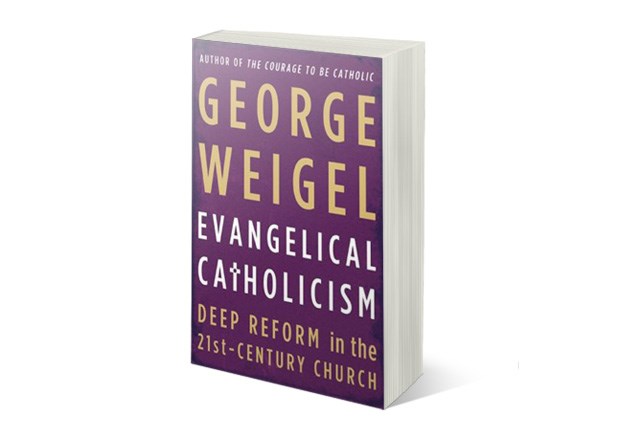
Evangelical Catholicism: Deep Reform in the 21st-Century Church
Author
George Weigel
Publisher
Basic Books
Release Date
February 5, 2013
Pages
304
Price
17.24
There is a great reform afoot in the Catholic Church! Or so says George Weigel, a prolific Catholic scholar and commentator. In Evangelical Catholicism: Deep Reform in the 21st-Century Church (Basic Books), Weigel argues the Catholic Church, since the 19th century, has been reorienting herself ever so slowly from "Counter-Reformation Catholicism" toward a confident, outward-looking, gospel-proclaiming, mission-driven faith. Which is to say, toward something distinctly evangelical.
As someone who joined the Catholic Church during his senior year at Wheaton College after being raised in an evangelical Protestant home, my first thought about Weigel's title was that it was potentially confusing, particularly for those who use the word "evangelical" primarily to designate a particular movement among Protestant Christians originating in the First and Second Great Awakenings in England and the U.S. So right from the outset, let's specify what Weigel does not mean. "Evangelical Catholicism," he writes,
is not a way of being Catholic that adapts certain catechetical practices and modes of worship from evangelical, fundamentalist, and Pentecostal Protestantism. Evangelical Catholicism is not the Catholicism of the future as imagined by either "progressive" Catholics or "traditionalist" Catholics... Evangelical Catholicism is not a movement within Catholicism, or a Catholic sect, or a new kind of Catholic elite. Evangelical Catholicism is not a substitute for Roman Catholicism.
The 16th-century Protestant Reformers diagnosed the problems of the medieval Catholic Church as theological, as opposed to being merely moral. But Catholic reformers across the centuries (St. Benedict of Nursia, St, Francis of Assisi, St. Catherine of Siena, St. Ignatius of Loyola, etc) have always believed true Catholic reform comes from a rededication to the teachings of the Church and a reinvigoration of authentic Catholic practice. Thus, Evangelical Catholics are not Catholics who take true Catholicism less seriously, but more seriously.
The Spirit's Preparation
Weigel frequently defines Evangelical Catholicism in contrast to some negative tendencies of Counter-Reformation Catholicism. Nonetheless, he insists the Counter-Reformation on the whole wasn't bad. It was appropriate for its time and was actually highly successful at not only preserving the Catholic faith during times of great crisis, but also in fulfilling the church's primary mission of proclaiming the gospel (with the successful evangelization of the Americas as an example. In any case, the cultural, theological, and political situation in which the church finds herself has changed dramatically, and the old ways are no longer sufficient.
But the Holy Spirit has been active, Weigel says, in preparing the church for a new period of her history. Changing demographics, for instance, help to explain the transition toward Evangelical Catholicism. Most of the places in which the church has been growing and thriving of late don't have the historical baggage of European Catholicism: The churches in Africa and Asia weren't around for the papal crowning of Charlemagne, the Protestant Reformation, or the French Revolution. Instead, they have been on the front lines of bringing the gospel to cultures that were not a part of Christendom—and have seen many of their brothers and sisters receive the crown of martyrdom in the process.
Weigel also points to the aftermath of the capture of the Papal States in 1870 as a pivotal moment in the rise of Evangelical Catholicism. The Pope, who for centuries had not only been the pastor of the whole church but also the King of a small country, was made "prisoner of the Vatican," as Pope Pius IX called himself. Indeed, no Pope left the grounds of the Vatican for the next 59 years. Pope Pius IX's successor, Leo XIII, mined the church's tradition for guidance and boldly forged a new way forward for engagement with the secular world with his seminal 1891 encyclical Rerum Novarum. Reform continued along in the 20th century, with a reinvigoration of the church's liturgy, biblical studies, and study of the church fathers. These processes culminated in the reforms proposed by the Second Vatican Council (1962-1965).
I say "proposed" since, as Weigel argues, much of the Second Vatican Council's vision has, at best, been unsuccessfully realized, or, at worst, ignored or even inverted. The Council explicitly called for a rejuvenation of the church's missionary work, specifically reaffirming that all Catholics, clergy and laity alike, are called to Christian holiness and the spread of the gospel. Yet, strangely, many Catholics in the West have made an appeal to "the spirit of Vatican II" as an excuse for embracing secularism, relativism, and a practical universalism.
Part of the problem, Weigel says, has been the prevailing interpretation of the Council as a contest between "traditionalist" and "progressive" Catholics, a false dichotomy that distorts the true intent of the Second Vatican Council. "Traditionalist" Catholics, Weigel argues, are right that the Church must retain her essential forms and teachings, but wrong that the church must express herself in the exact forms of Counter-Reformation Catholicism. "Progressive" Catholics are right that the church must reform herself, but wrong that reform means a break from her tradition. Evangelical Catholicism represents the third way, in that its purpose is to re-propose the essential, unchanging truths of the Catholic faith in the new modern context, with the goal of reinvigorating the church in her mission of bringing the gospel to the world.
Article continues below
Truth and Mission
Weigel gives two criteria for discerning what to preserve and what to reevaluate. The first is truth: Is a particular proposition part of the "faith that was once for all delivered to the saints" (Jude 3)? To determine this, Catholics will look to the two sources by which they believe the deposit of faith has been passed down—namely, written Scripture and oral Tradition (2 Thess 2:15)—and study them in line with how they have been authoritatively interpreted by the bishops, whom Catholics believe to be the successors of the Apostles. If the answer is in the affirmative, it's here to stay, and Catholics must recommit themselves to it. The second criterion is "mission." Does a particular practice aid the church in her primary mission of "making disciples of all nations" (Matt. 28:19)? The answer to this question, bounded by the answers to the first question, will of course be a prudential judgment, taking into account the new conditions of the world.
Weigel applies this two-fold analysis in chapters on the episcopacy, priesthood, liturgy, consecrated life, laity, intellectual life, public policy advocacy, and finally the papacy, with each chapter emphasizing loyalty to the gospel, careful application of church prescriptions, and prudent operational judgments. In the chapter on the Church's intellectual life, for instance, he exhorts bishops to boldness in their pastoring of theologians and other academics, encouraging them to do what's necessary—including, if necessary, the use of Church discipline—to help supposedly Catholic universities maintain their Catholic identity.
Article continues below
Evangelical Protestants should enthusiastically welcome many aspects of Weigel's vision for Evangelical Catholicism: renewed emphases on the centrality of Jesus Christ as Lord and Savior, the call for each person to share the gospel, and dedication to personal prayer and Bible study.
In other areas, however, many evangelicals will be disappointed Evangelical Catholicism preserves many of those things they might believe to be corruptions of the faith or improper Christian practice: obedience to the Catholic magisterium as the body established by Christ to authoritatively interpret the Word of God, the importance of cooperating with God's grace to live the Christian life for salvation, and devotion to Christ through the Sacraments, particularly the Eucharist. In fact, one hallmark of Evangelical Catholic revival has been growth in the number of parishes that have perpetual adoration chapels, where parishioners sign up to pray in shifts before the Eucharist continuously—all day, every day. Certain aspects of the Catholic faith simply are not on the table for reform.
Reliable Allies
If that is discouraging, evangelicals should be encouraged that the very same commitment Evangelical Catholics have to the teachings of the Church makes them reliable allies in cultural and legal battles over things like abortion, marriage, and sexual morality (with Evangelical Catholics perhaps even challenging their evangelical brothers and sisters to remember the historical pan-denominational Christian opposition to contraception). Ecumenically-minded evangelicals should also be encouraged by the fact that the Second Vatican Council permanently committed the Catholic Church to the work of re-establishing full unity among all Christians, and all signs point to ecumenism remaining a major priority for Evangelical Catholics.
Weigel is a brilliant mind and an excellent writer, well-versed in Catholic theology and history. But evangelicals should remember that Weigel writes only as a layman, and his suggestions regarding the prudent governance of the church are only that, suggestions. And while I'm not sure he hits the nail on the head in every instance—I'm somewhat uneasy with the readiness he thinks the papacy should have for deposing unruly bishops—most of his suggestions seem very reasonable.
Pulling together reforms that are already taking place in the Church with some prescriptions of his own, Weigel's Evangelical Catholicism is a bold vision for the future of the largest body of Christians in the world, and evangelicals would be wise to take careful notice.
Brantly Millegan is a Master's candidate in theology at St. Paul Seminary School of Divinity in St. Paul, Minnesota. He blogs at Young, Evangelical, and Catholic.
Our Rating
Book Title
Evangelical Catholicism: Deep Reform in the 21st-Century Church














 While we pray for peace, we need moral clarity about this war.
 A Christian reconciliation group in Israel and Palestine warned that war would come. Now the war threatens their relevance.العربيةFrançais
 But experts say it can offer opportunities for leaders and congregations to grow.





