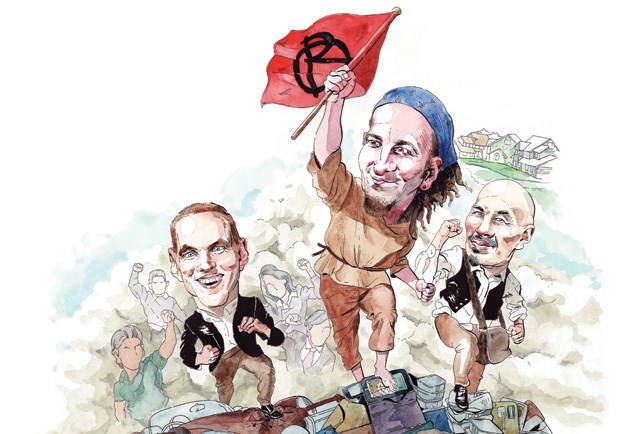
David Platt, Francis Chan, Shane Claiborne, and now Kyle Idleman are dominating the Christian best-seller lists by attacking our comfortable Christianity. But is 'radical faith' enough?
It's not easy to make the Church at Brook Hills, Alabama's second-largest congregation, look like a slum. But in 2010, the church collected trash all over Birmingham and set its stage in corrugated metal, scrap wood, plastic tarps, and other detritus. Three months before, their lead pastor, David Platt, had proposed that their church "take India," by which he meant pay for Compassion International's child survival programs in the country for an entire year. The whole church couldn't jet off to India, but the rubbish on stage tangibly reminded its members of the country's impoverished communities.
With the stage literally set, Platt called his church to something more than giving $525,000 to Compassion. Platt and the Church at Brook Hills (affiliated with the Southern Baptist Convention) spent a full year praying for the world, reading the entire Bible, giving their money to those in need, spending time in a context beyond Birmingham, and building community.
The five components of "the Radical Experiment" may not seem that radical; they're more like basic Christian discipleship. But they struck a nerve at the church and beyond. Forty families and singles committed to moving into a disadvantaged area of Birmingham. As one attendee told me, the news created something of a reputation for the church. "People still ask me," she said, "whether I go to that church where people are moving into the most dangerous parts of Birmingham." And the message spread well beyond the city of 1 million. After Platt released Radical in May 2010, it spent more than two years on The New York Times advice best-seller list. Three years later, it's still on CBA'S (formerly Christian Booksellers Association) best-seller list.
The first thing you notice about Platt is how young he is. When he took the position in 2006 at age 27, he was almost certainly the youngest megachurch pastor in America. Yet Platt's youthfulness belies both the boldness of his message and the conviction with which he presents it. His style avoids the verbal pyrotechnics some preachers rely on for their message to stick. The rising and falling intonations of his slow Southern drawl, and the way he draws out particular words and hesitates before hurtling through a string of sentences, make his preaching like a lazy float down a river with the occasional burst of rapids. He reels people in, almost unwittingly, with his easy charisma and lack of self-awareness. One moment, he'll have a grin reminiscent of a schoolboy on Christmas morning. The next, his voice will crack with an intense, pleading tone that betrays heartfelt resolve. When Platt told his church, "Let's say, Brook Hills, 'We're going to take India,'" the final words had that raspy, gasping tone. It suggested Platt felt the weight of the responsibility too deeply for his words to convey.
At the heart of Platt's message is his claim that we mistakenly turn the "radical Jesus of the Bible … into the comfortable Jesus of 21st-century American culture." He warns that the culture of "self-advancement, self-esteem, and self-sufficiency" and our "individualism, materialism, and universalism" have neutered American Christians' witness and blinded us to widespread global poverty, an orphan crisis, and the massive number of those who still have never heard of Jesus.
Platt's critique goes beyond the people in the pews. In case anyone missed his criticism of budgets and church-growth strategies, Platt's follow-up book, Radical Together, brought it to the surface: "[J]udging by what we hang on to in our churches, convenient programs and nice parking lots are still more important than [impoverished and orphaned] children and their families."
It's really hard to read these books, one after another, and confidently declare yourself a Christian at the end.
Platt isn't the only one attempting to recover a more rigorous understanding of the gospel's demands. Six years ago Shane Claiborne introduced "ordinary radicals" into the American Christian lexicon. His book The Irresistible Revolution offers a critique similar to that of Radical, albeit with a political focus that includes a more explicit repudiation of American nationalism (Platt's own work has hints of this) and a pacifist critique of violence.
More recently, Kyle Idleman, teaching pastor at Southeast Christian Church in Louisville, Kentucky, wrote Not a Fan after realizing he had made following Jesus "as appealing, comfortable, and convenient as possible." Francis Chan caught the wave with Crazy Love, a book that tries to affirm our desire for "more God," even if we are "surrounded by people who have 'enough God.'" Steven Furtick, whose Elevation Church in North Carolina is one of the fastest-growing megachurches, added Greater to the mix, proposing that Christians are mired in miserable mediocrity and should open our "imagination to the possibility that God has a vision for [our] life that is greater" than what we're experiencing. All of these have hit the Christian best-seller lists, and most are still on them.
Article continues below
In other words, the radical message has found an eager market. The books have their theological and pastoral differences, but the thrust of their rhetoric moves in the same direction. They have both incited and tapped into a widespread dissatisfaction with many Americans' comfortable, middle-class way of life and the Christianity that so easily fits within it. These pastors may not be saying much new about the Bible or Jesus, but their message says enough about us.
Radical Christianity's Favorite Word
Really. If there's a word that sums up the radical movement, that's it. Platt's Radical opens with it, by describing what "radical abandonment to Jesus really means." Idleman says he's going to tell us "what it really means to follow Jesus." Furtick says that "if we really believe God is an abundant God … we ought to be digging all kinds of ditches [for when he sends the rain, as Elisha did in 2 Kings 3:16-20]." Do those who lead mediocre, nonradical lives for Jesus really believe at all?
The question has ample biblical warrant, of course. Paul exhorts the Corinthians to test themselves to see whether they are in the faith (2 Cor. 13:5). Chan draws on this verse explicitly, calling for "a serious self-inventory." Idleman draws on it implicitly as he calls readers to have a "define the relationship" talk with Jesus to "determine the level of commitment." (Idleman draws on Jesus' warning in Matthew 7:21: "Not everyone who says to me, 'Lord, Lord,' will enter the kingdom of heaven.") In his latest work, Follow Me, Platt makes his warning explicit: "There are a whole lot of people who think that they've been born again, but they've been dangerously deceived." It's really hard to read these books, one after another, and confidently declare yourself a Christian at the end.
But most orthodox Christians don't need to be told how far they fall short of discipleship—and even less how much their self-described Christian neighbors need a "serious self-inventory." We've seen how "moralistic therapeutic deism" has infiltrated our churches. And it is little wonder that reductionist Christianity, with its stunted notion of "belief," has prompted the radical Christianity reaction. Yet no one seems to want to say what sort of belief actually "counts" head on.
Article continues below
Last year, Platt made waves by calling the Sinner's Prayer "superstitious." He explained that his critique was partly driven by his own fears.
"I can remember lying in my bed at night as a child/teenager, wondering about whether or not I'm really saved, and then thinking, Well, I just need to pray that prayer again—and really mean it this time—and then I'll know I'm saved," he said. "I don't want people to look to … a 'prayer they prayed' for assurance of salvation. I want them to look to Christ for this. Assurance of salvation is always based on his work, not ours."
Still, to join Platt and his church on their journey away from the American dream toward a "radical faith in a radical Jesus," Platt gives two preconditions: We must "commit to believe whatever Jesus says" and "commit to obey what we have heard."
These teachers want us to see that following Christ genuinely, truly, really, radically, sacrificially, inconveniently, and uncomfortably will cost us. Platt wants to safeguard the distinctness of God's saving work over and against our effort. But his primary concern is for the "outflow of the gospel." This means "putting everything in our lives on the table before God" and being "willing to sacrifice good things in the church in order to experience the great things of God."
The reliance on intensifiers demonstrates the emptiness of American Christianity's language. Previous generations were content singing "trust and obey, for there's no other way." Today we have to really trust and truly obey. The inflated rhetoric is a sign of how divorced our churches' vocabulary is from the simple language of Scripture.
And the intensifiers don't solve the problem. Replacing belief with commitment still places the burden of our formation on the sheer force of our will. As much as some of these radical pastors would say otherwise, their rhetoric still relies on listeners "making a decision." There is almost no explicit consideration of how beliefs actually take root, or whether that process is as conscious as we presume.
Article continues below
Or as dramatic. The heroes of the radical movement are martyrs and missionaries whose stories truly inspire, along with families who make sacrifices to adopt children. Yet the radicals' repeated portrait of faith underemphasizes the less spectacular, frequently boring, and overwhelmingly anonymous elements that make up much of the Christian life.
There's one significant exception to this: Each of these authors is keen to remind us of our mortality. Idleman lays out straightway that he's going to talk "more about death than life." Platt says, "Your life is free to be radical when you see death as reward." Chan says his sense of urgency comes from going to funerals a lot, and from losing his parents at a young age.
By contrast, there aren't many narratives of men who rise at 4 A.M. six days a week to toil away in a factory to support their families. Or of single mothers who work 10 hours a day to care for their children. Judging by the tenor of their stories, being "radical" is mainly for those who already have the upper-middle-class status to sacrifice.
Nor are there many stories of "failure"—of people sacrificing without visible signs of transformation. As a result, many of the narratives implicitly convey that the reason to go and die is the gospel success that will follow. In most stories, the results come during the lifetime of those who decided to "come and die." That's why the single most refreshing moment in the canon for me was Furtick's lengthy acknowledgment that God's "greater" often seems like disappointment and failure, and that in our "most dire moments [God] seems almost absent." Given how prevalent such moments seem in the Christian life—and in Scripture—they are disproportionately underrepresented in the "radical" literature.
The New Holiness Movement
Not a Fan begins with Idleman confessing that he had watered down the gospel "in hopes that more of you would fill these seats." It's reminiscent of another preacher's admission: "I felt a great want in my ministry. Crowds came and went, and yet with small result. I could not believe that all was right, and I [wanted] to see what was the secret of the spiritual power which some of my brethren possess."
That testimony came from a pastor attending a conference at Oxford in 1874. Americans Robert and Hannah Whitall Smith led the way, and called for a renewed focus on sanctification by prioritizing faith over action. One year later, the Keswick Convention began, which added theological muscle and legitimacy to the currents already at work.
Article continues below
Like today's radical Christianity, Keswick theology proved controversial. Andy Naselli, whose Let Go and Let God? explores the movement, says it was "based on the fundamental proposition that there are two categories of Christians." The first may be "free from sin's penalty," but they are not "free from sin's power." A "second blessing" lifts us out of our "carnal state" into the "spiritual life" through the presence of the Holy Spirit.
Today's radical movement does not descend directly from Keswick. But there are genuine similarities. As David Bebbington has demonstrated, Keswick theology has shaped evangelical piety for the past century. The language of "total surrender" and "complete abandonment" certainly echoes the Keswick rhetoric. And both movements strive to overcome the gap between professed belief and behavior. Keswick's two-tier solution tried to solve the lurking question about whether nominal believers are genuinely saved. While Platt goes a different route, questioning whether our conversions are real, the fundamental problem is the same.
Keswick's emphasis on the inner, higher life is understandable. The industrial revolution made comfortable middle-class life possible for millions for the first time—a little too comfortable for the Keswickians. Meanwhile, developments in physics and biology tempted even Christians to think of the world as the working out mechanistic laws of cause and effect. There seemed to be little room for the transcendent. Today's radical movement offers a similar complaint: The comfort of life numbs us to the life of God and eliminates any need to depend on his power.
In addition, Keswick theology arose just as evangelicalism started its decline in England—just as material comforts increased. Evangelicalism had exploded after a cholera epidemic had killed thousands some 40 years before. An awareness of death's imminence was one key to the movement's advancement. In the later 1800s, though, as the Keswick fervor took hold, the death rate fell—which, Bebbington slyly muses, "must not have been advantageous for recruitment."
For the poor, dying, and those excluded from upper-class leisure, it's natural that the gospel very much is about comfort and good news. But today's radicals believe that the church has become a country club. And yet, the poor and dying still exist in many places—and the radical movement keeps thrusting that fact before us. Because middle-class comforts inoculate us from those realities, it seems necessary to add adjectives—total, radical, complete—as though the substance of faith has dissipated.
Article continues below
'Really' vs. Reality
The Church at Brook Hills's slum stage reflects the tensions of the radical movement. The movement is marked by the sincerity of young, energetic pastors and writers eager to make a difference for the poor. Yet the message constantly fights with the medium. It occurs in massive church buildings in middle-class surroundings, spoken to people who shop at the Gap, on platforms called stages rather than pulpits. In order to inject the message with more power and meaning, we revert to the language and symbols of the theater—one of our culture's favorite pastimes.
Which is to say, the problem with the call to radical Christianity is that it may not be radical enough. It's clear that middle- and upper-class Christians are looking for a deeper, more profound experience of faith. Yet it's unclear whether we can invigorate faith without revisiting our worship and community practices, asking whether they are forming disciples at subterranean levels.
Consider the reminder that we are all going to die. This truth is easily forgotten in a prosperous society where the aged and infirm are cordoned off in their own communities. It is one thing for pastors to remind us of death in their sermons. But that won't engender more serious discipleship any more than, as Platt recognizes, a sermon on missions will engender love for missions. Concern for missions grows when missions are embedded into the life of a church, such as regular short-term missions. The same is true when it comes to facing our mortality. In the early church, persecuted Christians met in the catacombs out of necessity, but later Christians buried their own in graveyards around the churches. In both instances, the church was surrounded with reminders of mortality; such reminders were built into its architecture and practices. Staged slums take a church only so far.
Article continues below
The final paradox of emphasizing a radical faith is that the language of commitment and really risks allowing the very secularism they decry in through the back door.
What's more, the radical message comes packaged in the Christian-conference-publishing-celebrity-industrial-complex. While Platt warded off critics early on by donating his profits to relief and missions work, the popularity of his call for radical living requires the existence of a lucrative publishing culture that, by its nature, has to think and act with profits in mind. The really radical path for a megachurch pastor these days would be to refuse to publish, to take a smaller church, to not podcast sermons, and to embrace a more monastic witness. The irony is that if they tried, we'd probably turn them into larger celebrities and laud their humility. The desert fathers had a similar problem. But if the message is going to critique the American dream for the people in the pews, then we may need pastors willing to show us the path of downward mobility with their lives.
The final paradox of emphasizing a radical faith is that the language of commitment and really risks allowing the very secularism they decry in through the back door. By emphasizing the interior aspect of faith over the formal and distinctive elements of Christian worship—Communion, baptism, corporate singing—they risk missing just how secularized our communal life as Christians has become. It is easy to see signs of secularism in how Christians live from Monday to Saturday. But what about on Sunday morning?
Of course, such critiques of formalist Christianity—"going through the motions"—have a long and estimable history, voiced by everyone from Søren Kierkegaard, who railed against institutional Christianity, to Dietrich Bonhoeffer, who lamented cheap grace. But they weren't critiquing the church in the context of an anti-institutional, highly individualistic culture. When the call to individual radicalness is disconnected from a counterbalancing concern for the public form our Christian worship takes, we stand in danger of assuming the messages of the surrounding culture as we mimic their methods.
Interior-oriented movements can generate a lot of energy initially. But the gospel is supposed to create a culture, and a culture takes root only within a society over time. It perpetuates itself to future generations without requiring a new revival in every season. The urgent rhetoric of preaching the gospel to the billion unreached and helping the poor right now leaves little space to create the institutions and practices (art, literature, theology, liturgy, festivals, etc.) that can transmit such an inheritance to the next generation, and to form belief in deeper and more permanent ways. Buildings cost money, and beautiful buildings even more. Universities don't feed the poor or win souls, yet they promulgate knowledge in the church and around the world. These are the gears of a transgenerational movement. Yet it's not clear whether radical Christianity has any room for them. Most of the stories that are told in these books clearly do not.
Article continues below
The need for a revived attention to form is most clear in worship, which is the main theater of the church's confrontation with God. If the people in the pews have been uncritically co-opted by the American dream (and indeed many have), let's also point out that our worship practices have been nearly uncritically co-opted by the American emphasis on celebrity, stardom, and performance.
For us in the pews, testing ourselves must include deliberating about our vocations and whether we are called to missions, or to a life of dedicated service to the poor, or to creating reminders with art and culture of the gospel's transcendent, everlasting hope. Discovering a radical faith may mean revisiting the ways in which faith can take shape in the mundane, sans intensifiers. It almost certainly means embracing the providence of God in our witness to the world. The Good Samaritan wasn't a good neighbor because he moved to a poor part of town or put a pile of trash in his living room. He came across the helpless victim "as he traveled." We begin to fulfill the command not when we do something radical, extreme, over the top, not when we're really spiritual or really committed or really faithful, but when in the daily ebb and flow of life, in our corporate jobs, in our middle-class neighborhoods, on our trips to Yellowstone and Disney World—and yes, even short-term mission trips—we stop to help those whom we meet in everyday life, reaching out in quiet, practical, and loving ways.















 While we pray for peace, we need moral clarity about this war.
 We’ve got little information on Jesus’ appearance and personality. But that’s the way God designed it.españolFrançais
 Beyoncé’s right. Whether listening to Cowboy Carter or reading theology, diversity is a good thing.






