Of all the characters in the author's beloved Chronicles of Narnia, the title character of Prince Caspian is most like the author, and the book is surprisingly autobiographical.
In Jack's Life, Douglas Gresham's book about his stepfather C. S. Lewis, Gresham comments on the great love that the young Lewis had for Lizzie Endicott, the Irish woman who helped looked after Jack (as he was called) and his older brother Warnie. Gresham notes, "Jack was also fond of his nursemaid Lizzie, and she would tell him old Irish folktales and fairy stories."
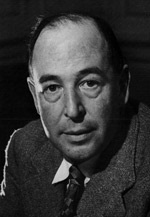
C. S. Lewis
In Prince Caspian, we find a comparable description: "The person whom Caspian loved best was his nurse, and though (being a prince) he had wonderful toys which would do almost anything but talk, he liked best the last hour of the day when the toys had all been put back in their cupboards and Nurse would tell him stories"—stories of the old days when dwarfs, fauns, and talking animals were abundant in Narnia.
When Prince Caspian the movie—the sequel to 2005's The Lion, The Witch, and The Wardrobe—opens in theaters next month, viewers might be interested to know that there are a number of parallels between the title character and the author of the Chronicles of Narnia.
One of the first things we learn about the young Caspian is that his mother has died and that his evil uncle, King Miraz, secretly killed Caspian's father. Lewis, too, lost his mother at a young age. Lewis's father—unlike Caspian's—lived until Jack was an adult but was aloof and emotionally distant, leaving the young Lewis, like the young Caspian, largely on his own.
In his recent best seller The Narnian, Alan Jacobs argues that Lewis was above all characterized by "a willingness to be enchanted." If we accept Jacobs's proposal, then it could be argued that of all his characters, Lewis was most like Caspian. In the profound love that both Lewis and Caspian had for fairytales, we discover what Jacobs refers to as "an openness to delight, to the sense that there's more to the world than meets the jaundiced eye."
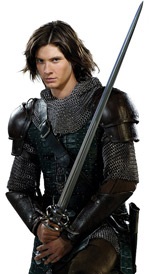
Ben Barnes plays Caspian in the movie
A yearning for the old days
Caspian and his creator are alike in another way. Caspian's insatiable yearning for the old days of Narnia, a yearning that fills "nearly all his spare hours," mirrors the desire Lewis himself felt.
In the opening chapter of his autobiography Surprised by Joy, Lewis describes this powerful longing he experienced from his youth onwards. There he cautions that anyone with no interest in this kind of experience need read no further, for, as Lewis asserts, "the central story of my life is about nothing else." Lewis found this yearning hard to categorize. He finally gave his sensation of deep longing the title of joy, defining it in a special way that distinguished it from mere happiness or pleasure and putting it center stage in his title.
Miraz puts a stop to the Nurse's "fairytales" by banishing her from the castle and ordering that a new caretaker be found. The tutor who appears in answer to Miraz's summons is none other than Doctor Cornelius, the half-dwarf who gives Caspian precisely what he needs, in much the same way the young Lewis was trained and guided by his own tutor, William Kirkpatrick.
While the physical appearance of Caspian's short and round instructor shares nothing in common with that of the tall, white-whiskered Kirkpatrick, both teachers were greatly loved and greatly influential. In a letter written after Kirkpatrick's death, Lewis maintained he owed his beloved tutor "as much as one human being can owe another" and went on to declare, "That he enabled me to win a scholarship is the least that he did for me." In a similar vein, Caspian will call Doctor Cornelius "my greatest friend" and "the savior of my life."
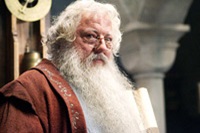
Vincent Grass as Dr. Cornelius
Myth becomes fact
Lewis and Caspian share another element—one more significant than all the others, for it changed the direction of their entire lives. The desire for another world which they both experienced as young boys did not remain unsatisfied longing. In a dramatic turnaround, Doctor Cornelius reveals to Caspian, "All you have heard about Old Narnia is true." In a same way, through the help of J. R. R. Tolkien and their fellow Inkling Hugo Dyson, Lewis came to see that the Christian story was not just a myth like the others which he loved, but a myth that "became fact."
When Caspian finally meets the Old Narnians, he tells them, "I want to stay with you—if you'll let me. I've been looking for people like you all my life." In a similar vein Lewis rejoiced in the discovery that his earlier longing had been "a pointer to something other and outer," that the Easter tale of the God who becomes man and dies actually happened "at a particular date, in a particular place, and was followed by definable historical consequences."
Devin Brown is a Lilly Scholar and a Professor of English at Asbury College, where he teaches a class on
C. S Lewis
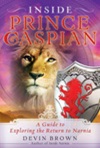
. He is the author of Inside Narnia (Baker 2005) and Inside Prince Caspian (Baker 2008). This summer he will serve as Scholar-in-Residence at The Kilns, Lewis's home in Oxford. Brown, who lives in Lexington, Kentucky with his wife Sharon and Mr. Fluff, their 15-pound cat, also wrote
"My Caspian Wish List"
for CT Movies.












 While we pray for peace, we need moral clarity about this war.
 A Christian reconciliation group in Israel and Palestine warned that war would come. Now the war threatens their relevance.العربيةFrançais
 Eastern Orthodox poet Scott Cairns reflects on his new collection, his journey of faith, and poetry’s capacity to apprehend inexhaustible realities.