It's that time of year when we start watching favorite Christmas movies, and for many, the list begins with Frank Capra's It's a Wonderful Life. When we think of Capra's films, it's easy to break into a smile, for he was "the great constructor of happy endings," as biographer Vito Zaggiro has written.
But Zaggiro doesn't stop there. In the very same sentence—in his article titled "It's (Not) A Wonderful Life: For a Counter-Reading of Frank Capra," Zaggiro notes that the director's films also often "represented enormous social contradictions and conflict that clash with the surface message of his films."
Barbara Stanwyck in 'The Miracle Woman'
One typical conflict is the struggle between individual faith and organized religion, particularly in two of five Capra films starring Barbara Stanwyck—The Miracle Woman (1931) and The Bitter Tea of General Yen (1933). A close reading of the former, in conjunction with Capra's comments about faith and discussion of Stanwyck's acting technique, all combine to underscore the primacy of that struggle.
Capra deemed it a failure
In his autobiography, Capra suggests The Miracle Woman—inspired by the life of 1920s evangelist Aimee Semple McPherson—was a failure because he was unable to create a role in which the heroine, Florence, followed the intended arc of "one woman's life in three acts: disillusion, venality, conversion." Instead, the plot breaks into these three parts: disillusionment with religion, spiritual confusion, and acceptance of individual faith. Thus, even though the outward plot does not follow Capra's intended sequence, it is possible to read the film in such a way that Florence's faith development coincides quite clearly with the arc he wanted.
Florence's disillusionment is evident from the start. The film begins on a Sunday morning in a Methodist church; Florence stands at the pulpit telling the congregation that her father, the minister, has just died. It soon turns into a rant—she is clearly disappointed with the congregation and, by extension, members of established religion. But she is not rejecting her faith.
Then Florence begins chastising the congregants for not paying her father enough to have saved for a "decent burial." As she becomes angrier and more specific about their perceived wrongs, a church member stands up and says she is not behaving appropriately for the "house of God." Florence responds, "What God? Whose God, yours? This isn't a house of God! It's a meeting place for hypocrites!" Florence then says she's "going to preach the sermon her father should have preached" and recites a passage about the hypocrisy of the Pharisees.
The key here is her delivery of the word "hypocrite," which she emphatically repeats. She chastises them because their actions do not coincide with their purported beliefs. Rather, they have reconciled themselves to the fact that their established religion does not coincide with their lives—and worse yet, they accept this. Florence refuses to accept the reality of hypocrisy: the apathy toward the conflict between the internal belief and external action. Florence's final words imply that the congregation's passive acceptance of hypocrisy has created stagnation in the place where faith is meant to breathe—and Florence feels as though she is suffocating.
Florence's disillusionment is paralleled in the second part of the film via spiritual confusion. Later, alone in the church, she is startled by the seemingly-sudden appearance of Bob Hornsby, a con man who proposes that she take evangelical preaching "on the road." Florence adopts the moniker of "Sister" and becomes a celebrity, touring with her "message" to "lost souls" who don't mind paying a fair price for a night of entertainment, music, religious conversion, and healing. The "lost souls" are paid actors who are clearly in on the scam, but it's unclear how much Florence/Sister knows about it.
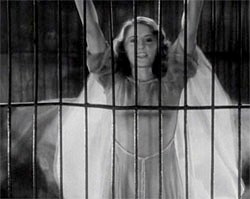
A scene from 'The Miracle Woman'
The plot is further complicated when Florence calls up an actual blind man—not one of the regular actors. Onstage, she claims that God will heal his blindness if he just believes enough; she even brings him into the lion's cage as a testament to her truth as a prophetess.
As viewers, we wonder why Florence would call up a stranger if she was in on the scam—and if she was cold to the Scriptures she espouses. The answer is unclear and thus, the viewer delves deep into the film's ambiguity and nuance. She seems to believe the words she says, but she is so clearly jaded to certain aspects of religion—indications of her spiritual confusion. We ask the same question Capra asks: Does she or does she not believe her own sermons?
Eventually, Florence's spiritual confusion becomes too much to bear. She comes clean about the scam, sobbing as she confesses; in her powerful delivery, we clearly see her guilt and struggle. It's not the confession of a fraud who has been caught; she confesses willingly, and the viewer realizes that though the miracles themselves may be fake, the faith is not.
Article continues below
But Florence apparently needs some intervention—perhaps divine—to help her resolve her internal conflict. While confessing to her audience, the stage accidentally catches on fire. She remains on stage, seemingly unconcerned with the proximity of the flames to her ecstatic and now fully spirit-filled moment. As she faints, she is rescued.
This scene sets up the final resolution where see Florence marching along with the Salvation Army, leaving us with a shot of her singing "Glory, Glory Hallelujah" while smiling triumphantly. The camera zooms in; her face fills the screen as the film fades to black.
We are left with a heroine who maintains her own faith while seeming to reject "organized religion." In some ways, that's more complicated than the plot Capra feels he failed to create, and Stanwyck's performance of power and conviction makes it work.
Capra's spirituality
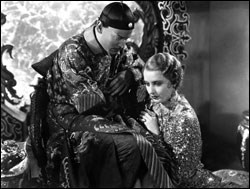
In his autobiography, Capra says The Miracle Woman was not intended to "kid religion" as Harry Cohn, the head of Columbia Pictures, suspected. Capra's own spirituality was similar to that depicted in The Miracle Woman and in The Bitter Tea of General Yen, in which Stanwyck plays Megan Davis, an American missionary in China who character also struggles to find balance between individual faith and established religion.
Capra recounts his experience with Catholicism in his birthplace, Sicily, where he was a follower of science who equated religion with "peasant superstition." But he would also attend Mass at Christmas and Easter, and described a particular experience of the Eucharist: "On those holy days I sneaked into a Catholic church to kneel; to smell the incense, hear the angels sing, and be lifted out of my shoes by the passion and resurrection of Christ. It may happen to you only once in a hundred Masses—but it will happen. You walk back from Communion with the Host on your tongue—a nobody. You kneel, drop your head in your hands. Slowly the wonder of it fills you with joy—the dissolving Host in your mouth is the living Christ!"
So, one on hand, he appears to reject Catholicism, but on the other, his Eucharist experience reflects a personal reach toward spiritual transcendence.
Stanwyck in a scene from 'Bitter Tea'
While Capra criticizes what he sees as ambiguous messages of The Miracle Woman and Bitter Tea, it is that ambiguity that makes both films more palatable—and perhaps successful—to contemporary audiences. Regarding the former, Capra claims he "turned chicken" and created an outside villain to take the blame for the scam, while the heroine is not completely blamed. Capra claims he wanted a fervent religious follower to fall from grace and then have a powerful conversion; instead, he is left asking of the film: "Did she or did she not herself believe those 'inspiring' sermons delivered in diaphanous robes, with live lions at her side? I didn't know, Stanwyck didn't know, and neither did the audience.'" He feels that the film created an ambiguity about the heroine's religious and spiritual journey, which he automatically interprets as a negative.
Article continues below
But in both films, we see the struggle of the spirituality in conflict with established religion, and ultimately, both films support the claim that spirituality abides as the source of strength for Stanwyck's characters.
The key to discovering these below-the-surface readings is in Stanwyck's ability to create nuanced performances of power. Stanwyck appears in Capra's films more than any actress—five—but all are more controversial and lesser known. In all five, Stanwyck's character experiences a struggle between the internal and the external, which manifests on multiple levels, but mostly between individual faith and organized religion. It's difficult to believe that this ongoing struggle is mere coincidence. It's one reason Capra worked with her so often; the creative reciprocity between them adds a dimension of purpose and skill that is reflected in the more nuanced readings of the films.
In his interviews, Capra was frank about preferring Stanwyck above other actresses, including Jean Author and Claudette Colbert: "She [could] give you that burst of emotion better than the other two could … she [was] probably the most interesting of the three. She [was] also the hardest to define … she played the parts that were a little tougher."
Stanwyck's ability to do a film-ready performance on the first shot forced Capra to change his directing/shooting style. He says she had to learn to control the emotional power in her performance, while he "had to invent ways not to rehearse her." Capra rescheduled rehearsals and the way the film was shot in order to accommodate Stanwyck's strengths. Hers was a power he both cultivated and wanted to preserve.
I believe that the type of spirituality portrayed through Stanwyck in these films reflects Capra's own life experience—a unique symbiosis between director and actress. In each film, Stanwyck's characters—perhaps like Capra himself—are fully capable of claiming personal faith even when they may dismiss the roles of religious institutions.
Katherine Richards, a grad student in English at Duquesne University, writes on the representation of women in film and literature. This essay is excerpted from a chapter in Faith and Spirituality in Masters of World Cinema, Volume II, edited by Kenneth R. Morefield, a CT film critic who blogs here.













 While we pray for peace, we need moral clarity about this war.
 We’ve got little information on Jesus’ appearance and personality. But that’s the way God designed it.españolFrançais
 After lobbying from fellow Southern Baptists and Christians affected by the war, the House speaker moves a package forward.