As the Twilight juggernaut gets into gear again this week with Friday's release of Breaking Dawn, Part 1, the frenzy about this story and these characters continues to fascinate millions while baffling others. For many Christian fans, this saga relates more than a tale of teenaged love and all of its trials and tribulations. These narratives raise issues related to faith, redemption, and hope as well as demonstrate positive values with regard to family, friendship, building community, and the expression of sexuality. But many overlook one of the more interesting religious themes: The idea of human free will and the importance of the ability to make moral choices stand out as central topics throughout the Twilight saga, although they are often confused by the idea that these characters exist in an eternally fixed and determined universe.
The core story of the series revolves around the obsessive love of the vampire Edward Cullen and the human Bella Swan. As the saga unfolds, each repeatedly asserts the inevitability of their bond; in their world, it really is destiny. Edward, for instance, believes he spent many of his 100-plus years (he was born in 1901, and turned into a vampire during the 1918 influenza epidemic) searching for something he could not find because Bella did not yet exist. He further determines that when he first meets Bella, the unique scent of her blood mystically drew him in and that his inability to hear her thoughts demonstrated her unique nature in relation to him. Bella, likewise, figures out relatively quickly that Edward is a vampire. While she understands the danger that represents, she also asserts that she cannot help but love him no matter what. Indeed, when he separates from her in the second book, New Moon, she loses the ability to function normally. In her mind, her life depends on being with him.
Edward and Bella, a love story of destiny?
While one might claim these are merely the feelings of a young love, Edward and Bella also appear to exist in a world that they understand to operate under unchangeable or inevitable conditions. Edward contends that vampires have no options other than damnation. In spite of the Cullen family's unique diet of no human blood, vampires represent a soulless species having lost the precious gift of their humanity. As amoral blood predators, they can only produce death, by feeding on victims—human or otherwise—or turning them into powerfully animated corpses. Edward's sister Rosalie makes this point clearly when she expresses her anger toward Bella for her willingness to transform into a vampire and give up the possibility of having a child.
Similarly, Bella's friend Jacob Black, a werewolf, lacks control over his nature. In his reality, the presence of vampires forces his tribe to shift from human to wolf form. Additionally, as both a man and a wolf, he must respond to the commands of the pack's alpha. Further, like many others of his kind, he can "imprint" on another person, creating a bond that can neither be resisted nor broken. Like Edward, he sees his world as circumscribed by the conditions of what he is.
The human world, to Bella, seems equally fixed, but also mundane by comparison. While she feels trapped by her aging (in comparison to Edward's eternal 17-year old self) and faces a different kind of peril due to her mortality, she fails to see that these features actually offer her a world of options that serve as the most important aspect of her humanity. Instead of human life being determined, it is actually marked by choices.
Mormon tradition, moral choices
The author of the Twilight series, Stephanie Meyer, comes out of the Mormon tradition. As Latter Day Saints understand the world, humans pre-exist with God in the divine realm. Incarnation as mortal beings happens in this world as a testing ground to demonstrate a person's worthiness for life eternal. Of most significance, God does not control humans, and salvation is not inevitable. Rather, in Mormon theology, God looks to humans to develop the ability to make moral choices and thus to find their way into eternity.
Most mainline Christian traditions express this idea in the concept of free will. Protestant Christianity in particular, found such a concept controversial. On the one hand, if humans could not exercise true choice, then God could not hold humans accountable for their decisions. On the other, if God truly is God and all-knowing and all-powerful, human choice must be predetermined.
For Bella, then, the ability to choose her fate defines her as a human and opens up a variety of possible outcomes for her. In Meyer's story, this concept plays out most clearly in the decision Bella must make between Edward, the vampire for whom she professes love, and Jacob, her best friend. Upon close consideration on this score, Jacob emerges the better man in his willingness to teach her the value of making moral choices.
Jacob, the good-guy werewolf
Jacob presents himself as a powerful hero and protector as well as a living example of learning to make sound decisions. For example, he not only offers Bella legends and information that give her necessary knowledge into the larger interplay of vampires and werewolves, but he also saves her from the vampire Laurent, from killing herself cliff diving, and from freezing to death in the wilderness before a battle. Additionally, Jacob demonstrates and articulates what he can offer to Bella, including growing old together, having a family, and living a "normal" life.
Article continues below
Most significantly, he encourages Bella to take on a more mature self. Jacob consistently pushes Bella to act out of something other than her own desire. He makes her aware, for instance, that she cannot simply abandon her father Charlie. Further, he shows her what selflessness means. When she finally decides to marry Edward, Jacob uses the story of Solomon, the two women, and the baby to say that he will walk away in order not to cause her additional pain. He also risks his life to protect her when she gets pregnant—even to protect her from Edward.
By contrast, although Edward comes across as the great romantic hero always saving and protecting Bella from other vampire, from the ruling vampire group the Volturi, and even from himself, he also seeks to manipulate and control her decision making, and he places Bella in situations where she must be dishonest. For instance, to see Edward, she lies to family and friends when she sneaks off to see him, runs away to Italy to save him, or violates her father's rules by repeatedly allowing him into her bedroom. Further, he seeks to keep Bella away from Jacob by disabling her vehicle as well as arguing that Jacob puts her in a peril that never materializes.
When Bella wants a relationship, no matter the cost, Edward chooses to leave her bereft and alone. When she wants Edward to turn her into a vampire and earns the support of his family, he demands a marriage she does not want as the condition. When she becomes pregnant, he plans to destroy the child that she wants, and she must seek protection from his sister Rosalie to make certain her wishes get enforced. Edward simply never shows that he understands or respects Bella's choices. Instead, he most frequently acts out of a vampire nature that seeks power and control, manifested here as a manipulative self-interest or, if considered more generously, patronizes her in a manner that demonstrates no regard for her ability to make a rational choice.
When placed against a Mormon frame of reference, Edward appears more like the figure of Satan, who argued while still an angel that humans should be compelled to salvation. God, however, wanted humans to have moral choice. Likewise, Edward seeks to block Bella's ability to do what humans must. He attempts to circumvent her own process of maturation by pushing her into decisions that he sees as better for her rather than allowing her to make her own choices and her own mistakes. In such an environment, she must break free of his sway in order to become who and what she should, and to choose freely and accept the consequences of decisions she makes for herself.
Article continues below
Edward as Christ figure
Why, then, does Meyer develop the story in such a way that the importance of moral choice takes a lesser role? The answer rests in the apocalyptic frame of reference she develops over the course of the saga. In the biblical tradition, apocalyptic literature straddles the divide between a community under significant stress and the radical hope for something better. Books such as Daniel and Revelation encourage the faithful to hold fast to their beliefs, even if it means death, and to know that a new world where the problems of the old will no longer exist awaits in their future. Seen in this light, the relationship between Edward and Bella takes on an entirely different and somewhat odd cast.
Is this vampire also a Christ figure?
Here, Edward emerges not only as the hero, but as a type of Christ figure. Outside of the norm of the human world, he exists in a body that defies mortality, can act outside the bounds of normal physical limitations, appears (at least in the sunlight) transfigured to human eyes, and he functions, on a regular basis, as Bella's savior. What he promises Bella, through his blood, is a new and perfected body and life eternal. Although this transformation requires death, the new possibility represents something desirable.
In response, Bella comes across as an unusual combination of willful and reckless. Her fierce and unwavering attachment to Edward reads, at least in part, negatively as an overly dramatic teenager who clings obstinately to a choice without even the capability of weighing options in a realistic frame. However, on a more positive note, she can be seen as a Luke 14:26-35 kind of Christian, who willingly gives up family, friends, and her life to follow her faith in who Edward is and in what he represents. Indeed, she is also willing, as is typical of believers in apocalyptic stories, to be martyred for Edward. Her run-ins with the Volturi and her willingness to sacrifice herself in battle demonstrate that point.
Article continues below
The faith she exhibits when seen in this light ushers in a new age and a new reality. Bella marries and consummates the relationship with Edward as a human being. She becomes pregnant, and at birth, as their child, Renesmee, a hybrid, claws out from her womb, Bella must die to her human self and be transformed into a vampire to survive the savage birth. Like Christian martyrs, she dies only to receive a new life, and one she experiences as superior in every way. Her body possesses a physical strength and perfection. Her intimacy with Edward becomes more powerful; apparently vampires have great sex.
Further, she lives in a community that can break the formidable grip of the ruling Volturi over the Cullens, as well as experience reconciliation between once opposed species. Through the child that she and Edward create, a true merging of what human and vampire can be appears. The Cullens love and cherish her. Charlie, Bella's father, can enter into this community and be a part of it. And Jacob, once violently opposed to this union, imprints on the infant and brings the werewolves into this idealized kingdom where peaceful coexistence of varied species is not only possible, but actualized. And yes, it's a lion and lamb metaphor.
Although a romantic ending, this conclusion loses some of its power by presenting an apocalyptic world where, in biblical terms, the tide of the inevitable means good must triumph over a persistent, dangerous, but ultimately overmatched evil for a redeemed Jerusalem to emerge. For Twilight reader or movie goers, Bella can appear as the true heroine; her courage and fortitude become an embodiment of what it takes to produce the new world she builds and then inhabits. But this option also misses the true nature of a world in which free will operates.
The ability, indeed the requirement, to make choices stands out as central to authentic relationship with the divine. If God already knows the end, and the decisions humans will make, then those decisions have no real import and free will does not exist. In this understanding, what if Bella chose Jacob? Or moved to Florida with her mother? Would her life have been less meaningful? An inevitable ending might prove both romantic and comforting, but it does not acknowledge the real and powerful persistence of evil, or require much of humanity as a partner worthy of life with God.
If humans can decide whether or not to enter into relationship with the divine, whether they want to accept or to reject the grace God extends through Christ, then the end of our stories remains in question. Perhaps of greatest significance, the decisions we make will then matter in terms of working out the ethical and moral dilemmas we face. In Bella's world, we would then pose the question, "Could the already cooperating vampires and werewolves not have figured out another mechanism for peaceful coexistence? Was her solution the only possible outcome?"
Article continues below
To a believer in free will, the answer must be no.
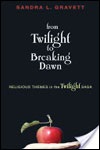
Sandra L. Gravett is author of From Twilight to Breaking Dawn: Religious Themes in the Twilight Saga (Chalice Press, 2010). She is also a professor in the department of philosophy and religion at Appalachian State University, and enjoys exploring the intersection of religion and culture.















 While we pray for peace, we need moral clarity about this war.
 We’ve got little information on Jesus’ appearance and personality. But that’s the way God designed it.españolFrançais
 Christian artists work at the intersection of music and climate change.