Born to a Catholic family and later attending a Jesuit school, Alfred Hitchcock often incorporated religious imagery into his films—even though he had a love-hate relationship with faith.
The Jesuits have a saying: "Give me a child until he is seven and I will give you the man." That motto could almost be said to describe Alfred Hitchcock, the legendary film director and TV producer who made over 50 movies in a career that spanned half a century. Born to a Catholic family in London in 1899, Hitchcock didn't begin his studies at a Jesuit school until he was a year or two older than seven, but the influence of his religious upbringing can be seen throughout his work.
Hitchcock grew up in a strict Catholic family that went to Mass regularly at a church pastored by one of Hitchcock's cousins, a priest. Hitchcock himself was, briefly, an altar boy. In 1908, he began attending St. Ignatius College, a Jesuit school.
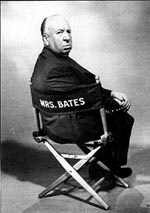
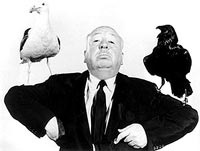
Alfred Hitchcock on the set of 'Psycho' in 1968
In later years, he tended to downplay the religious significance of his education. In an interview with film critic turned director Peter Bogdanovich, Hitchcock credited the Jesuits with teaching him "organization, control, and to some degree analysis …. I don't think the religious side of the Jesuit education impressed itself so much upon me as the strict discipline one endured at the time." The religious influence at school consisted mainly of fear, he said, "but I've grown out of religious fear now."
Nevertheless, Hitchcock was a practicing Catholic for most of his life. His wife Alma, a film editor, converted to Catholicism before their marriage in 1926, and they worked and lived together until his death in 1980. They attended Mass weekly, and they quietly made several generous donations to Catholic churches and charities. In 1952, their daughter Patricia married the grandnephew of the late Cardinal William O'Connell, who had been a powerful archbishop in Boston.
Hitchcock, one of the most successful directors in British and Hollywood history, began in silent films and directed England's first talkie, Blackmail, in 1929. After a string of international hits, including The 39 Steps (1935) and The Lady Vanishes (1938), he moved to the United States and directed Rebecca (1940), the first of six films for which he was nominated for the Academy Award for Best Director. (He never won, though Rebecca did win the Oscar for Best Picture.)
He thrived on technical challenges. He staged entire films, like Lifeboat (1944) and Rear Window (1954), on a single set, and he shot Rope (1948) in a series of long shots, averaging eight minutes each, designed to make the entire film look like it was done in one take. He also liked to experiment with new genres and mediums, whether shooting Dial M for Murder (1954) in 3-D, creating his own TV series in 1955, or making his own version of the cheap but highly profitable B-movies of that era with Psycho (1960).
And while he may have grown out of what he called "religious fear," Hitchcock's films became famous for their suspense, their psychological complexity, their focus on the nature of guilt, and their power to remind the viewer that good and evil reside in the hearts of everyone. What's more, he frequently depicted these themes in ways that rely on religious imagery—churches, icons, and men of the cloth.
A recurring theme in Hitchcock's films is that of the innocent man who is accused of a crime he did not commit—what the critics call "transference of guilt." On one level, this theme echoes the way that Jesus, as an innocent victim, was falsely accused and took on the sins of the world. But Hitchcock also uses this theme to explore how even seemingly innocent people have their own dark side.
For example, in the silent classic The Lodger (1927), a jealous police officer with a blonde girlfriend—blondes are also a recurring Hitchcock motif—accuses a stranger of being a serial killer who has already murdered a number of blonde women. The stranger is innocent of this particular crime, but he is not exactly pure, himself; he is actually plotting to find and murder the serial killer, to avenge his own sister.
Things get more complicated in, say, Strangers on a Train (1951). A famous tennis player is trying to get a divorce from his cheating, manipulative estranged wife, and he meets a man who says he wishes his own father was dead. The man proposes swapping murders; if the wife and the father are killed by complete strangers, the police will never be able to establish a motive for their murders. The tennis player does not take the man seriously, until after his wife is actually killed—and because the tennis player can't establish an alibi, he is suspected of the crime anyway.
Significantly, before the murder takes place, the tennis player says in a moment of anger that he would very much like to kill his wife. So while he may be technically innocent of the crime, he still benefits from her murder, and he still arguably shares the guilt for her death on some deeper, spiritual level. At any rate, Hitchcock underscores how the impulse to sin lurks within us even when we don't commit it.
The transference-of-guilt theme finds its most explicitly Catholic form in I Confess (1953), which stars Montgomery Clift as a priest who hears a murderer's confession and is then suspected of the murder himself. Because the priest is required by the sacrament of confession to keep what he hears to himself, he cannot tell the police who really committed the crime, not even to save his own life.
Article continues below
On one level, the priest has been interpreted as a sort of Christ figure, because he bears the burden of another man's sin. Hitchcock himself seems to point in that direction when he frames the priest against a large crucifix in the background, or when he puts the priest behind a statue depicting Christ carrying his cross.
But the film is more complex than that. For one thing, it turns out the priest himself stands to gain from the murder of the man in question; we learn that the victim, purely by coincidence, happened to be blackmailing a woman with whom the priest had had an affair some years before he was ordained. And as each character confesses the sins in his or her past, we begin to realize that the "I" of the movie's title could be referring to any one of them. In this way, Hitchcock underscores the shared fallenness of humanity, but also the shared possibility of redemption.
A reaffirmation of faith
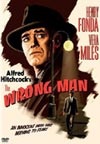
One of Hitchcock's more unusual films also touches on this theme. The Wrong Man (1956) is based on the true story of Manny Balestrero (Henry Fonda), a musician who is arrested outside his home and prosecuted for a series of armed robberies that he did not commit. As Manny is shuttled between the police station, prison, and the courtroom, his wife Rose (Vera Miles) suffers a nervous breakdown.
Because it is based on a true story, The Wrong Man is filmed in a much more realistic style than most of Hitchcock's films—though there are exceptions to this "realism." In one scene, Manny's mother urges him to pray, and so he does, standing before an icon of Christ with his rosary beads. As he prays, Hitchcock uses a double exposure to show a man walking down a street until his face is in close-up, overlapping the image of Manny's face. This man then tries to rob a store—and when he is caught, he is promptly charged with all the crimes that Manny had been accused of.
Thus, Manny is set free, and at least some of his prayers are answered. According to biographer Patrick McGilligan, Hitchcock often apologized for this scene because it seemed to violate the film's "realism," yet he also insisted that it was one of his favorite things about the film. "The one thing he liked was a cinematic intrusion that violated neorealism—a moment that provided a moving reaffirmation of his faith that, in a just world, God wouldn't condemn a wrong man," McGilligan writes.
Article continues below
Of course, this is not to say that Hitchcock believed the world was just. Nor is it to say that Hitchcock's faith was uncomplicated. Richard A. Blake, author of Afterimage: The Indelible Catholic Imagination of Six American Filmmakers, says later films like The Birds (1963) reflect a troubling, terrifying view of the natural world. "The birds, like God, are most terrifying because they are most unpredictable," writes Blake.
Hitchcock's 'Birds' were, like God, unpredictable
On one level, The Birds raises the question of why God permits evil, but on another, it also suggests that there is something dreadfully awe-inspiring in the sometimes violent, sometimes eerily calm birds. Blake does not say the birds represent God, per se, but he does note that they are "totally Other" and "totally incomprehensible to the human mind," and neither reason nor superstition can explain them away.
Beyond that, Blake notes that there is hope for the human characters in The Birds—as in many of Hitchcock's other films—and it lies in acting "as members of a community, who are both sinners and searchers for love."
Never a pious Catholic
Hitchcock was never exactly the most pious of Catholics. His films had their share of risque innuendo, and he sometimes depicted clergymen in mildly irreverent ways, from the minister who provides the punchline for Strangers on a Train to the priest who is abducted in the middle of a service in Family Plot (1976), his last film.
It is said that Hitchcock was once offered an audience with the Pope, during a trip to Rome during the latter part of his career, and he turned it down, lest he be given advice that he dare not refuse. "What would I do," he asked, "if the Holy Father said that in this world, where there is so much sex and violence, I ought to lay off?"
When asked about his beliefs, Hitchcock tended to downplay the significance of his Catholic faith—though he admitted the influence was there. In an interview with Francois Truffaut, he said, "I don't think I can be labeled a Catholic artist, but it may be that one's early upbringing influences a man's life and guides his instinct." And, in a 1973 interview with the student newspaper at St. Ignatius College, he said, "A Catholic attitude was indoctrinated into me. After all I was born a Catholic, I went to a Catholic school and I now have a conscience with lots of trials over belief."
Article continues below
Toward the end of his life, Hitchcock stopped going to church, and as his health declined, he resisted or even refused a priest's offer to come to his home for a private Mass or for the last rites. Even so, after his death, a memorial Mass was held for him at the Church of the Good Shepherd in Beverly Hills. "He was a Catholic all his life," writes Blake, "a cranky one to be sure, but a Catholic nonetheless."
Filmmakers of Faith
, an occasional feature at Christianity Today Movies, highlights directors who adhere to the Christian faith—sometimes strongly, sometimes loosely, and sometimes somewhere in between. This series will include everyone from biblically-minded evangelicals to directors who may only have a "church background" and perhaps a lapsed faith … but their films are clearly informed by their spiritual history.












 While we pray for peace, we need moral clarity about this war.
 As my doubts about his teachings grew, so did a secret fascination with Jesus.
 The founder of Concerned Women for America was credited by President Ronald Reagan with “changing the face of American politics.”