Director Tom Shadyac, a Christian best known for his mega-hit Bruce Almighty, has come a long way since Ace Ventura. Here, we take a look at Shadyac's faith and films.
For a filmmaker of faith, presenting a supernatural worldview in a movie can be a major obstacle to getting it made. Hollywood executives would often rather remove the supernatural from a story, demythologizing and disenchanting it (e.g. The Last Temptation of Christ, Troy, Tristan + Isolde), despite the fact that this method does not prove lucrative.
Even so, Hollywood sometimes takes a chance on the supernatural, especially when it's couched in a "politically correct" way—for example, in fantasy (Narnia, Lord of the Rings), horror (Emily Rose), or, as we will examine here, comedy. In such cases, Hollywood—and moviegoers—will allow for the existence of the supernatural, the mention of a deity, yea even for the appearance of God himself.
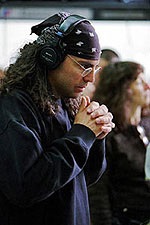
Director Tom Shadyac
Tom Shadyac, a professing Catholic who reads Augustine and Merton, was the youngest joke writer ever for Bob Hope. He graduated UCLA film school in 1989 and then worked in television for a few years before making the leap to feature films. Shadyac also dabbles in standup comedy and guest stars on TV. He works frequently with Jim Carrey and screenwriter Steve Oedekerk.
When Christian interviewers asked him about depicting unmarried sex and characters who curse, Shadyac replied, "One of the challenges of the church is to accept humanity for all it is. And I as a filmmaker am not going to deny that. I think it's important to acknowledge that we are imperfect … The Bible is chock-full of some racy stuff—a lot of sexual impropriety, violence, all kind of things. But the point of the Bible is that it's not about a moment, it's about the entire journey. Because if the Bible hadn't ended where it ended, it'd be a downer of a book. But it ends with redemption … If you look at the Bible as a whole, it's redemptive and beautiful, and it's God's love story to mankind." (See the complete interview here.)
With this exegetical approach in mind, let's look at how Shadyac accepts humanity for all it is in his films, and how he finds redemption at the end of his journey.
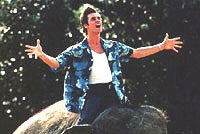
Jim Carrey as Ace Ventura
Serving an Ace; Going a Bit Nutty
When beginning one's career in Hollywood, it is helpful to start out with a bang. Shadyac's first film did just that for both him and, in a much bigger way, its star, Jim Carrey, who for his first film role would play the goofiest detective since Inspector Clouseau.
A weird blend of Dr. Doolittle and film noir, Ace Ventura: Pet Detective (1994) is also the least spiritual arrow in Shadyac's quill. Rooted in Carrey's physical plasticity, the comedy also seems to have started a trend of gross-out movies—though, in retrospect, today Ace's bawdy humor seems almost childlike.
Two years later, Shadyac did a remake of Jerry Lewis' 1963 classic The Nutty Professor, changing the story to suit his star, Eddie Murphy. Shadyac made the professor morbidly obese, allowing him to satirize while feeding on America's eternal obsession with weight.
Carrey as the fib-happy Fletcher Reed
Getting More Spiritual
Shadyac's next film, Liar Liar (1997), edges more toward a supernatural worldview. Reuniting with Carrey, Shadyac cast him as an unscrupulous lawyer (= liar) whose son's birthday wish is that his father would stop lying for one day—and, somehow, the wish is granted.
Fletcher Reede speaks the absolute truth for the next 24 hours, putting his job and life in jeopardy, yet ironically also saving him, setting him free, by revealing the truth to himself. It is that "somehow" that allows for the hint of a divine entity behind the spiritual truth serum that Reede has been administered. Perhaps God is unmentioned, but his presence is in every frame.
"Trust Me," the tagline of Liar Liar, is perhaps more than just an ironic quote of Fletcher's. It's also seemingly a plea from Shadyac to let him explore darker, more serious territory. And so, inching ever closer to the real world, his next film told the true story of the Gesundheit Clinic founded by Patch Adams, who believes in God, the integrity of every human being, and the power of laughter to heal.
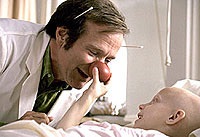
In Patch Adams (1998), the eponymous doctor (Robin Williams, Shadyac's third mega-star!) heals with humor and humanism. He lets the poor come to his clinic free of charge. His detractors work to remove his license, forcing him to fight for his cause. When it can't get any worse, Adams' girlfriend dies. He storms out to a cliff to hurl himself off. For the first time in a Shadyac film, a character speaks directly to God.
Robin Williams as Patch Adams
"So what now, huh?" Adams asks God. "What do you want from me? I could do it. We both know you wouldn't stop me. So answer me, please. Tell me what you're doing. Okay. Let's look at the logic. You create man. Man suffers enormous amounts of pain and dies. Maybe you should have had a few more brainstorming sessions prior to Creation. You rested on the 7th day. Maybe you should have spent that day on compassion … You know what? You're not worth it."
Magically, a butterfly appears.
Shadyac's first overtly supernatural film, Dragonfly (2002), concerns a widowed doctor, Joseph Darrow, who gets messages from his dead wife via his patients who have near-death experiences. Shadyac told an interviewer that the story "is intended to be a modern-day parable, where the message and meaning lie in the story. Here's a doctor who doesn't believe in anything after death, but through strange circumstances finds faith in what he can't see, and no one else around him will believe. The key is to think parable. Christians miss so much when they condemn things without being open to the overall message. Yes, we have the Bible, but we don't know everything. Obviously God does work in mysterious ways."
Article continues below
Dragonfly marked the first time Shadyac didn't get his first choice in casting: Harrison Ford turned down the role, which went to Kevin Costner instead. Ford would surely have brought more wit to the role than Costner's half-baked sleepwalker. But the story also suffers from predictability and obviousness, and it ended up being Shadyac's first box office failure.
He wisely returned to comedy for his next film—and to his golden goose, Jim Carrey, with his most supernatural film to date, one that even featured God as a main character.
An Almighty Smash
Having paid his dues with his comedic track record, Shadyac was allowed to explore more explicitly spiritual terrain, a place where Hollywood angels fear to tread. But the risk proved worthwhile: his next movie became one of the top-50 grossing films of all time.
A postmodern parable, Bruce Almighty (2003) features Carrey as TV news reporter Bruce Nolan, who loses the anchor position to his archrival, Evan Baxter (Steve Carell).
The film opens with a disgruntled Bruce complaining to God in the grand tradition of Job, Jonah and Jacob: "Why do you hate me?" God, played by Morgan Freeman, answers by letting Bruce be God for a day.
Carrey parts his tomato soup in 'Bruce'
Bruce Almighty pulls out all the stops with allusions to Scripture: Bruce walks on water, parts his tomato soup, turns water to wine, and logs on to yahweh.com to check his e-mail for prayers from his aptly named girlfriend/roommate Grace (Jennifer Aniston).
"I am Bruce Almighty," he says to himself. "My will be done!" Bruce uses his supernatural powers to turn Grace on sexually and to turn Evan into his puppet, making a fool out of him on live television. But Bruce turns into something else; his ego swells to match his power, which leads Grace to break up with him. He witnesses her intercessory prayer for him (one of Aniston's finest moments), tries to force her to fall back in love with him, and finds that he is powerless.
Article continues below
Bruce asks God, "How do you make somebody love you without affecting free will?" God says, "Welcome to my world, son." The whole of the Bible—especially as summarized by Shadyac near the top of this article—is wrapped up in those two lines.
Bruce humbles himself, allowing Grace the freedom to love and to be loved, and allowing grace, in the form of graciousness and gratitude, back into his life. And, as all good couples do at the end of a comedy, they marry. When you take Shadyac at his word and look at the entire journey, Bruce Almighty is, so far, his clearest version of the love story that is at the heart of Scripture.
Will Evan Pick Up Where Bruce Left Off?
Due next year, Evan Almighty will be the first sequel Shadyac will direct, if it can truly be called a sequel. The plan, hopefully, is that it will be the second in a series of parabolic films in which supernatural events affect ordinary people.
Originally titled The Passion of the Ark, Shadyac thankfully changed it when Carrey declined to play Bruce again and the lead fell to Steve Carell (Evan in Bruce Almighty). Evan is contacted by God (Freeman again) to build an ark for the sequel to the Great Flood.
Based on his work so far, we can expect more hysterical and supernatural explorations of humanity for all it is, journeys toward redemption, and love stories from Tom Shadyac.
Eric David, a writer and maker of short films, is working on Movies to Live By, a book on faith and film, and Bridge Over Troubled Water, a feature film about civil rights. He and his wife, Jana, live in LA with their children Chandler, 6, and Dylan, 3.
Filmmakers of Faith>,an occasional feature at Christianity Today Movies, highlights directors who adhere to the Christian faith—sometimesstrongly, sometimes loosely, and sometimes somewhere in between. This series will include everyone from biblically-minded evangelicals to directors who may only have a "church background" and perhaps a lapsed faith … but their films are clearly informed by their spiritual history.














 While we pray for peace, we need moral clarity about this war.
 A Christian reconciliation group in Israel and Palestine warned that war would come. Now the war threatens their relevance.العربيةFrançais
 Leader explains why the movement is seeing its biggest membership bump in 30 years and its mission for the years ahead.