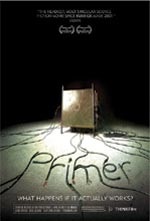
Is it possible to make a good movie for a measly $7,000? Yes. Shane Carruth proves it with his film debut, Primer, which is stirring up buzz-the good kind-at film festivals everywhere.
In a day when blockbuster movies often cost well over $100 million to make, a "low-budget" film might cost, say, less than $5 million. Rare is the film that cost less than a "measly" $1 million. There's the occasional shoestring budget smash hit, like 1999's Blair Witch Project, which was made for $40,000. But now along comes Shane Carruth, an introspective dreamer who has proven you can make a good movie for $7,000. That's not a typo: Carruth made Primer, his film debut, for seven thousand bucks. Carruth, 31, took three years, working 18-hour days, to make the film, wearing just about every hat himself; he conceived it, financed it, wrote the script, directed, edited, scored it and even acted in it, playing one of the lead roles—all (mostly) to save money. The result is a heady-but-quirky sci-fi gem that is fast gaining acclaim, winning the Grand Jury Award at Sundance, and receiving high marks at other festivals and by critics everywhere.
Primer (PG-13) features two young engineers, Aaron (Carruth) and Abe (David Sullivan), who work for a large corporation by day and do experiments in the garage at night. When one of their experiments turns into a time machine, the guys discover they can have anything they want. Taking advantage of the opportunity is their first challenge; dealing with the consequences of their choices is the next. It's a fascinating story, though not a simple one. Esquire exclaimed, "Anybody who claims they fully understand what's going on in Primer after seeing it just once is either a savant or a liar." But Esquire also called it "the headiest, most singular science-fiction movie since Kubrick made 2001." Heady praise indeed.
Meanwhile, New York Times critic A.O. Scott wrote, "I wouldn't say that it entirely makes sense," but added that his "bafflement is colored by admiration. Mr. Carruth has the skill, the guile and the seriousness to turn a creaky philosophical gimmick into a dense and troubling moral puzzle."
Interestingly, this "moral puzzle" comes from the mind of a Christian who, somewhat like the characters in his film, is a bit of a math geek. Carruth ended up quitting his first three jobs as an engineer, ultimately to pursue his first love-telling a story on film. He taught himself everything he could about filmmaking, and then, with that $7,000—and three years—he did it. We talked to Carruth about his movie, a filmmaker's responsibility to communicate clearly, and what it all means. Or doesn't.
How has your film been received at various festivals?
Shane Carruth: It's been good. Although I know no one will come up and tell me that I wasted two hours of their lives. If they're talking to me, they usually have something nice to say.
And that started with Sundance, your very first film festival, where you won the Grand Jury Prize. Not a bad way to start your film career, eh?
Carruth: Yeah, it was pretty amazing. Other films usually just kind of start off on the festival circuit and kind of have to build momentum. But as great as that Sundance prize was, it doesn't really guarantee anything as far as whether people are going to show up at the theaters or not. [For a schedule of screenings, click here.]
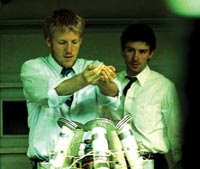
Shane Carruth plays the role of Aaron in the film
Sorry for the ignorant question, but I've only seen it in print. Is it pronounced primer or primmer?
Carruth: That's funny. I called it "Primer" [with a short "i"] for the longest time, and people kept asking me how to spell it. But if I called it "Primer" [long "i"], they didn't ask. So I just started calling it "Primer" [long "i"].
But the two pronunciations have different meanings. Why'd you pick that title?
Carruth: A couple of reasons. One was that it was just a beginning lesson plan. These guys [the film's protagonists] are technical experts, but ethically they're just kids, and they never really had to deal with the moral implications of what they do for a living—or for a hobby. And then there was the other meaning of "primer"—these guys trying to get that power position at the head of the line. Nobody wants to think they're second class of some kind, so that first position—that prime or primer—is the place you want to be.
So it works on either level no matter how people pronounce it.
Carruth: Yes. It's so deep, isn't it? (Laughing)
Speaking of deep, I was glad to see that other critics were scratching their head after the film. Is that aggravating for you, or do you want people to walk away saying, "Huh?"
Carruth: It's only aggravating if they write it off, if they say it's not able to be understood or that I'm purposely complicating it. I actually read something that said I had made it purposely complicated to get more box office dollars—as if when I was writing the script I was thinking about theatrical release. But no.
My favorite films are the ones where I can get at least the first inkling of what it's thematically about, but it gives me something to puzzle over—and if I see it again, I realize there's more information in there. I would be frustrated if somebody watched Primer and thought there was nothing going on subtextually, that it's just trying to be complicated and it's a time travel enigma story. But now I've just talked myself into a corner. I'm not sure …
Article continues below
Abe (David Sullivan) and Aaron (Carruth) and their little experiment
I hear ya. I hate movies that don't make you think at all, where everything is spelled out. But then, I don't want to leave the theater in a total state of confusion either. Is there a happy medium, and what is the filmmaker's responsibility for communicating clearly?
Carruth: That's just what I've been puzzling over for a while. I first got interested in writing this script while I was in college, when I had some kind of weird awakening. The Great Gatsby [book, film] was always such a great template to study, as far as irony and symbolism and subtext. My professors would go on and on about all the color symbolism of the oranges at the parties. I'm like, Man, oranges are oranges. I just felt like too much is being read into this. I thought, Did Fitzgerald ever own up to what everything was about? Or should he have?
To answer your question, when it comes to the plot, as an author or filmmaker, I have a responsibility to make sure the information is in there. Even if I'm talking "in code," my first sentences need to be an example of how the code works so you can apply it to the rest of what I'm saying. We need a cipher. That was my hope for this film—to make sure the information is in there, and I will walk you through enough to show that I have done the homework. And if you want to figure out the rest of these details, then by all means that information is in there, and here's the key code of how to unlock them.
I know I could have written a scene with an emotional breakdown of some character, and then explain what happened. But that seemed counterproductive. I'm hoping the audience is right there with Abe and Aaron as they're going through this thing, and it felt insulting to say, right at the end, "Here's what you've just seen."
OK, so what do you want people to walk away with? The general message I got is, if you start messing with destiny, you're really going to screw things up. But what beyond that?
Carruth: It's more than just a science fiction movie. It's about trust, and how that trust is dependent on what's at risk. The main characters who have a conventional relationship at the beginning, but the relationship changes with the introduction of this device and its power. It unravels the relationship. Not that either of them is necessarily a good or a bad person, but because there's too much to trust somebody else with.
Article continues below
I'm getting older, and I have to find a way to understand some of these things. There are people that are doing bad things, but they're not going home and thinking they're a bad person. They found a way—we all do—to rationalize what they've done. One of the ways we do that is by being very protective of our situations. I think that's what leads people to do things that they probably wouldn't be doing otherwise. And so this is my attempt to understand that and explore that a little bit.
There are themes in the film Christians will appreciate—greed is bad, trust is good, and so on. Are you coming from any kind of a spiritual or faith perspective on this?
Carruth: I'm a Christian, I was raised in the church, and for a long while I've been very devoted to my quiet times, where I meditate on the Bible. So everything that I believe is informed by that, including this film. I meet people and I know that what they're doing is hurting people, though the intention isn't there. They found a way to make it work. And so I'm just trying to understand it in a more practical way: How can it be that we've got all these well-intentioned people, and yet at the end of the day there's conflict. I think it's a very complicated problem. I'm just trying to understand how it actually manifests as opposed to whether it's a sinful nature or not.
You did everything in this film—conceived, wrote, directed, edited, scored and even acted. Is that because you had a limited budget? Or are you a bit of a control freak too?
Carruth: Number one, because of the budget. But I think I am a little bit of a control freak. (Laughs.)
So, if you had the money, would you have given some of these responsibilities to other people?
Carruth: Yes. I would have hired a cinematographer, but then, I knew so little about cinematography at the time that I wouldn't have had the vocabulary to explain exactly what I needed. So I needed to puzzle it apart myself. A lot of this was just necessity for me to learn as I was going.
If you had had more money, would you have made a better movie?
Carruth: If I wouldn't, that would be really sad, wouldn't it?
Does more money necessarily mean a better movie?
Carruth: What the money would have bought me was less stress for my life, and it would have bought me back about a year and a half of my time. I didn't use the right tools, and I wasted a lot of time doing that. To keep the budget down, we only shot one take of everything. But even if I'd had more money, it would have been roughly the same movie, I think.
Article continues below
If somebody were to say, "Hey, I've got seven grand, and I want to make a movie," what would you say?
Carruth: I would say get some more money. Or I'd say, "Yeah, if you've got three years to kill, by all means, do it." I don't know. Maybe it depends upon your age. When I'm 30 years old and spending 18 hours a day in front of a monitor editing this thing and people ask me what I do for a living and I don't have a good answer, that's not a fun place to be.
What has the movie's success at film festivals done for you financially?
Carruth: Nothing.
It would have to do well at the box office, then?
Carruth: Yes. I get paid as the theaters get paid. My ability to make another film the way that I'd like to make it is directly related to whether people show up for this one.
Shane Carruth's brother, Caleb, is a Christian musician and a former bandmate of Shane Barnard, now half of the popular duo Shane & Shane. (Yes, that's a lotta Shanes to keep straight.)













 While we pray for peace, we need moral clarity about this war.
 A Christian reconciliation group in Israel and Palestine warned that war would come. Now the war threatens their relevance.العربيةFrançais
 Eastern Orthodox poet Scott Cairns reflects on his new collection, his journey of faith, and poetry’s capacity to apprehend inexhaustible realities.