Douglas Gresham has dreamed of seeing Aslan on the big screen since he was a little boy. Now that his dream is about to become reality, C. S. Lewis's stepson talks about the new movie, and his role in it. (Part 2)
Since he first read The Lion, The Witch and The Wardrobe as a young boy, Douglas Gresham has dreamed of someday seeing it on the big screen. His dream will come true on December 9, when the film adaptation hits theaters worldwide.
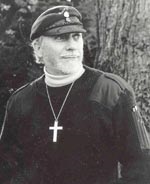
Douglas Gresham
Gresham, stepson to LWW author C. S. Lewis, was a co-producer of the film, representing his stepfather and the Lewis estate throughout the process—the writing of the script, the making of the movie, and even the merchandising of the spinoff products, including the toys for McDonald's Happy Meals.
We recently had an hour-long interview with Gresham, where he discussed his life with Lewis and the upcoming movie. Yesterday's part one of the interview focused on the former; today's part two focuses on the latter. We talked about his role as co-producer, the religious imagery in the film, how he thinks Christians—or anyone, for that matter—should watch it, and what Lewis might think about his book being turned into a Hollywood movie … or, for that matter, his characters being turned into fast-food toys.
What were your duties as co-producer on this film? I read somewhere that you said your duty was basically to represent C. S. Lewis on the set.
Douglas Gresham: That's part of it. And not just on the set. To represent C. S. Lewis when they're writing the script, when they're designing the sets, when they're doing storyboards—just keeping an eye on everything to make sure that Narnia stays Narnia. And that has spun off into checking out all of the merchandise that's going to be produced—all of the toys, all of the apparel, every single thing to do with Narnia, I have to check to make sure somebody doesn't make silly mistakes. It's a full-time job.
Now when people take artistic liberties, you …
Gresham: There's a difference between stupid mistakes and artistic liberties. When the artist goes too far, you have to rein him in. I'm ready to accept artistic liberties with the director [Andrew Adamson], of course. But there are certain things I think were wrong, and said so. We talked it out and achieved a compromise. Andrew is a very easy man to work with. He respects the material probably almost as much as I do.
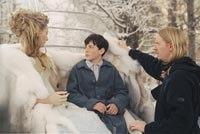
Director Andrew Adamson, here with Tilda Swinton and Skandar Keynes (Edmund), has a great love for the book, says Gresham
Where did you feel like he was off course?
Gresham: Well I wouldn't do that, because those things are confidential between myself and Andrew.
I hear that someone associated with the film said you can't even spit without Douglas Gresham's permission.
Gresham: That was an exaggeration, but yes, to a certain extent I think I had probably been something of a nuisance to my colleagues in the production team, on occasion when I said, "No, you can't do that." But they have been very tolerant of me. I've met a lot of people I admire greatly and enjoyed working with enormously on this project.
Did you ever feel a vibe of "Ssshhh! Here comes that jerk!"
Gresham: (laughs) No, there was never anything like that, because they took the attitude that I should contribute, because we were all dedicated to the same end—to make this the best possible movie it could be.
Christians are concerned that this film retains the apparent Christian imagery of …
Gresham: You have to bear in mind that Hinduism has a dying god who dies for his people, then comes back. Norse mythology has the dying god. Greek mythology has the dying god. This myth is not new and it's not unique to Christianity. Yes, Christians who watch the movie or read the book will look for Christian symbolism. But I think that's the wrong way to approach it. I think it's far better to read the book or see the movie and try to find out where you fit into Narnia. Analyze yourself and how you would react under these circumstances. Who are you? Are you an Edmund? Are you a Peter? Or a Lucy or a Susan or a Tumnus? Where do you fit?
Which are you?
Gresham: I used to be an Edmund, very definitely—before he turned good. I'm trying very hard to be a Lucy now.
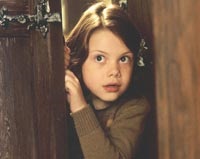
Lucys wide-eyed wonder, faith and trust are to be traits to aim for, says Gresham
Meaning?
Gresham: Faithful and available. Lucy was the one who expressed her faith without fear. Lucy the Valiant. Lucy was the one who was most believing and most trusting in Aslan all the way through. That's where I'd like to be.
You mentioned merchandise, and I've heard that will include McDonald's Happy Meals. People can get jaded by the mass merchandising of something that's practically sacred to them. I assume you'd be the first person who would want to keep all of that under control?
Gresham: Yeah, we've tried it tone it down to a fairly minimalist program. We've cut down a lot of categories. We've also tried to make the merchandise the highest possible quality at each price point. And when I have found proposed products that did not meet my quality standards within that price point, I have stopped them.
What would C. S. Lewis say if he knew Mr. Tumnus was going to show up in a Happy Meal? Would he roll his eyes?
Gresham: I don't think Mr. Tumnus exactly shows up in a Happy Meal. The premiums will consist of some very nice little Narnian gifts to play with.
Article continues below
Well, you get my point, right?
Gresham: I don't think Jack would be the least perturbed by that. The very thought that his Narnian characters would be given away to kids enjoying themselves in a fast-food restaurant—I don't think that would bother him at all.
What would Jack say about having a movie made of his books?
Gresham: Jack's problem with cinema was that he could see this wonderful technology emerging and developing, and he was worried about the uses to which it was being put. Until recently, cinema has been used almost exclusively to corrupt man rather than to develop man. Some of the great movies have been terrific, but by and large most movies are just to titillate, to excite—stuff to entertain. Basically, I think the Enemy has been running the cinema. It's time we took it back from him.
Do you think that's happening?
Gresham: It's beginning to happen. I've put this project in the Lord's hands in prayer for many years. The main reason I went with Walden Media [to make the film]—as opposed to the many other studios pursuing this project—is because of their mandate to produce good, entertaining movies that also educate, not merely in factual matters but in matters of ethics and values and morality. There could be no better fit than a company that wants to do that with The Lion, the Witch and the Wardrobe.
The clincher for me was meeting Phil Anschutz [the money man behind Walden Media], and growing to respect him enormously and spending time in prayer with him. His commitment to bankroll Walden into making this movie—at very large expense—shows his determination to revise what cinema is being used for. Walden Media has exactly the right idea what we should be using cinema for. And I think the Narnian Chronicles are a terrific vehicle for what they want to do.
When books are adapted into film, and the writer is still alive, the writer often wants to be in on the screenwriting process. If Jack were still alive, would he say, "I want in"?
Gresham: No, I don't think he'd say that, because Jack was very well aware of his own limitations. But what he would want, probably, would be a power of veto and approval rights on the script. Because he would be aware, as I was aware, how easy it is for a scriptwriter who isn't familiar with the back-story—how a book like this became written—to make silly mistakes. So you have to have someone on board who knows how to handle these things. But as it happens, there was very little of that sort of mistake in the screenplay. It was extremely well done.
Article continues below
Did you have that power of veto?
Gresham: I think that's too strong a way to describe it. The relationship is such that if I had said, "Absolutely wrong, you really shouldn't do it," they would probably say, "Okay, if that's how you feel, we won't do that. What would you suggest instead?" We haven't ever actually got into a state where Andrew, myself and the writers have gone head-to-head. It just didn't happen because they were good at what they did. And they all have an appreciation for the material.
I grew up with these books, so I already had images in my head all these years—based on how I imagined Narnia and these characters. But now my sons, even though they'd read The Lord of the Rings before seeing those movies, are growing up thinking that Gandalf looks like Ian McKellen and that Frodo looks like Elijah Wood. Are you concerned that the same thing will happen with Narnia, that the movie will hinder kids' ability to use their imagination?
Gresham: That's part of the challenge of converting a book to a movie. We have to be aware that everyone who's read the book has in their mind's eye an image of Narnia—an image of the White Witch, an image of Aslan and Peter and Susan and Lucy. We have to at least equal if not excel all of those images.
But we also have to be responsible for an image that we are putting into the next generation of readers' minds. So that when the next people come, having seen the movie and never read the book, and they see Tilda Swinton as the White Witch, she has to fit the picture. She has to be good enough in that role for their imagination to accept her as the White Witch and to take that forward with them.
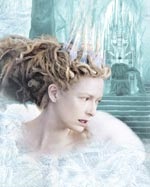
Gresham says Tilda Swinton is the perfect White Witch for anyone's imagination
And you're okay with people reading these books for the first time visualizing Tilda Swinton as the White Witch, and not using their imaginations?
Gresham: If we get it right, yes, it's okay. If we get it wrong, it isn't. In Tilda's case, believe me, we've got it right. Tilda's a lovely person, the sweetest girl. We got to be good friends on set. But as the White Witch, she is scary, evil.
When my grandson Jack, who was four years old at the time, visited the set in New Zealand, we were filming in a forest at the White Witch's camp. There were all the racks of evil looking weapons, and the White Witch's pavilion with campfires and cauldrons and the usual stuff for a witch. We get out there, and the smoke generator guys had started the mist drifting through the forest, and the campfires and cauldrons were burning. Jack looked around and said, "This place is evil." And we knew we had got it right.
Article continues below
What one thing has most impressed you about the whole process of making this movie?
Gresham: There are literally thousands of people working behind the scenes, doing mundane jobs like painting sets and making swords and cleaning toilets and cooking the food—people who never, ever get mentioned. Nobody ever knows they exist. So I made the point of going around and thanking the people like the cooks and the bus boys, the painters and the welders, the guy who services the generators, the mechanics, all these types of people. I'd say, "I'm Doug Gresham, the co-producer of this project, and I would just like to thank you so much for the great work you're putting in, because everything's running so smoothly, and it's largely due to you guys." Without exception, every single one of those people was utterly thrilled to be involved in this particular project.
That impressed me more than anything—the enormous enthusiasm of everybody I ran into. Everybody loves the material; everybody was thrilled to be involved with this particular project. And I'm very grateful to all of them.
Movie images copyright 2005Disney Enterprises, Inc. and Walden Media, LLC. All rights reserved.
C.S. Lewis recommended discernment over diatribes in exactly the moments we’re most eager to indulge in critique.
Bonnie Kristian
Narnia Comes to Life
1 of 4
Douglas GreshamDirector Andrew Adamson, here with Tilda Swinton and Skandar Keynes (Edmund), has a great love for the book, says GreshamLucys wide-eyed wonder, faith and trust are to be traits to aim for, says GreshamGresham says Tilda Swinton is the perfect White Witch for anyone's imagination












 While we pray for peace, we need moral clarity about this war.
 A Christian reconciliation group in Israel and Palestine warned that war would come. Now the war threatens their relevance.españolالعربيةFrançais
 C.S. Lewis recommended discernment over diatribes in exactly the moments we’re most eager to indulge in critique.