Dan Merchant has an agenda, and he doesn't care who knows it.
"I want us all to have a conversation," he said while weaving his car through traffic, sandwiched between events promoting his new film, Lord Save Us From Your Followers. "My agenda is for people outside the faith to come away with a more complete picture of who Christians are, or are at least are trying to be.
Dan Merchant directs and stars in his film
"My agenda is for Christians to understand how we sound to others and actually listen to those who disagree with us or who don't understand us, instead of being so quick to fight. I think that some of the basic fundamentals of the gospel—love your enemy as yourself, love one another—have somehow been lost."
Merchant's documentary turns on a deceptively simple question: Why is the gospel of love dividing America? Christianity, he contends, is far more interested in the "gospel of being right" than the gospel of Jesus Christ. Fed up with the strident language and angry rhetoric that have come to define modern Christendom, Merchant, a veteran of the entertainment industry, set out to explore the flashpoint of faith and culture in America.
Merchant is ready with a quick answer for what he sees as Christianity's principal failings. With a nonchalant manner that miraculously never comes across as judgmental, Merchant zeroes in on politicians who use God to win elections, Christian organizations who bait the world and then cry foul when the world fights back, religious leaders who set themselves up to interpret global events as God's wrath, and the church's attitude toward abortion and homosexuality as its pet sins.
"We're not good at living the truth," he says. "I just want us all to live up to it instead of making excuses for why we can't. What grieves me the most is our ability to judge, dismiss and separate from other people, whether because of race, denomination, sexual orientation, divorce. We do a really good job of saying God came to save everyone—except you and you and you. We need to take a page from Jesus' radical compassion. The Lord's bar is as high as you can get: Love your enemy as yourself. I would just love the church to be better known for what it is for rather than what it is against."
Talking to strangers
To get to the heart of the debate in his documentary, Merchant dons a white jumpsuit plastered with bumper stickers both for and against religion and wanders around Times Square seeking conversations with complete strangers.
Merchant in his 'bumper sticker suit,' interviewing folks at Times Square
Wherever he goes, Merchant runs into the same situation—non-believers who don't have a problem with Jesus, but vehemently dislike many who claim Him. For Merchant, their ability to separate faith from founder with such ease indicates a disastrous PR problem for Christianity.
"People say, 'Well, the truth divides,' and yeah, it does," he says. "But I think we've done most all the dividing already before anyone ever gets to any 'truth.'"
Merchant is quick to admit that his film is directed first and foremost at himself. And it is precisely this humility—Merchant's awareness of his own profound faults and a sly, self-deprecating humor—that separates Lord Save Us from other films like it.
"The film is as much about me as it is about anyone else," he says. "It wouldn't have been fair if I got into the midst of this thing without looking in the mirror first. When did someone being gay become worse than my pride and arrogance? My heart was broken over my own sin. I've got to get over myself and figure out what Jesus meant when he said, 'Love your neighbor as yourself.'"
'The church is a whore, but …'
If you were to walk out of Lord Save Us at the halfway mark, you might think the film is little more than a tirade against Christians behaving badly. As vital as that message may be, you'd only be half right. What makes the film so powerful is its intractable ability to embrace both the baby and the bathwater. This is a film made by a follower, and therein lies its unique musculature. Merchant never lets us forget the powerful words of St. Augustine: "The church is a whore, but she is my mother."
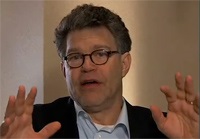
Al Franken is among the many who Merchant interviews
"If the first half of the film is showing how we're missing the mark," Merchant says, "the second half is really an examination of who we're trying to be. If (the world) wants to criticize (Christians) for the things we do wrong, we should accept it and apologize. But let's also be honest that that is not the whole picture."
From Bono discussing God's grace at the National Prayer Breakfast to youth groups swarming into Louisiana and Mississippi after Hurricane Katrina; from medical missionaries in the most remote parts of Africa to Pastor Rick Warren's outreach in Rwanda; from Portland churches gathering together to care for the poor to the thousands of Christ-like acts believers commit every day—Lord Save Us also reveals Christians acting in ways that bring honor to the God they serve, earning the respect of all those around them. Rather than using the Bible as a weapon, these believers use it as a salve, and the response is as simple as it is astonishing. Suddenly Christ and Christians are synonymous again.
Article continues below
Says merchant, "Let's be so like Christ that others say, 'You can always count on the Christians when they come around.' I'd love for us to be that. That's how Jesus did it."
Fessing up to gays
Perhaps the most powerful moment of the film occurs when Merchant borrows a page from Donald Miller's book, Blue Like Jazz, and sets up a confession booth at Portland's gay pride parade. Rather than letting those who enter confess to him, however, Merchant instead begs their forgiveness for the ways in which Christians have harmed homosexuals. Many of the gays are stunned at Merchant's words of contrition, most are genuinely touched, and some are even moved to tears by his sincerity.
In the 'confession booth' at the Portland gay pride festival
"You come out of the confession booth understanding how broken we all are," he says. "I began to understand positions I didn't agree with—still don't—but I understood where they were coming from and it completely changed how I related to them. If you demonstrate you are willing to listen to other people, they are willing to listen to you. The way we show Christ that we love him is by loving others. It's hard to do. It's a lot harder than standing on a parade route, shouting at people that you don't like their lifestyle."
Merchant's documentary is building steam through a word-of-mouth campaign fueled by church congregations and college campus screenings. At first, he was deeply concerned that the film would not be well received in all quarters. When my mother told me her church, in a leafy Portland suburb, was going to screen the film, I was apprehensive. While she and my grandparents belong to a terrific, vibrant congregation, I was unsure that the film would find a receptive audience within the older demographic. When my mom later told me my 84-year-old grandmother was the first to her feet for a standing ovation, I knew Merchant was onto something special.
"Our reception has been amazing!" he says. "We've been surprised at how widely accepted the film is. We expected it to do well in an Emergent church, but I did not expect it to play well at a secular, atheist college. But it 'killed,' to use the comedy term. It doesn't matter if it's a mainline, conservative, evangelical, mega-church or anything in between, to say nothing of those who are not in the faith, have left the faith or are of other faiths. All are finding the film to be a valuable conversation and an entertaining movie."
Article continues below
Great conversation starter
Church leaders agree. On the film's official website, Rick McKinley, founding pastor of Imago Dei Community church in Portland, says the film "may be one of the most important conversation starters the church has seen in a long time." And Jack Hayford, President of the International Church of the Foursquare Gospel, adds, "This is a stroke of genius in the film—people need to see that the world knows better how we think, than we know how they think. Learning about ourselves is humbling. They don't think we have an answer because they only see we have an argument."
Lord Save Us From Your Followers is incisive and fair, goofily funny and deeply moving. There is no watering down of the gospel. Merchant knows sin when he sees it. He simply finds the plank in his own eye of greater importance than the mite in his neighbor's.
"Love is stronger than hate," he says. "It conquers all. It is the most important command in Scripture. So why aren't we doing more of it? Loving the unlovable is what it's all about. We are not called to judge the moral worthiness of those we are commanded to adore. It's time for a conversation. The monologue isn't working. Let's be willing to respect each other and listen to each other. You might be surprised what happens."
In the 'confession booth' at the Portland gay pride festival
To learn more about the film, to schedule a screening at your church, to join the conversation, or even watch the movie online (for $6.99), go to the official website.
Christian artists work at the intersection of music and climate change.
Kelsey Kramer McGinnis
A Good Look in the Mirror
1 of 5
Dan Merchant directs and stars in his filmMerchant in his 'bumper sticker suit,' interviewing folks at Times SquareAl Franken is among the many who Merchant interviewsIn the 'confession booth' at the Portland gay pride festivalIn the 'confession booth' at the Portland gay pride festival















 While we pray for peace, we need moral clarity about this war.
 As my doubts about his teachings grew, so did a secret fascination with Jesus.
 Christian artists work at the intersection of music and climate change.