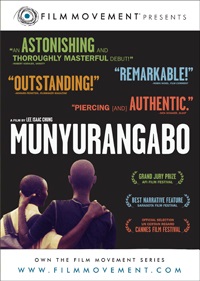
In the summer of 2006, Lee Isaac Chung went to Rwanda as a volunteer with Youth With a Mission (YWAM), the Christian ministry that his wife Valerie worked for. Chung and Valerie, who had a background in art therapy, decided that their best gift to Rwanda's youth would be to help them use art to work through the traumas and horrors they'd been through in the 1994 genocide. Chung, who studied film at the University of Utah, wanted to teach filmmaking and allow the kids to tell their own stories, "to let the culture speak for itself." The result of that summer filmmaking class was a feature film, Munyurangabo.
But Munyurangabo has since become much more than a class project. The film played at many of the world's top festivals in 2007 and 2008, including Cannes, Berlin, Toronto, London, and New York. It won the grand jury prize at the AFI Festival in 2008, and has been thoroughly praised by critics. Variety's Robert Koehler described it as an "astonishing and thoroughly masterful debut … the finest and truest film yet on the moral and emotional repercussions of the 15-year-old genocide that wracked Rwanda."
The film, now available to Film Movement subscribers (and to the rest of the public on October 6), follows two boys—Munyurangabo (Ngabo) and Sangwa—from two separate tribes as they embark together on a journey through the backroads of Rwanda. Munyurangabo wants justice for his parents who were killed in the genocide, and Sangwa wants to visit the home he deserted years ago. Though they plan to visit Sangwa's home for just a few hours, the boys stay for several days. Their friendship is tested when Sangwa's wary parents disapprove of Munyurangabo, warning that "Hutus and Tutsis are supposed to be enemies."
Chung recently spoke to CT Movies about his faith, the process of making Munyurangabo, and how it fits in to the genre of African films.
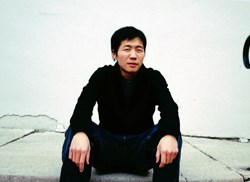
Director Lee Isaac Chung
When you went to Rwanda with YWAM, did you already have the idea for the film?
Lee Isaac Chung: Yes. When I got the idea that I was going to teach filmmaking, the idea to actually make a film seemed like a logical one. I wanted to make a film that wasn't just a class project, but was as professional as possible, where all the students are involved in a very professional way. It seemed like a good way to both honor Rwanda and honor the students.
How did the story come about?
Chung: The general idea, which I developed with my friend Sam Anderson, was that the film should be about the revenge that someone from the Tutsi people group wanted to enact upon the person who killed his father in the genocide. We both thought that a number of things should shape this character's journey and that they had to be firmly rooted in Rwandan culture. So we introduced a lot of cultural elements like dance, music, spoken word. But we also wanted to root the story in everyday experience, so we decided that the main character should have a friend who's from a different tribe, and he goes and sees how this friend's family lives on a day to day basis, experiencing the natural countryside. That was the general idea, but the specific things that these characters encounter, and the things they say, all came about as we made the film in Rwanda. I used a technique that some Iranian filmmakers use when they film in rural areas with different dialects, which is simply to let the people have their own words and to give them a lot of space to improvise. Our idea was that we wanted to hear from the people themselves.
Chung: A lot of these films were a little discomforting to me because they were all geared toward a Western market. Usually there are no actual Africans in these films. They're either African-Americans or Westerners, and we enter the story through them. I don't think this does a lot of justice to what has happened. I noticed that even though we'd seen a barrage of these films, none of us really knew who Africans were. I talked to some people in Rwanda who had acted as extras in some of these Western films, and most of them had played people holding machetes in the background or something, or dead bodies. On a symbolic level, this is the wrong message we're sending to Africa.
When you present this film to Western audiences, what do you want them to know?
Chung: Normally I just tell people not to expect the traditional Hollywood type film. I often introduce it with a warning about the 7-minute shot of the poem being recited in the middle of the film. It's my favorite shot in the film because we're forced to listen to a character we're unfamiliar with recite a poem he actually wrote, in his native tongue. It was very moving to me to watch that, because it's just so rare that we give people like that the chance to express themselves in such a direct way.
That scene, and the film at large, struck me as very observational. Nothing felt very forced.
Chung: I wanted to do that, but not in the way documentaries do it where you're just highlighting suffering or problems. I wanted to highlight communities and what they go through on an everyday level—their hopes, concerns, and everyday moments.
Article continues below
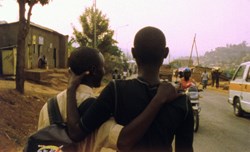
The two friends walk down the road
The materiality of the film—earth, dirt, mud, water—plays a big role. The extended scene of the two boys just throwing mud at the wall, for example, stuck with me.
Chung: I knew that later in the film I wanted to have a scene where it rains on Ngabo as he comes to a realization, and I wanted to emphasize that as he goes deeper into the countryside, he gets more and more into the earth. I felt like it wasn't too difficult to come to that conclusion. Everywhere you go, houses are made out of mud. The principle action of most people in the countryside is not farming, it's what they call "digging." They're very much dependent upon and in harmony with the land.
Are there any filmmakers or film theorists who particularly inspired you?
Chung: I think for this film, Ozu was probably the biggest influence—in the sense that the drama is played out in the everyday and the ordinary. And Bresson is someone I also really admire, and recently the Dardenne brothers. Someone recently told me they thought the Dardennes were the biggest influence on this film, and I think that might be the case. I do love their films and I think they have a very similar, observational approach.
Your father was a Korean immigrant, and you grew up in Arkansas. Were you raised Christian?
Chung: Yeah, we were raised Christian, and I think my dad's generation was the first generation of Christians in our family, thanks to missionaries in Korea. My parents used to work on Sundays because they worked in the chicken industry, along with a lot of Koreans in the neighborhood, so the Koreans would meet together on Saturdays for church. It was a Methodist church, and then on Sundays while my parents worked, they dropped me off at the local Southern Baptist church so I'd have something to do. So I have this weird mix of church traditions.
How has your faith influenced how you think about art?
Chung: I don't think of myself as having the type of Christian faith where I hear a lot from God and there's just so much I want to say. Bonhoeffer discusses the idea of the "dark night of the soul," and I can certainly relate to this. When I'm making films, I really draw from this idea—what Bonhoeffer references, "My God, my God, why have you forsaken me?" Cinema feels like a medium in which I'm wrestling with that. I want to explore how this plays out in various communities' lives. It's not a medium in which I want to evangelize or to be didactic.
Article continues below
You definitely get the suffering side in the film. But it's also hope-filled, especially in the whole context of Africa, which we always associate with suffering and pain. Was the Christian idea of resurrection and renewal important for you in this film?
Chung: I tend toward despair and sadness when I think about the world, so in a way I wanted to make a film that was a type of prayer. I think hope is the right word for it, but I think hope is tied up in what we perceive to be the impossible. Hope is always tied up in sadness.
The DVD is now available through a subscription at Film Movement, and will be available to the public on October 6, 2009.












 While we pray for peace, we need moral clarity about this war.
 We’ve got little information on Jesus’ appearance and personality. But that’s the way God designed it.españolFrançais
 Eastern Orthodox poet Scott Cairns reflects on his new collection, his journey of faith, and poetry’s capacity to apprehend inexhaustible realities.