R (for war violence and brutality, and for some language)
Directed By
David L. Cunningham
Run Time
1 hour 57 minutes
Cast
Robert Carlyle, Kiefer Sutherland, Ciarán McMenamin
Theatre Release
September 02, 2001 by 20th Century Fox
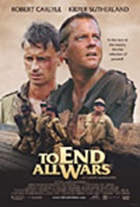
To End All Wars is a film with something to say. Which turns out to be its great strength, as well as its greatest weakness.
I should have loved this film: It's about self-sacrificing heroism in the face of impossible circumstances, the power of forgiveness over hatred, the futile tragedy of war and God's way of peace in the midst of it. And I was pulling for it, ever since reading the glowing article in Books & Culture a couple summers ago. Then after hearing about the filmmakers' travails trying to get it onto big screens or into video stores, I've been wanting this project to succeed.
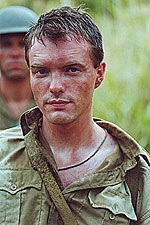
Ciaran McMenamin as Ernest Gordon
The premise is a great one, and the story true, inspired by Ernest Gordon's autobiographical Miracle on the River Kwai. It comes out of the same brutal prisoner of war camps that gave us the deeply affecting Bridge on the River Kwai. The Japanese are striving to build a strategic railroad link to India, and they are willing to sacrifice their prisoners to build it on an impossible schedule. How will these men stay alive in such extreme and hopeless conditions?
The men begin a secretive "jungle university," teaching one another whatever they know best: the philosophy of Plato, the poetry of Shakespeare, or the radical teachings of Jesus. In so doing, they discover purpose and hope. Screenwriter Brian Godawa draws out the deepest of Christian truths in this horrific but anything-but-God-forsaken setting.
There is a spiritual maturity here that very few films achieve. When a man like Ernest Gordon—who survived the camps and went on to serve as chaplain at Princeton University for a quarter century—speaks of the faith, his experience gives him immense authority, and Godawa (a Christian) brings passion and wisdom to the task of rendering
these truths into cinema. Unfortunately, it may be his very eagerness to convey these insights that undermines the effectiveness of the story he seeks to tell.
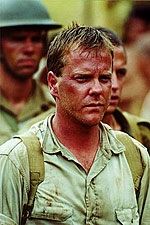
Kiefer Sutherland as Reardon
In his book Hollywood Worldviews: Watching Films With Wisdom & Discernment, Godawa insists that every film is, fundamentally, the embodiment of a
philosophy, and what Christian filmgoers should really be watching—or watching out for—are the underlying worldviews. It almost feels as though he sees a movie as a bottle, and what really counts is the message inside: we need to smash the bottle, sift through the broken glass and dig out the message concealed inside so we can decide whether it's Christian or not.
To End All Wars doesn't require much sifting or digging—the worldview is front and center, displayed in the way he fashions his characters and spelled out in an ever-present voice-over. The filmmakers don't want this picture to be described as "a Christian film," but for all its strong language and refusal to solve every problem with a conversion, I'm afraid it still feels like propaganda. That's the real problem with "Christian films"—their preaching. Worse swearing and better theology and production values only provide a higher-quality varnish on what is, after all, still a pulpit. To End All Wars doesn't hand us pat answers, but it hands us answers nonetheless, or at least theme statements, in a way that leaves little room for ambiguity or mystery.
This message-first approach results in a film that is far too easily reduced to a tidy character chart. We realize early on that Campbell embodies The Loyal-But-Driven Military Man, Dusty is the personification of Compassionate Self-Sacrifice, Ernest will have to choose between their two worldviews, and Reardon ("Yanker") will serve as the central character's irascible foil—and there just aren't enough surprises in the journeys of those emblematic central characters to create real interest.
Compare the baffling, but utterly convincing, character reversals in David Lean's 1957 Bridge Over the River Kwai, and the agonizing moral complexities that emerge—not to mention the way we are drawn into the story. The Kwai screenwriters don't explain how people ought to be, so much as observe how they are, in all their mystery and complexity. To End All Wars deals with deeper truths, but it tells too much and shows too little.
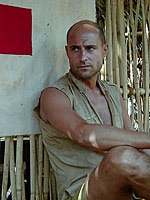
Still, there is much to praise. I liked all the performances here, testimony not only to the actors but to the director who inspires such consistently good work from his entire cast. Mark Strong is the Christlike Dusty: trained at the Bristol Old Vic and seasoned in productions at the RSC and the Royal National Theatre, he fills even his silences with such a tremendous sense of presence and calm it's hard to imagine another actor in the role. Kiefer Sutherland gets the most unpredictable and dynamic role as the self-interested American whose true allegiance is often in doubt, and he plays him with an opaque changeability that keeps us guessing, providing much of the story's dramatic interest. I was particularly struck by Yugo Saso, who plays the interpreter with tangible compassion and intelligence.
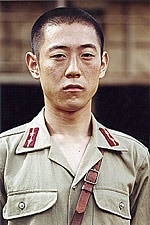
Yugo Saso as Takashi Nagase
But in the end, I wasn't able to like this film as much as I wanted to. I applaud its sentiments, cheer its substantial theology—suffering before glory, cross before crown—and admire the persistence it's taken to get this labor of love to the audience it deserves. But it's not a story I should have had to stand outside of—not when the film's preoccupations are so close to my heart.
Article continues below
Should you rent or buy To End All Wars? Absolutely—it's far more worthwhile than 90% of the commercial product you'll find lining the walls of your local video store. Am I glad I saw it? Certainly—this is an important story, well worth telling, and I intend to watch it again. Its message of costly sacrifice and hard-won reconciliation is at the heart of the gospel, and the fact that this story is drawn from actual events demands attention. If only the filmmakers had stuck to telling the story, and let the message take care of itself. If only they believed that dramatic action can speak louder than words.
For further information, check out the film'sofficial site.
Talk About It
Discussion starters
In the behind-the-scenes documentary, Kiefer Sutherland says, "The greatest act of humanity is that of forgiveness, and the understanding that whatever can rage in somebody else can rage in you. And the only way that we'll get past it collectively is through forgiveness." Were the soldiers right to forgive—and cooperate with—their captors? What would you do in such a situation?
In the film, Christian faith encounters the Japanese Bushido code of honor. How are they different, and what surprising things do they have in common?
What do you make of Plato's teaching about "the fate of the just man"?
The Family Corner
For parents to consider
This R-rated film is strong stuff, including graphic (but never gratuitous) depictions of the kind of injury, torture and suffering that are common in war, and which occurred in World War II prisoner of war camps. As a response to these circumstances, there are some instances of strong language, including one particularly intense scene in which a character's shock and grief lead him to use the F-word repeatedly.
To End All Wars, a new movie from director David Cunningham, is causing a stir among critics with its powerful wartime tale. It made a splash at the 2001 Cannes Film Festival and was later nominated for Best Feature Film at the Hawaii Film Festival.
Nevertheless, it may cause a different stir in religious communities. Cunningham, son of Youth With a Mission founders Loren and Darlene Cunningham, is an outspoken Christian. So is Brian Godawa, author of the script. But the film differs from others identified with Christian filmmakers. Whereas the Left Behind/Omega Code-type films avoid foul language, sexuality, and graphic violence as they deliver their apocalyptic tales, this movie is rated R.
Article continues below
Could it be anything else? It's a World War II epic about four POWs enduring harsh treatment in a Japanese camp. In a plot that recalls the classic Bridge Over the River Kwai, the main characters—portrayed by a talented cast that includes Kiefer Sutherland (TV's 24) and Robert Carlyle (The Full Monty)—are forced to construct "the Death Railway" through jungles in Thailand. To endure their trials, the men get involved in philosophical conversations. Christian faith proves a source of strength and inspiration in a dark place.
Cunningham explains that the film is "not a Christian movie, and we don't want it portrayed as one." In an interview with The Oregonian, he elaborated: "The rating is an R and my frustration [with conservative Christians] is this: that over the last few years, all the great movies—Schindler's List, Dead Man Walking, The Shawshank Redemption and Amistad—are all R-rated pictures, and everybody should be seeing them. They'll accept PG-13 in The Fast and the Furious but not the R of Schindler's List. The church should not be basing its decisions on that system, which covers such a range."
When asked why he doesn't follow the route of films like Left Behind and The Omega Code, Cunningham explains, "They almost seem to me like fear-motivated messages—'turn or burn' kind of things. I don't think they're related to modern life. It may be well meaning, but none of these people are filmmakers; they're all evangelists trying to use film. My heart and desire has been to make a film that causes you to think. It's not based on fear, but on the struggles that we have inside us."
The first major mainstream review of the film can be found at The Hollywood Reporter. "An ensemble effort that recalls other great POW movies, Wars boasts many superb performances," writes critic David Hunter. "[The film] is quite successful at showing how [the heroes] use their minds and Christian faith to bend rather than break under the Japanese system of Bushido. The cinematography of Greg Gardiner, costumes and production design are all exemplary for such a modest budget."
Article continues below
So far, the film is receiving positive reports from Christian media critics. You can read Doug LeBlanc's review of the film, which appeared in CT in tandem with his review of Star Wars Episode Two: Attack of the Clones, here. At Christian Spotlight on the Movies, Ken James raves about the film's excellence and potential for discussion fodder. Another Christian media review, by Eric Metaxas, appeared a few months ago in CT's sister publication Books & Culture. You can read it here.
Click here to visit the film's official website. David Bruce's Hollywood Jesus website also offers a page full of information about the film along with a collection of stills. (A review there is pending.)
It is exciting to see some Christian artists taking on difficult subjects with honesty, realism, and craftsmanship. Let's hope it's the beginning of a trend. (For more on the subject of R-rated films and a Christian perspective, look back at the series Film Forum ran last year: "Wrong, Right, and Rated R," parts 1, 2, and 3.)
from Film Forum, 11/07/02
To End All Wars, a World War II film about soldiers whose Christian faith helped them endure captivity, continues to draw praise from religious media critics. (Film Forum featured coverage of the film a few weeks back. Christianity Today's Douglas LeBlanc reviewed it for the July issue.)
Movieguide's critic is deeply impressed. The reviewer writes that the story "teaches valuable lessons, has brilliant acting, and deserves the awards it's winning. In spite of the violence and foul language, mature people of faith and values need to support this profound movie."
from Film Forum, 03/06/03
Holly McClure (Crosswalk) caught up with Brian Godawa's film about faith during wartime, To End All Wars (GMT Pictures). She writes, "I salute [the filmmakers] for telling a story that needed to be told in the dramatic, realistic way that it occurred. This is a powerful example of the triumph of the human spirit over inhumanity and a valuable lesson about the courage and faith it takes to forgive our enemies in the midst of persecution. A lesson we might be forced to learn in the not so distant future."
from Film Forum, 06/17/04
Marking the DVD release of screenwriter Brian Godawa's war film To End All Wars, Ron Reed (Christianity Today Movies) writes, "I should have loved this film: It's about self-sacrificing heroism in the face of impossible circumstances, the power of forgiveness over hatred, the futile tragedy of war and God's way of peace in the midst of it. The premise is a great one, and the story true."
Article continues below
But, unfortunately, he did not love the film. "Godawa (a Christian) brings a passion and wisdom to the task of rendering these truths into cinema that is in turn inspiring. Unfortunately, it may be his very eagerness to convey these insights that undermines the effectiveness of the story he seeks to tell. The filmmakers don't want this picture to be described as 'a Christian film,' but for all its strong language and refusal to solve every problem with a conversion, I'm afraid it still feels like propaganda. That's the real problem with 'Christian films'—their preaching. To End All Wars doesn't hand us pat answers, but it hands us answers nonetheless, or at least theme statements, in a way that leaves little room for ambiguity or mystery."
The few mainstream critics that have reviewed the film offer mixed reviews as well.













 While we pray for peace, we need moral clarity about this war.
 We’ve got little information on Jesus’ appearance and personality. But that’s the way God designed it.españolFrançais
 NIL deals in college athletics present new challenges—and opportunities—for colleges and students.