François Leterrier, Charles Le Clainche, Maurice Beerblock
Theatre Release
August 26, 1957 by New Yorker Video
Robert Bresson is one of those directors film lovers inevitably discover, and his Christian faith, shaped by the traumas of World War II in France, make him especially fascinating to cinephiles with a taste for spiritual things. Recently New Yorker Video released one of Bresson's greatest films on DVD, 1957's A Man Escaped, and it's well worth renting or buying. This is a film you can return to over and over again, a stark and powerful experience that reveals layer after layer of mystery and understanding the more we consider it.
The "man" of the title is Fontaine, a French Resistance fighter locked away in a Nazi prison. We know from the blunt title and his past-tense narration that he has escaped and is recounting his story at some later time. Or do we? If we know his fate is secure, why do we feel such tension and suspense?
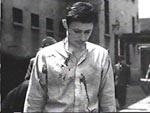
Francois Leterrier plays Lieutenant Fontaine, the 'man' in the film's title
As relentless as the filmmaker's attention is to the inescapable physical realities of this prison—wood and iron and stone, fabric and wire and water on a face—we're also led constantly to question whether these are the only reality available to Fontaine, and maybe that's what makes us question whether he'll ultimately escape from the literal prison. Perhaps his escape will be spiritual, the kind of rebirth suggested in a Scripture smuggled to him on a scrap of paper: "You must be born from above." The film's subtitle undercuts the main title's apparent sense of certainty when it refers to that same passage in John, reminding us that God defies predictability: "the wind blows as it listeth." (Bresson, a master filmmaker whose Christianity is perhaps more integrated into his work than any other, loves titles that introduce notes of uncertainty which stand in tension with the "certainties" of faith: Le Diable Probablement translates to "The Devil Probably," and the "au hasard" of Au Hasard Balthasar means "by chance.") Or perhaps Fontaine's only escape will be into eternity, through the doorway of death, as suggested by the man without hope in the next cell: when Fontaine encourages him by saying, "We'll meet up," the man replies, "In another life, maybe." Perhaps Fontaine will be taken away and shot without warning or explanation, like other prisoners? Perhaps he will he escape the walls of his cell only to be taken in a corridor or gunned down on a rooftop?
Is escape even a possibility? It hardly seems likely, and Bresson explicitly tells us that the slim hope of freedom will only be kept alive through constant faith—the substance of things hoped for, the evidence of things not seen. Visually we're as confined as Fontaine: we glimpse the corridors of the prison only through the peephole in his cell door, by surreptitious glances down hallways when the prisoners are led to the prison yard, in the awkward view from his barred window. We hear cryptic sounds that must be deciphered—tappings from other cells, footsteps, keys on a railing, unidentifiable squeaks and sobs and whimpers. Secretive conversations at the trough where inmates wash their face elude our understanding, cut short by guards or full of obscure and uncertain meanings. And from outside the prison, sounds of traffic, trains, a clock tower's bell.
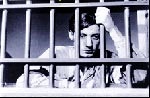
Letterier wonders if he'll ever get out from behind the bars
We are caught, along with Fontaine, in a constant, sometimes unbearable tension between confinement and liberty, between palpable physical circumstances and invisible spiritual realities.
While it may sound like A Man Escaped is an extended allegory about the hope of escaping "the prison of this life" through some sort of spiritual transcendence, the film is far too particular for that. Its overwhelming realism uses endless visual details and all the tactile sensation they suggest to draw us vicariously into an experience of imprisonment in WWII France. Confinement, waiting, fearing, hoping. The inscrutable capriciousness of the mostly-unseen prison authorities. The way our senses strain to pick up minute details when denied of almost any stimulation. The way stolen scraps of conversation must satisfy the craving for human contact and community, the way smuggled scraps of Scripture speak to a starved human spirit. The mechanics of hope.
I'll be honest: this film is hard going. People often refer to Bresson's films as "rigorous" or "austere," and A Man Escaped is quintessential: there's little dialogue and long silences, we're as cut off from beauty and certainty as the character whose prison cell we share, and the story itself is stripped down to absolute essentials—cold, hard physical reality, and the will to escape.
If you're looking for more accessible prison movies that touch on these spiritual questions—hope in the face of despair, the power of human relationship in a place of terrible inhuman isolation—I would recommend The Shawshank Redemption or To End All Wars. But if you've got an evening free of distractions and you're ready to experience a true landmark of spiritual cinema, let me point you to A Man Escaped. As with so many truly great films, you may want to view it more than once, to talk about the film with friends and to read up on it—on the Web, at your local university library.
Article continues below
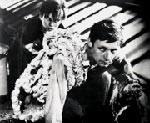
Letterier and a fellow prisoner plan their getaway
But don't get the idea that this film is an intellectual puzzle that has to be picked apart and philosophized over to make any sense. The fact is, it can be a remarkably powerful experience the first time you view it, its suspense gradually building to excruciating intensity—frankly, this film made me breathless the way few Hitchcocks ever have. And the master director accomplishes all of this with incredible restraint and nuance. It's nothing short of a wonder that so stark and minimal a film can create such potent feelings, images and moments that linger so persistently, divine intimations that seem so inescapable.
________
The DVD release is as stripped-down and essential as the movie itself, with no extras except the original French trailer for the film (without subtitles). That trailer, though, stands by itself as a miniature work of art, consisting of many shots not used in the feature film, and closing with an extended shot of a blank prison wall, with only the sound of a choir singing the "Dona nobis pacem."
Talk About It
Discussion starters
This film is adapted from the memoir of Andre Devigny, a Catholic French Resistance fighter who was imprisoned in Montluc prison during WWII. Devigny writes, "There were two elements in this plan: mine and God's. Where, I wondered, was the dividing-line set? Alas, I could not tell; but I felt that heaven would only aid my grimly resolute struggle insofar as I threw every physical and moral reserve I possessed into the balance." Where do you see God's hand in the events of the story?
Like many prison movies, this one moves from a sense of complete isolation to the creation—against all odds—of real community. What acts of kindness and self-sacrifice break down the walls between characters in this hostile environment, and aid Fontaine in his efforts to escape?
One of the prisoners is a pastor, arrested while delivering a sermon, who once dreamt of being alone with his Bible. What do you think of his apparent lack of interest in escape from the prison?
The Family Corner
For parents to consider
There is nothing here to offend: the film contains no offensive language or sexual behavior, and any acts of violence occur off-camera. But younger viewers are likely to be bored by the slow pace.
When I married into a Jewish family, antisemitism hit home. Now, the holy day reminds me of our future hope.
Jennifer Greenberg
A Man Escaped
1 of 3
Francois Leterrier plays Lieutenant Fontaine, the 'man' in the film's titleLetterier wonders if he'll ever get out from behind the barsLetterier and a fellow prisoner plan their getaway













 While we pray for peace, we need moral clarity about this war.
 A Christian reconciliation group in Israel and Palestine warned that war would come. Now the war threatens their relevance.العربيةFrançais
 When I married into a Jewish family, antisemitism hit home. Now, the holy day reminds me of our future hope.