Yu-Gi-Oh! is a marketer's dream, the Total Media Package: action figures, T-shirts, lunch boxes, game cards, a television show, and now a feature movie. It has a fiercely loyal fan base built mostly from grade school and young adolescent boys, but it includes some girls and older youths.
Yu-Gi-Oh! shares a basic archetype with all successful children's literature: the triumph of the diminutive over the mighty. It's not hard to see why little boys, tyrannized by a world of older brothers and schoolyard bullies, find escape when Jack defeats the Giant, when Frodo helps destroy Sauron, or when the kids in Narnia come out victorious.
Yu-Gi-Oh!—the movie and TV show—has much in common with the Harry Potter series. Both Harry and Yugi are grade school boys with magical powers which they use for good. Each has a nemesis in a better looking, more popular older boy. Harry's imagined world is drawn from pre-Christian European myths like good and bad witches, flying broomsticks and black cats. Yugi's is a more eclectic blend of Asian and Egyptian beliefs, suffused with science fiction and transforming robots.
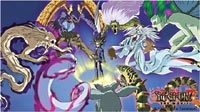
All sorts of creatures do battle in this movie
A surprisingly sophisticated trading card game is the basis for the franchise; the movie gives adults a good understanding of how such games are played. Each card summons up a magical spell or a monster. Each card can be trumped by another if it is well chosen. Like poker, it relies on the luck of the draw, concentration and strategy. Like chess, it requires that the player be one or two moves ahead of the competition.
The movie is based on an epic game between Yugi and his rival. The game takes place both in fantasy and in real time. As the players summon up their monsters and spells, the monsters actually appear, battling one another and roughing up the players. It's a little bit like war: You can send in your helicopters to smash the other guy's tanks, but he can shoot you down with a Stinger missile. He can hide his troops during the day but you can give your guys night vision goggles for when they come out at midnight.
Yugi with some type of spiritual amulet that gives him power
Yugi's rival is a more popular boy at school but he has never defeated Yugi in a duel—because Yugi has some secret "god" cards that give him a supernatural edge. As they play, we see that Yugi has an alter ego that speaks in a strong, adult voice; apparently Yugi was an Egyptian sage in a former life. As Yugi channels this ancient wise one, he becomes more and more powerful. The game gets more and more real, and soon it becomes evident to Yugi that this is more than an adolescent grudge match.
An ancient god who was defeated and sealed up when he tried to take over the world five thousand years ago is using the game to re-enter the world. Yugi's alter-ego is the god's nemesis, and Yugi's erstwhile game foe is an unwitting pawn. This story plays out to the end, which we won't divulge here—but you can probably guess where it's going.
It's hard to know how impressionable kids will process a fantasy movie like this. Many teens, for instance, see The Matrix as diversionary fun; I teach it as an example of allegory and archetypes in my college and high school film classes. Most kids will see Yu-Gi-Oh! as fantasy and have no trouble separating it from reality, but some may get lost in a world that, frankly, is more than a mere nod to the occult. The world of Yu-Gi-Oh! includes more than a fair share of spiritual darkness, and the trading cards—while not exactly a role-playing game along the lines of Dungeons and Dragons—sometimes can suck kids, unwittingly, into that world, sometimes to the point where they blur the lines between fact and fiction—and even between good and evil. Some Christians have denounced Yu-Gi-Oh!—and other, similar Japanime franchises—as a proverbial "foothold" for Satan (Eph. 4:27; also 2 Tim. 2:26). (Here are a couple of articles from a Christian perspective worthreading.)
Some of the many monsters—good and bad—that appear
C. S. Lewis and J. R. R. Tolkien felt no conflict in creating stories full of fairies, elves, and witches because their stories—and their readers—were grounded in a generally Christian-based culture. The Bible was read in schools, after all, as a literary text. Even secular authors of their age could discuss biblical concepts with a degree of fluency.
That's not the case today, where few kids know more than the sanitized stories from the Old Testament and the usual New Testament verses on salvation and God's love. When impressionable kids watch a movie like Yu-Gi-Oh! they may find it more compelling than most Sunday school lessons.
Lintz and Donnerstein, psychologists at the University of Wisconsin, conducted studies of the ways movies influence our attitudes and beliefs, and how those attitudes and beliefs spill over into actions. They found that repeated exposure to a film would eventually habituate the viewer to what was being shown. After a while, it became part of that person's worldview. Their focus was on sexually violent films, but the principle applies to other genres as well.
Article continues below
Yugi's magic cards can call up all sorts of monsters
It's fair to say that most kids—especially boys—will want to see Yu-Gi-Oh! Many will have a great time and jabber on and on about it with their friends. After the advance screening, my wife and I interviewed kids and found that most of them were wildly enthusiastic; some even brought their playing cards to the movie. Like Harry Potter, Shrek and Spider-Man, it will become part of the currency of grade and middle school conversation. And once it's out on video (possibly in time for Christmas), kids will end up watching it over and over again.
When a movie like Yu-Gi-Oh! becomes, like Harry Potter, a key cultural reference point, it's a good idea to see it with your kids and talk about it—if you choose to see it at all. If you do choose to see it, do a lot of listening, and ask your children focused questions.
Talk About It
Discussion starters
Why do Yugi's cards have such power? Do you believe that power is real, or just pretend?
Does Yugi believe in the Christian God, or does he believe in many gods? Are any of those gods good? Which one(s)? How do they show their goodness? Which one(s) are bad? How do they show their badness?
What if Yugi's world was real? What would it be like to live in a world ruled by gods and magic? How does that compare to our real world—and the supernatural forces that are real? (See Ephesians 6:10-18)
How could a small, not-too-popular kid get respect without having Yugi's powers?
The Family Corner
For parents to consider
Yu-Gi-Oh! is rated PG for cartoon violence and scary monsters, and its occult themes may be of concern to some parents. (See more details in the review above.)
compiled by Jeffrey Overstreet from Film Forum, 08/19/04
In what some critics are describing as a "feature-length marketing ploy," the popular Japanese comic book, cartoon, and playing card game Yi-Gi-Oh! hit screens last week. Yu-Gi-Oh! The Movie is about a magical card game that transforms the players into supernatural heroes in a clash of good versus evil.
Stefan Ulstein (Christianity Today Movies) says, "When a movie like Yu-Gi-Oh! becomes, like Harry Potter, a key cultural reference point, it's a good idea to see it with your kids and talk about it—if you choose to see it at all. If you do choose to see it, do a lot of listening, and ask your children focused questions. Most kids will see Yu-Gi-Oh! as fantasy and have no trouble separating it from reality, but some may get lost in a world that, frankly, is more than a mere nod to the occult."
Article continues below
David DiCerto (Catholic News Service) translates the title as "Waste of Time." "Yu-Gi-Oh! is a dizzying, disjointed mess. The story is nonexistent and the Japanese animation is sketchy at best. Yu-Gi-Oh! makes those annoying Pokémon films seem almost Oscar-worthy."
"Clearly, the point here is to sell product," says Rhonda Handlon (Plugged In). "And the makers of Yu-Gi-Oh! The Movie seem to have only one goal: to serve the greater good of the Yu-Gi-Oh! empire. As for its dark spiritual side, TV series writer/producer Mike Pecoriello claims that 'despite all the magic and supernatural forces involved in the movie, the power of friendship proves to be stronger than anything else, and in the end, that bond will always prevail.' In reality, friendship takes a thematic back seat to big bangs and unctuous spells."
"My recommendation," writes Douglas Downs (Christian Spotlight), "is to skip this one, and soon Yu-Gi-Oh! fever will pass."
A whopping 98 percent of the mainstream critics reviewing the film went to work trying to steer the masses away from it. Nevertheless, the film scored fourth place at the box office this week.
NIL deals in college athletics present new challenges—and opportunities—for colleges and students.
Emily Belz
Yu-Gi-Oh!
1 of 4
All sorts of creatures do battle in this movieYugi with some type of spiritual amulet that gives him powerSome of the many monsters—good and bad—that appearYugi's magic cards can call up all sorts of monsters

















 While we pray for peace, we need moral clarity about this war.
 We’ve got little information on Jesus’ appearance and personality. But that’s the way God designed it.españolFrançais
 NIL deals in college athletics present new challenges—and opportunities—for colleges and students.