R (for strong violence and language throughout, and for some drug content)
Directed By
Jean-François Richet
Run Time
1 hour 49 minutes
Cast
Ethan Hawke, Laurence Fishburne, Gabriel Byrne
Theatre Release
January 19, 2005 by Rogue Pictures
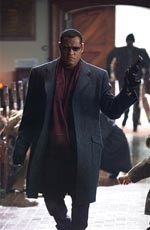
Soon after the opening credits of director Jean–François Richet's Assault on Precinct 13, a gangster resembling Morpheus from The Matrix sits down near the back of a crowded church. The morning's sermon is a simple lesson: "Cherish your power to choose the righteous path."
This cynical churchgoer quickly disobeys. The church is quickly thrown into chaos. As the Detroit police close in for his capture, a series of events is set in motion that begins with a dead body in the sanctuary and concludes with corpses strewn all through a police precinct in the dead of a snow–buried night.
Richet, formerly a rap music producer, makes his first prominent American movie into an unremarkable, even dismaying, event—just another generically hyperviolent and overbearing genre flick. He's chosen to remake a 1976 action film by one of the kings of B–movies—John Carpenter—who went on to direct Halloween, Escape from New York, The Thing, and They Live. But instead of improving on Carpenter's film, he's only succeeded in making it a wearying assault on the eyes, ears, and intelligence.
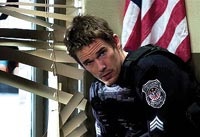
Ethan Hawke is the good–guy cop … well, relatively speaking
Carpenter's Assault took a disrespected rookie policeman, some secretaries and cops, and some jailed crooks—including a notorious killer on death row—and he penned them all up in a police precinct on the night before its closure. Due to the office's imminent shutdown, the usual staff and supplies were unavailable. Our heroes were left to crouch behind desks while an army of zombie–like street gang members closed in from all sides. Fast, lean, efficient, and shockingly violent (for the time), this original Assault developed a few memorable characters with sparse, potent dialogue. Part exploitation–film, part Rio Bravo, it remains an amusing B–movie indulgence.
Richet's version of the film changes everything but the set. Once again, a bus transporting some prisoners is forced to make a detour—this time due to a closed road instead of a sick prisoner—and the criminals are locked up in the nearby precinct to wait out the storm. Again, Precinct 13, which has a remarkably similar layout to the original, is almost empty. And, just as before, men with guns advance out of the night and surround it. Over the course of the crisis, we become as acquainted with that building as Bruce Willis did with his Die Hard skyscraper.
But where Carpenter's film was effective in its simplicity and focus, Richet has overburdened the skeletal plot, giving several characters heavy emotional baggage and spoiling the nightmarish suspense by revealing the motivation of the heavily armed troops attacking the precinct. Carpenter's film turned up the tension by keeping the motivations of the murderous, multi–ethnic gang members mysterious. Richet casts the invaders as cops gone bad, closing in with body armor and night–vision, trying to kill one of the jailed crooks before he reveals what he knows about police corruption.
Laurence Fishburne plays a gangster who looks a lot like Morpheus
Desperately trying to hold down the fort, even as he realizes that he's up against his own colleagues, Officer Jake Roenick (Ethan Hawke) must keep his unlucky companions supplied with bullets and manage the tense relationships between the "good guys" and the crooks he turns loose.
Not all of the revisions are mistakes. While Carpenter's precinct was isolated in a ghost town of an L.A. neighborhood, Richet effectively isolates the precinct with a paralyzing snowstorm, making it almost impossible for help to get in or heroes to get out.
But where Carpenter slowly developed suspense and tension, Rivet's version is simply violent. The first instance of a bullet through the head happens not even five minutes into the film. Soon, the audience is applauding for stabbings and chests blown out by grenades. Richet's action lacks creativity. When we see a dagger–like icicle within the reach of combatants fighting in the snow, we have time both to figure out how the fight will end and to remember where we've seen this before—Die Hard 2. The clichés comes as fast as the bullets. Mexican standoffs. The conveniently forgotten escape route. Exchanges like, "It's quiet out there." "That's what worries me." Something smell fishy? Probably another red herring. And it all comes down to a dispiriting conclusion, in which the chief villain turns clumsy and forgetful.
Carpenter's film ran on his own simple, wire–taut synthesizer theme; Richet drowns the action in what sounds like a three–car pile–up of orchestral suspense soundtracks, and he wraps it up with a deafening rap song in which the singers praise the movie, singing lines like, "Wow! What a conclusion!" Cinematographer Robert Gantz seems to think he's solely responsible for creating a sense of excitement, jerking the camera around so wildly that we're left dizzy and disoriented. Carpenter wrote, directed, edited, and scored his Assault; Richet clearly needed a lot help for his.
Kudos to the cast for making the most of it. Hawke fully commits to the poorly written role of Roenick, a cop sinking into sarcasm and regret after losing his partners in a drug bust. It's been amazing to see that timid youngster from Dead Poets Society grow up to become Training Day's tough trainee and Before Sunset's philosophical romantic. Here, Hawke makes some awful dialogue sound pretty good, and he's convincing in his desperate attempts to improvise order in the midst of chaos.
Article continues below
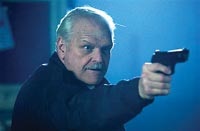
Brian Dennehy plays a cop whose doesn't like working with crooks
Brian Dennehy turns up as Jasper, an "old school" cop on the verge of retirement. Jasper's disgust at having to join forces with a cop killer becomes the film's most volatile element. (But how many times does the script require him to say "scumbag"? I lost count.)
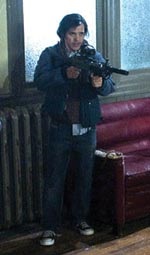
The crooks—both the hunted and the hunters—are well–chosen too. Laurence Fishburne smolders as Bishop, the crime boss in handcuffs. And John Leguizamo is memorably zany as Beck, a nervous junkie with a steady supply of punchlines. (A cop says, "Your eyes are red; are you stoned?" Beck snaps back, "Your eyes are glazed; you been eatin' donuts?") Outside the precinct walls, all Gabriel Byrne gets to do is scowl, playing the cold–hearted chief of the Organized Crime and Racketeering Squad, Marcus Duvall.
The poor ladies trapped inside serve as little more than sex objects. Drea de Matteo of TV's Joey is Iris, who rambles on incessantly about her sex life. Her big scene arrives when she partners with Bishop and his language of violence turns out to be her idea of foreplay. Lovely.
Maria Bello plays Roenick's therapist, who stops by for a late–night session on her way to a New Year's Eve party. How convenient—she's established as a smart lady, but when the action gets going she'll strip down to her party dress. And of course, it turns out that therapists are obsessive–compulsives themselves, boosting their egos by advising neurotic cops. Bello, a fine actress, is reduced to shivering in the corner, vulnerable and lost, while the audience wonders what happened to the winter coat she was wearing when she came in.
Thus, it seems our heroes are only slightly less despicable than the villains. This movie's idea of a courageous moral stand is Roenick's vow that, when this is over, he "can't let a murderer walk out of here." Like a stepstool in a deep pit, that's as good as moral high ground gets in this film, folks.
John Leguizamo wielding this film's prop of choice—a big gun
It's troubling to see a film so willingly whipping the audience into a frenzy by casting cops as bad guys. In fact, the whole film might have been crafted to exploit current anti–government sympathies. Where Carpenter insists his original Assault was "apolitical," Richet's film easily reads as a crude indictment of the current administration.
Article continues below
Think about it: The authorities tolerate the existence of a warlord because he serves their purposes. But when they realize he is capable of implicating them in some shady dealings of their own, they manipulate the media and close in to eliminate him, painting themselves as heroes ridding the world of a tyrant while they cover their bloody tracks. Bishop describes Duvall as "one of those nervous God fearin' types." Peering out at the encroaching police, Beck quips, "Government thugs abusing their authority again? I feel real safe, man."
But if this is intended as political commentary, we must acknowledge the sort of intellect offering the editorial—one that relies on caricatures and clichés, and uses relentless expletives as blunt instruments to whack us into submission. Meanwhile, the filmmakers positively worship artillery and they dish out the grisly payback scenes with reckless abandon. It's not wrong to question authority, but it's not helpful to throw fuel on the fire of anti–authoritarian sympathies by portraying police as valid target practice for men with guns.
By the umpteenth time Iris the Sexpot whimpers, "What the [bleep] are we supposed to do?" the answer has become obvious to the viewer. Walk away. Or, to alter a line from that ill–fated sermon at the opening of the film—"Cherish your power to choose a worthwhile movie."
Talk About It
Discussion starters
What's the proper way to respond to authority figures who abuse their authority? How might a person be treated unfairly, or even dangerously, by a policeman, a pastor, a teacher, a president? What is the honorable way to respond? What routes of action are available to you?
What does the Bible say about a proper attitude towards authority? (See Romans 13, among others.)
What do you think of Roenick? Do you think he's fit to wear a badge? What do you think of the ways he copes with his grief and regret? Do you think the therapist's advice is helpful? How would you advise him? If you had been in Roenik's place, what would you have done?
Do you think the filmmaker had an "agenda" when making this movie? What was it?
The Family Corner
For parents to consider
Assault on Precinct 13 is rated R for relentless profanity; for frank sexual references; and for its revelry in gratuitous violence. Its portrayals of women are degrading, and its idea of a "hero" is whatever character is guilty of the fewest character flaws. (And even he has quite a few.) The film's anti–authoritarian tone is also disturbing.
It's New Year's Eve. A Detroit police precinct is closing down—only a couple of cops remain on duty there while the staff clean out their desks. The weather outside is frightful. And thus the stage is set for trouble … which arrives in the form of a bus transporting prisoners. When the prisoners are locked into holding cells to wait out the storm, the precinct is besieged by killers bent on gunning down everyone inside—cops and crooks alike.
This remake of John Carpenter's 1976 thriller Assault on Precinct 13 strays from the details of the original in many ways. Instead of a black cop pushing back against prejudice, we have Jake Roenick (Ethan Hawke), a white cop with a therapist (Maria Bello). Instead of sparse, sharp–edged dialogue, there's relentless profanity and crass innuendoes. And as our heroes get out the heavy artillery to defend themselves from the invasion, the villains they use for target practice aren't street gang members … they're cops.
Director Jean–Pierre Richet, formerly a rap music producer, makes his first prominent American movie into an unremarkable, even dismaying, event—just another generically hyperviolent and overbearing genre flick. Instead of improving on Carpenter's film, he's only succeeded in making it a wearying assault on the eyes, ears, and intelligence.
Tom Neven (Plugged In) says, "The audience is encouraged to root for a bad guy who's fighting badder guys. The sense that bad character and bad actions aren't mitigated by later 'good' behavior is completely missing. And that leads to a final disappointing development." It ends, he says, with "a plot twist that will assault audiences' moral worldview every bit as much as the film's out–of–control vulgarity and violence."
Harry Forbes (Catholic News Service) says the movie "has its share of suspenseful moments, but the bloodshed and violence seem unnecessarily explicit, and the improbable story calls for major suspension of disbelief. For an action film the attention to characterization and good performances make this several cuts above the usual mindless mayhem movie."
Michael Elliott (Movie Parables) says it's "peopled by stereotypes instead of fully drawn characters. The cast is actually better than the material and as a result the movie reaches the level of effective B–level entertainment."
Mainstream critics are divided over whether to rate it as an above–average or below–average action thriller.
NIL deals in college athletics present new challenges—and opportunities—for colleges and students.
Emily Belz
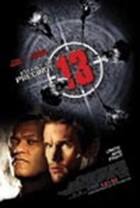
Assault on Precinct 13
1 of 3
Ethan Hawke is the good–guy cop … well, relatively speakingLaurence Fishburne plays a gangster who looks a lot like MorpheusJohn Leguizamo wielding this film's prop of choice—a big gun













 While we pray for peace, we need moral clarity about this war.
 A Christian reconciliation group in Israel and Palestine warned that war would come. Now the war threatens their relevance.españolالعربيةFrançaisрусскийУкраїнська
 NIL deals in college athletics present new challenges—and opportunities—for colleges and students.